
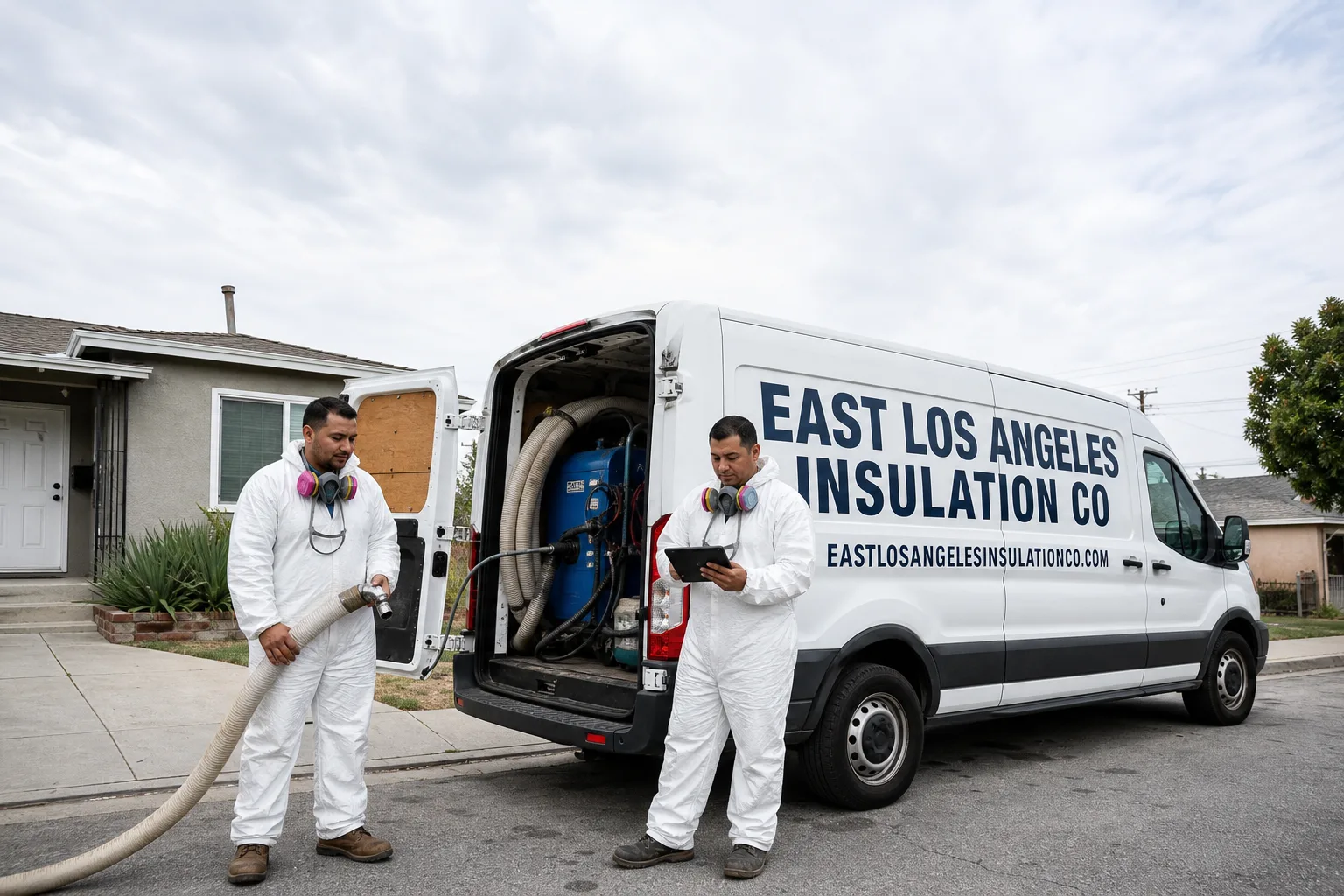
Fast, Reliable Attic Insulation Across Fountain Valley
Attic insulation in Fountain Valley usually runs $1,200 – $3,400 for a full retrofit on the single-story ranches that dominate this city, and most jobs are completed in a day. The price gap comes down to attic size, what’s already up there, and whether salt-air corrosion has damaged the access hatch hardware or venting along the way. We know these homes. The 92708 and 92728 tracts were built fast between the late 1950s and early 1970s, and the attics show it. Call (866) 566-0304 and we’ll give you a straight answer on what your attic needs and what it’ll cost.
Why East Los Angeles Insulation Co Is Fountain Valley’s Preferred Attic Insulation Company
We’re a dedicated Attic Insulation contractor, not a generalist splitting time across HVAC and roofing. For Fountain Valley homeowners, that means the crew that shows up has spent their entire workweek in attics like yours: shallow-pitch, wood-framed, stucco-clad tract homes from the 1960s with original batts that have settled to near nothing. We don’t need to learn your house’s layout. We’ve already worked on it, or one just like it two streets over.
Ruben Acosta built this company around the idea that homeowners should get the right product for the conditions, not whatever a single-brand shop happens to stock. Fountain Valley’s near-zero rainfall and warm asphalt-shingle roofs mean the enemy isn’t moisture, it’s heat. So we scope radiant barrier and venting every single time, not just when a homeowner asks. We carry eight brands because no two attics here are identical. Some need quiet mineral wool. Some need closed-cell spray foam. Most need blown-in fiberglass done fast and clean. We bring the one that fits.
We respond to Fountain Valley calls same day or next morning, and our crews know the interior tracts off Ellis Avenue, the neighborhoods around Mile Square Park, and the older Shadow Lane area near Talbert Avenue from years of repeated work. That repetition matters. It means we already know your attic access is probably in the garage, probably tight, and probably rusted at the hinges if the home’s been near that coastal air for sixty years.
Attic Insulation Removal in Fountain Valley
Attic Insulation Removal in Fountain Valley usually means pulling out degraded fiberglass batts from the 1960s that have flattened to R-5 or less, and hauling away everything down to the bare deck before we blow in a fresh layer. Most homes in 92708 and 92728 that haven’t been touched since original construction need this, especially where salt air has compromised the attic hatch seal and let heat pour in. A full removal and disposal for a standard 1,100 – 1,500 square foot ranch typically runs $800 – $1,600 of the total job cost. If the old insulation is damp, mold-stained, or infested, the range climbs toward the top of that band because of the containment and disposal requirements.
When removal beats topping up
Topping up makes sense when the existing batts are still dry, clean, and intact, just under-depth. But in tract homes where a rusted hatch seal or failed garage-door spring has blown debris through the attic, or where sixty years of hot air cycling has baked the fiberglass into a brittle mess, topping up just buries a problem. We’ll tell you if removal is needed. We won’t sell it if it isn’t.
Removal before re-roofing or remodeling
Fountain Valley is thick with homeowners re-roofing, re-piping, and gut-renovating the original ranches. If you’re opening walls or replacing the roof, removing the old insulation first gives us access to inspect venting, seal bypasses, and check for rust damage at the attic hatch assembly. It’s far cheaper to do it then than to cut open a fresh ceiling later.
Insulation Contractors in Fountain Valley
Insulation Contractors in Fountain Valley fall into two camps: general home-services companies where insulation is a fourth or fifth line item, and dedicated shops like ours that live in the work. The distinction shows up fast. A specialist looks at a 1964 ranch off Talbert Avenue and immediately checks the attic hatch seal for salt-air corrosion, the venting ratio, and the condition of the original batts before proposing anything. That’s the diagnostic difference.
Working with us means one company handles all three installation methods – blown-in, spray foam, and batts – across eight brands including Owens Corning, Johns Manville, Knauf, Rockwool, CertainTeed, Icynene, Demilec, and GreenFiber. A standard Fountain Valley attic insulation job with us typically runs $1,200 – $3,400 depending on the scope. We give a written line-item estimate before any work starts, and Ruben Acosta personally reviews every proposal that goes out the door.
Specialist access to better products
Most single-brand installers can only offer one answer. If your attic needs mineral wool for fire resistance near a furnace, recycled-content GreenFiber for low-VOC living, or closed-cell Icynene foam for air sealing, we can spec it. That’s the practical upside of carrying eight brands.
One crew from start to finish
No subcontractors. The same team that removes old insulation, replaces rusted hatch hardware, installs baffles, and blows the new material is the team that stands behind the work. For Fountain Valley homeowners mid-remodel, that sequence control matters.
Trusted Brands We Service in Fountain Valley
We stock and install Owens Corning, Johns Manville, Knauf, Rockwool, CertainTeed, Icynene, Demilec, and GreenFiber. That’s eight professional-grade lines, which matters in Fountain Valley because the right product for a coastal-adjacent 1960s ranch isn’t the same as the right product for a newer inland build. We keep local stock of the most common Fountain Valley-spec materials – primarily blown-in fiberglass, radiant barrier, and coated hardware for attic access assemblies – so most jobs can start within a day or two of your call. No waiting on a supply house delivery for the product your neighbor’s attic actually needs. We carry CertainTeed and GreenFiber in depth here because they cover the majority of retrofit scenarios we scope across 92708 and 92728.
Common Attic Insulation Problems We See in Fountain Valley Homes
- Rusted attic access hatch seals and hinges. Salt air from the coast works on the metal hardware of the attic hatch for decades. Once the seal fails, conditioned air escapes into the attic and superheated attic air drops into the garage. We replace the hardware and re-seal the opening before any insulation goes in.
- Corroded garage-door springs that snap and compromise the attic. The spring bolts to the structure near the attic access in many of these attached-garage ranches. When a rusted spring gives way, the shock can tear hatch seals and scatter debris across the insulation. We inspect for this before quoting.
- Settled original batts from the 1960s. Most of the original fiberglass in these homes has compressed to a fraction of its rated R-value, if it was ever adequate at all. In a shallow-pitch roof with little clearance, that means a hot attic and a hotter house. We remove and replace, no shortcuts.
- Unvented or poorly vented shallow attics. These low-pitch roofs trap heat. Add a radiant barrier and proper baffles, and the garage and living space both cool down. We see this on nearly every pre-1980 tract home we open up.
Pricing for Attic Insulation in Fountain Valley, CA
Here are the real numbers for Fountain Valley’s market. A standard blown-in attic insulation retrofit on a 1,200 square foot ranch runs $1,500 – $2,800 including air sealing and baffles. Attic insulation removal and replacement adds $800 – $1,600 depending on depth and condition of the old material. Spray foam runs higher, typically $3,200 – $6,500 for a full attic, because the material and prep are costlier. Radiant barrier installation adds $500 – $1,000 and often delivers the biggest single comfort gain in these hot attics. Estimates are free, and (866) 566-0304 is the number to call for a precise line-item quote.
We Also Serve Cities Near Fountain Valley
Our crews work across the Orange County tracts, so if you’re just outside city lines we’ve got you. We regularly serve Midway City, Huntington Beach, Costa Mesa, and Westminster with the same specialized retrofit approach we use in Fountain Valley. Same day response, same eight brands, same honest pricing. Call (866) 566-0304 and tell us which city you’re calling from.
Serving Fountain Valley, CA - Our Local Coverage Area
We serve Fountain Valley and nearby communities. Use the map below to see the area we cover. If you’re nearby, we can almost certainly help.
FAQs About Attic Insulation in Fountain Valley
Fountain Valley sits closer to the coast than Santa Ana, so the air carries more salt and moisture across the whole day. That salt lands on springs, hinges, rollers, and opener chains and accelerates oxidation. In a tract home where the garage-door hardware sits near the attic access, that rust eventually becomes an insulation problem when seals fail or springs snap and jolt the assembly. We inspect the hardware during every retrofit.
Yes, often. The original batts in these 1960s ranches have typically settled, compressed, or collected debris from rusted hardware over the decades. When that’s the case, blowing new insulation on top buries the problem without fixing the heat leak. We’ll tell you after a quick attic inspection whether removal is required or a top-up will do – both answers come with a written quote.
Corrosion attacks the metal fasteners and staples that hold venting and radiant barrier in place. Once those fasteners fail, the venting shifts and the barrier sags, and neither does its job. We use coated or stainless fasteners for Fountain Valley installs specifically because of this. The radiant barrier itself holds up fine; it’s the steel holding it that needs an upgrade.
For Fountain Valley’s coastal-influenced, summer-driven heat load, we typically recommend R-38 in the attic, which is current code for the region. In the older shallow-pitch attics, achieving that often means removing old batts, air sealing, and adding baffles before blowing in the new material. We also recommend a radiant barrier. In this climate it’s the single best comfort upgrade per dollar, because the enemy is radiant heat from the roof deck, not cold.
Yes. If you’re re-roofing, re-piping, or gut-remodeling one of these older Fountain Valley tract homes, we’ll coordinate removal and re-insulation with your other trades. Doing it while walls and ceilings are open saves you money and gives us access to seal bypasses and inspect venting that would otherwise be buried. Call (866) 566-0304 and ask for Ruben Acosta’s team to scope it with your remodel.
The Salt-Air Problem Fountain Valley Homeowners Deal With
Nothing kills attic hardware faster than coastal air, and Fountain Valley sits close enough to the water that the salt rides in every afternoon. The first things to go are the springs on the garage door and the hinges and seals on the attic access hatch. We open up attics in the Shadow Lane tract off Talbert Avenue that haven’t been touched since 1964, and the original hardware looks like it came from a shipwreck. The seal around the hatch dries and cracks. The spring hangs by a thread. And the homeowner wonders why the garage feels like an oven and the energy bill climbs every August.
This failure pattern changes how we scope insulation retrofits. A homeowner calls about a hot bedroom, and the real culprit is often a rusted hatch seal letting 140-degree attic air pour into the garage, or a spring that snapped and tore the insulation away from the deck. So our process in Fountain Valley includes a hardware inspection before we talk R-values. We replace the rusted hinges, install a proper seal, re-set the hatch, then blow in the insulation. Skip the hardware, and you’ll be redoing the insulation job in a few years when the next component lets go.
In the Shadow Lane tract off Talbert Avenue, we retrofitted a 1964 ranch home where the original garage-door spring had corroded and snapped, sending the door off-track and tearing the attic access hatch seal. Our tech replaced the spring with a galvanized unit, swapped all hinges and rollers to stainless and nylon, then blew in Owens Corning R-38 and installed a radiant barrier to cut summer attic heat gain. The homeowner reported a 15°F drop in garage temperature and no more rust dust on stored items.
Written by Ruben Acosta, Owner at East Los Angeles Insulation Co, serving Fountain Valley since our founding.