
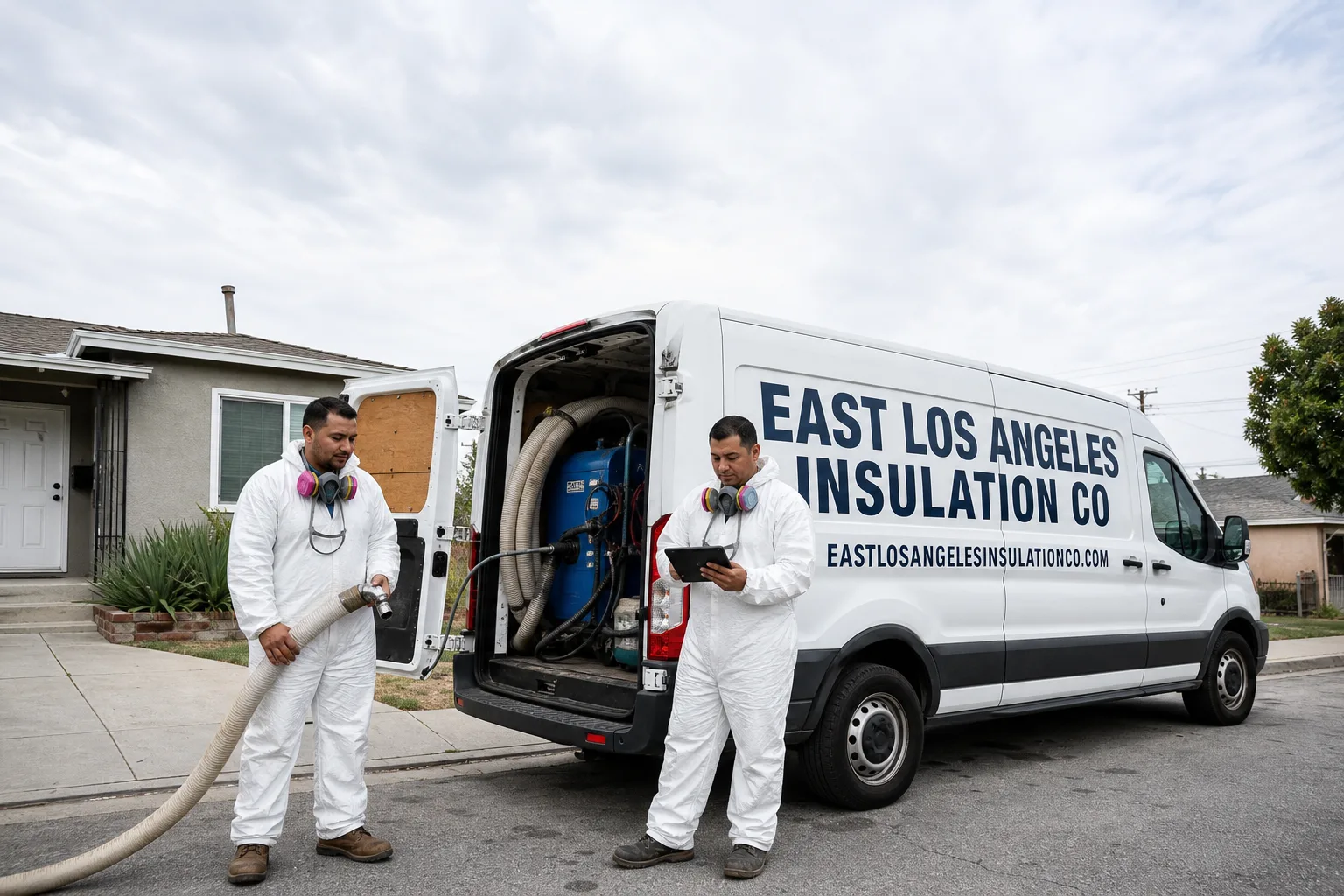
Trusted Spray Foam Insulation for East Los Angeles Homeowners
Spray Foam Insulation in East Los Angeles addresses what batt insulation simply can’t: the air leaks around plumbing penetrations, electrical boxes, and the odd framing gaps common in homes built from the 1920s through the 1980s. When we inspect attics in Boyle Heights or El Sereno, we routinely find that air leakage, not thin insulation, is what’s driving $400-plus summer cooling bills. East Los Angeles Insulation Co installs both open-cell and closed-cell foam using Icynene and Demilec products, and Ruben Acosta leads a crew that’s been spraying foam in this neighborhood long enough to know which homes need vapor management and which just need a thermal boundary. We’re licensed, insured, and available same-week for most East LA spray foam jobs. Call (866) 566-0304 to have someone walk your attic with you.
Closed Cell Spray Foam Insulation
Closed Cell Spray Foam Insulation is the denser of the two foam types, expanding to roughly an inch of thickness but packing an R-value around R-7 per inch, and because its cells are sealed, it stops both air and water vapor movement. We recommend it for crawl spaces and rim joists in East Los Angeles, where ground moisture rises through the soil and old foundations stay damp more months than homeowners realize. A typical closed-cell rim joist job in this area runs $1.50 to $3.00 per board foot installed, and a full crawl space encapsulation with closed-cell foam usually lands between $4,500 and $9,500 depending on square footage and access height, so if you’re wondering how much Spray Foam Insulation costs, scope and access are the main variables.
When Density Matters
Closed-cell foam adds structural rigidity. On older East LA homes with settled framing or undersized joists, that extra stiffness matters. We’ve glued loose subflooring back to joists with closed-cell foam in more than a few converted garage additions.
Moisture Control Properties
Closed-cell acts as a vapor barrier at about 1.5 inches thick. That’s why we push it for raised foundations and crawl spaces from El Sereno to City Terrace, where humidity carries up through floorboards and makes the whole house feel sticky by July.
Open Cell Spray Foam
Open Cell Spray Foam is the lighter, softer foam with an R-value around R-3.7 per inch, and it’s our default recommendation for attic rooflines in East Los Angeles where the priority is air sealing and sound dampening rather than vapor blocking. It expands aggressively, filling cracks and odd-shaped cavities that batts leave open, and it costs less than closed-cell: most open-cell attic sprays in this market run $0.75 to $1.80 per board foot, with a typical 1,200-square-foot attic landing between $2,800 and $4,900. Because East LA sees so much radiant heat coming through unshaded roof decks, open-cell on the roofline makes an immediate difference in afternoon upstairs temperatures.
Attic Roofline Applications
We spray open-cell directly against the roof deck to move the thermal boundary from the ceiling to the roofline. That keeps the attic within a few degrees of the living space, which matters when your ductwork is up there. Most East LA homes built before 1990 have leaky supply ducts baking in 140-degree attic air.
Sound Attenuation Benefits
Open-cell foam is what we use for interior wall cavities on noisy corners. Homes along Whittier Boulevard or Olympic get real relief when we spray open-cell into shared walls and floor cavities. The phone stops vibrating on the nightstand every time a bus goes by.
Spray Foam Insulation Contractors
Spray Foam Insulation Contractors are not all the same, and the difference shows up two years after the job when cheap foam starts shrinking away from studs or off-gassing that fishy smell through the drywall. We carry only Icynene and Demilec, two brands with manufacturer-backed warranties and long field histories, and we spray them exactly to the millage the manufacturer specifies. In East Los Angeles, where many homes have been remodeled multiple times, hiring a contractor who understands how old framing interacts with expanding foam matters more than the product itself. Full spray foam installations here typically run $5,000 to $18,000 depending on scope, with attic-only jobs starting around $2,800.
Why Experience Changes the Quote
A contractor who’s sprayed foam in 1930s East LA bungalows knows that old knob-and-tube wiring shouldn’t have foam sprayed directly over it, and that certain lath-and-plaster walls need different prep than drywall. Ruben Acosta walks every job site himself before a quote is ever written. That’s the difference between a real price and a surprise change order.
Vetting the Crew You Hire
Ask any spray foam contractor in East Los Angeles which brand of foam they spray and what their mix ratio testing procedure is. If they don’t mention ISO and resin temperatures, they don’t know their own equipment. Our rigs are checked every morning before the first job, because foam mixed off-spec doesn’t cure properly and has to be cut out and redone.
Spray Foam Attic Insulation
Spray Foam Attic Insulation is the single highest-impact upgrade we perform on East Los Angeles homes, because the attic is where 40 percent or more of a house’s heat gain happens during a Southern California summer. We spray foam on the roofline (not the attic floor) to create a sealed, conditioned attic space, which both stops radiant heat at the roof deck and prevents hot outside air from getting pulled through every ceiling penetration. A typical open-cell spray foam attic in East LA costs $2,800 to $6,500, while closed-cell on the same roofline runs $6,000 to $12,000 because the material is denser and uses more product per board foot. The payback shows up on the first Edison bill after a heatwave.
Roofline Spray Method
We spray directly onto the underside of the roof sheathing, filling the rafter bays completely. This transforms the attic from a passive buffer zone into an actively sealed part of the house envelope. Ducts and air handlers that used to sit in a hotter-than-outside attic now sit in air that’s close to whatever you set your thermostat to.
What We Leave Behind
After spraying, we leave the attic clean and the roof framing visible for any future inspections. We also photograph every stage of the job so you know exactly what was sprayed and how thick. You shouldn’t have to crawl up there to verify the work.
Spray Foam Wall Insulation
Spray Foam Wall Insulation solves a problem that’s especially common in East Los Angeles: uninsulated or barely-insulated exterior walls in stucco and wood-frame homes built between the 1940s and 1970s. The walls were often framed and finished with no insulation at all, or with a thin layer of fiberglass that’s since settled into a soggy, useless mat at the bottom of each cavity. We can insulate existing walls through small injection holes without tearing out drywall, or we can spray open-cell into open wall cavities during a remodel. Injection and cavity-spray wall jobs in East LA typically run $1,500 to $4,500 for a single story, depending on wall count and access.
Injection Method for Existing Walls
For finished walls, we drill small access holes at the top of each stud bay and inject foam that expands into the cavity. The holes get patched and painted, and you never have to live through a gut remodel. This works best with open-cell foam, which is forgiving in irregular cavities.
Remodel-Ready Cavity Spray
If you already have walls opened up for a kitchen or bath remodel in East Los Angeles, that’s the cheapest moment to spray. The studs are exposed, the wiring is visible, and the foam can be applied in one pass. We coordinate with your contractor so the insulation goes in before the drywall crew shows up.
Rim Joist Spray Foam
Rim Joist Spray Foam is one of the most cost-effective air sealing measures available to East Los Angeles homes with raised foundations, and it’s a job we do standalone without pushing a whole-house upgrade, including Boyle Heights properties with similar construction. The rim joist, also called the band joist, is the perimeter framing where your floor system meets the foundation, and it’s typically riddled with unsealed gaps, gaps that let outside air move through the crawl space and up into the house. We seal rim joists with closed-cell foam, which stops both air and the moisture that feeds musty crawl space smells. A typical rim joist job in East LA runs $900 to $2,800 depending on the number of perimeter feet and crawl space height.
Why Rim Joists Leak
Builders in the 1950s and 1960s simply didn’t detail rim joists the way we would today. Fiberglass shoved between joists does nothing to stop air movement. That’s why you feel a cold draft at the base of the wall in winter even with the heat running.
What Closing the Perimeter Does
When we seal the entire rim joist band, the crawl space becomes part of the conditioned shell of the house instead of a vented cavity under it. You’ll notice the living room floor feels warmer in January and the house doesn’t smell like dirt after a rain.
Crawl Space Spray Foam Insulation
Crawl Space Spray Foam Insulation changes the moisture profile of older East Los Angeles homes, many of which sit on raised foundations over bare dirt that exhales humidity year-round. Spraying closed-cell foam on crawl space walls and the underside of floor joists seals out that moisture while adding real R-value, and unlike fiberglass batts that absorb dampness and slide out of the joist bays, closed-cell foam stays locked to the framing. Crawl space encapsulation and insulation in East LA runs $4,500 to $11,000 for a typical 800-to-1,400-square-foot home. It’s a bigger job, but it’s the only one that actually fixes the root cause of clammy floors and mildew-smelling closets.
Walls or Floor: Which to Spray
In most East LA crawl spaces, we spray the perimeter walls and rim joist band, not the underside of the floor. That turns the crawl space into a sealed, semi-conditioned buffer instead of trapping moisture between the dirt and the floor framing. For homes with ductwork in the crawl space, sealing the walls also keeps conditioned air from leaking into the dirt.
What Encapsulation Involves
A full crawl space job means prepping the terrain (sometimes laying a vapor barrier on the dirt), spraying the walls, sealing the perimeter, and making sure any existing vents are blocked. We inspect for existing termite damage first. Foam over active termite galleries just hides the problem.
Garage Spray Foam Insulation
Commerce Spray Foam Insulation for garages turns an unconditioned, unusable-in-summer space into a workspace, home gym, or storage room that doesn’t cook in East Los Angeles heat. Garages are almost never insulated, and the attic above them is usually a heat trap that radiates down through the drywall all afternoon. We can spray the garage roof deck, the common wall between garage and house, or the garage’s exterior walls depending on your budget. A standard two-car garage spray in East LA runs $1,200 to $3,500, with roofline-only jobs at the lower end and full-wall-plus-roof jobs at the higher end.
Roofline Spray for Garages
Spraying the underside of the garage roof deck stops heat before it ever enters the garage volume. This is the fastest fix for a garage that’s unusable between June and October. An afternoon spray job can lower the interior temperature by 15 to 20 degrees the same day.
The House-Adjacent Wall
If your laundry room or kitchen shares a wall with the garage, that wall is a major energy hole. We spray open-cell into that shared wall cavity, and the kitchen floor stops feeling like it’s sitting over an oven. This is also a code-required fire-safety upgrade when done correctly, since open-cell foam here needs an ignition barrier or thermal barrier once sprayed.
Brands We Service
We stock and install Icynene and Demilec for spray foam work, and we chose both brands because they’ve held up in the field for decades, not because they were cheapest on the distributor’s dock. Icynene’s open-cell foam has been through enough independent testing cycles that we can tell you exactly how it performs in a hot-roof assembly on an East LA bungalow. Demilec’s closed-cell product, especially the Heatlok line, gives us the R-value and vapor control we need for crawl space and rim joist work.
For non-spray-foam jobs like attic blow-ins or wall batts, we pull from Owens Corning, Johns Manville, Knauf, Rockwool, CertainTeed, and GreenFiber. That’s the point of this company: we’re not married to one manufacturer’s product line. We match the material to your home’s actual problem. If you’ve got a home in East Los Angeles with fiberglass batts that were installed in the Nixon administration, we’ll tell you whether replacement, top-up, or foam is the right call, and we’ll be specific about why.
Signs You Need a Pro Right Now
- Upstairs rooms run 8-10 degrees warmer than downstairs. That’s a roofline heat gain problem, and it means your attic insulation isn’t doing its job. Spray foam on the roof deck is the only fix that stops the heat before it loads the attic.
- Your energy bill doubled between May and August. East LA cooling loads are driven by attic heat and air infiltration. If your bill keeps climbing while your thermostat setting never changes, you’re paying to cool air that’s leaking straight out of the house.
- You smell dampness every time it rains. That’s a crawl space moisture issue, and it means water vapor is moving through your floor and into the living space. Closed-cell spray foam on crawl space walls stops it at the source.
- You see daylight through the rim joist area from inside the crawl space. If you can see light, air is moving through those gaps year-round. You’re heating and cooling the neighborhood, not your house.
- Your attic is full of old, settled fiberglass batts. Batts installed in the 1980s or earlier have lost most of their R-value and never stopped air movement to begin with. A spray foam application on the roofline makes the batt issue irrelevant, because the old material just stays out of the way.
Our Process, Step by Step
- 1
An on-site inspection. Ruben Acosta or a senior crew lead walks the home, gets into the attic and crawl space if you have one, and looks at the air paths and insulation you already have. If you have knob-and-tube wiring, old recessed lights, or any condition that changes how foam should be applied, we flag it on the spot.
- 2
A written scope and material recommendation. We give you a written breakdown that names the product (open-cell Icynene, closed-cell Demilec, or something else), the areas to be sprayed, the expected R-value, and the total installed price. No verbal number, no surprise line items later.
- 3
Prep and protection. On spray day, we mask off everything we’re not spraying, cover floors and furniture, and set up ventilation. Spray foam application generates heat and gases during curing, so windows get opened and fans run while the crew works.
- 4
Application to manufacturer spec. We spray to the exact thickness and pass count that Icynene or Demilec requires for the listed R-value, and we check our equipment calibration with test shots before the first production pass. Once the foam is down, it cures fully within 24 hours and is safe for occupancy shortly after.
- 5
Post-job walkthrough. We show you the sprayed areas, confirm the depth, and explain what to expect over the next few days (minor off-gassing that clears, foam that shrinks a fraction of a percent, no more attic heat). You get photos of everything for your records.
How Much Does Spray Foam Insulation Cost in East Los Angeles?
A typical spray foam insulation job in East Los Angeles runs $2,800 to $12,000 depending on the area being sprayed. Attic roofline work with open-cell foam averages $2,800 to $4,900, closed-cell attic applications run $6,000 to $12,000, rim joist sealing is typically $900 to $2,800, and crawl space encapsulation lands between $4,500 and $11,000. Wall insulation, depending on whether we’re injecting into finished walls or spraying open cavities, runs $1,500 to $4,500.
What moves the price: foam type (closed-cell costs about twice what open-cell does per board foot), total square footage, access difficulty, and whether we’re working in a finished or unfinished space. A 30-inch-tall crawl space takes longer and costs more per square foot than a 4-foot one because the crew is working on their backs. To avoid overpaying, get a written scope that names the product, the area, the thickness, and the price. A free estimate from us includes all of that, plus a walkthrough of what we saw and why we’re recommending what we’re recommending. Call (866) 566-0304 to schedule one.
Our Service Area Near East Los Angeles
We work throughout East Los Angeles and the surrounding neighborhoods, from El Sereno and City Terrace to Montecito Heights and Boyle Heights. Our home service area also covers West Rancho Dominguez, Spray Foam Insulation in West Rancho Dominguez, Spray Foam Insulation in Arcadia, and Spray Foam Insulation in Mayflower Village. Most East LA jobs can be scheduled within 5 to 7 business days, and we’ll give you a firm date at the time of the estimate.
Serving East Los Angeles, CA - Our Local Coverage Area
We serve East Los Angeles and nearby communities. Use the map below to see the area we cover. If you’re nearby, we can almost certainly help.
Frequently Asked Questions About Spray Foam Insulation in East Los Angeles
Spray foam insulation is a two-part liquid material (resin and ISO) that mixes at the spray gun, expands on contact, and hardens into a solid foam that both insulates and air-seals. Open-cell foam is soft and breathable with an R-value near R-3.7 per inch, while closed-cell foam is dense, moisture-resistant, and about R-7 per inch. We use Icynene for open-cell work and Demilec for closed-cell applications in East Los Angeles.
A rim joist or single garage roofline job usually takes one day, attic work takes one to two days, and a full crawl space encapsulation can run two to three days depending on access and prep. The foam itself cures in under 24 hours, after which you can walk into the space normally. We’ll give you a specific timeline at the estimate.
Most East Los Angeles spray foam jobs run $2,800 to $12,000, with rim joist work on the lower end and full attic or crawl space work on the higher end. The two biggest cost drivers are foam type (closed-cell runs about double open-cell per board foot) and total square footage. Call (866) 566-0304 for a free, written estimate that names the exact product we recommend.
Yes, Icynene and Demilec are the two spray foam brands we install, and we carry them because both have manufacturer-backed product warranties and long histories of field performance. We spray both open-cell Icynene and closed-cell Demilec depending on what your specific job calls for. If you have questions about either product, call us and we’ll explain the differences in plain terms.
Emergency appointments are available for active air leaks, failed insulation in a home being sold, or any situation where you need a professional assessment immediately. Most non-emergency jobs in East Los Angeles can be scheduled within 5 to 7 business days. Call (866) 566-0304 and we’ll tell you what’s available this week.
Both Icynene and Demilec offer manufacturer product warranties, and we stand behind our installation workmanship as well. If the foam doesn’t perform as specified, we come back and make it right. We’ll walk through the warranty terms specific to your product at the estimate.
Remove anything you don’t want covered in the area being sprayed, and plan to be out of the house for a few hours during application since the foam gives off gases while it cures. We handle all masking, floor protection, and ventilation setup. If the job area is an attic or crawl space, we’ll need access cleared the day before we arrive.
Schedule Your Spray Foam Insulation Service in East Los Angeles Today
If your East Los Angeles home is fighting the heat with worn-out insulation and leaking air paths, the fix is straightforward. Call (866) 566-0304 for a free, no-obligation estimate. We’ll send someone who actually knows spray foam, not a sales rep reading from a script. Same-week appointments are available for most East LA neighborhoods.
Written by Ruben Acosta, Owner at East Los Angeles Insulation Co, serving East Los Angeles and nearby communities.