
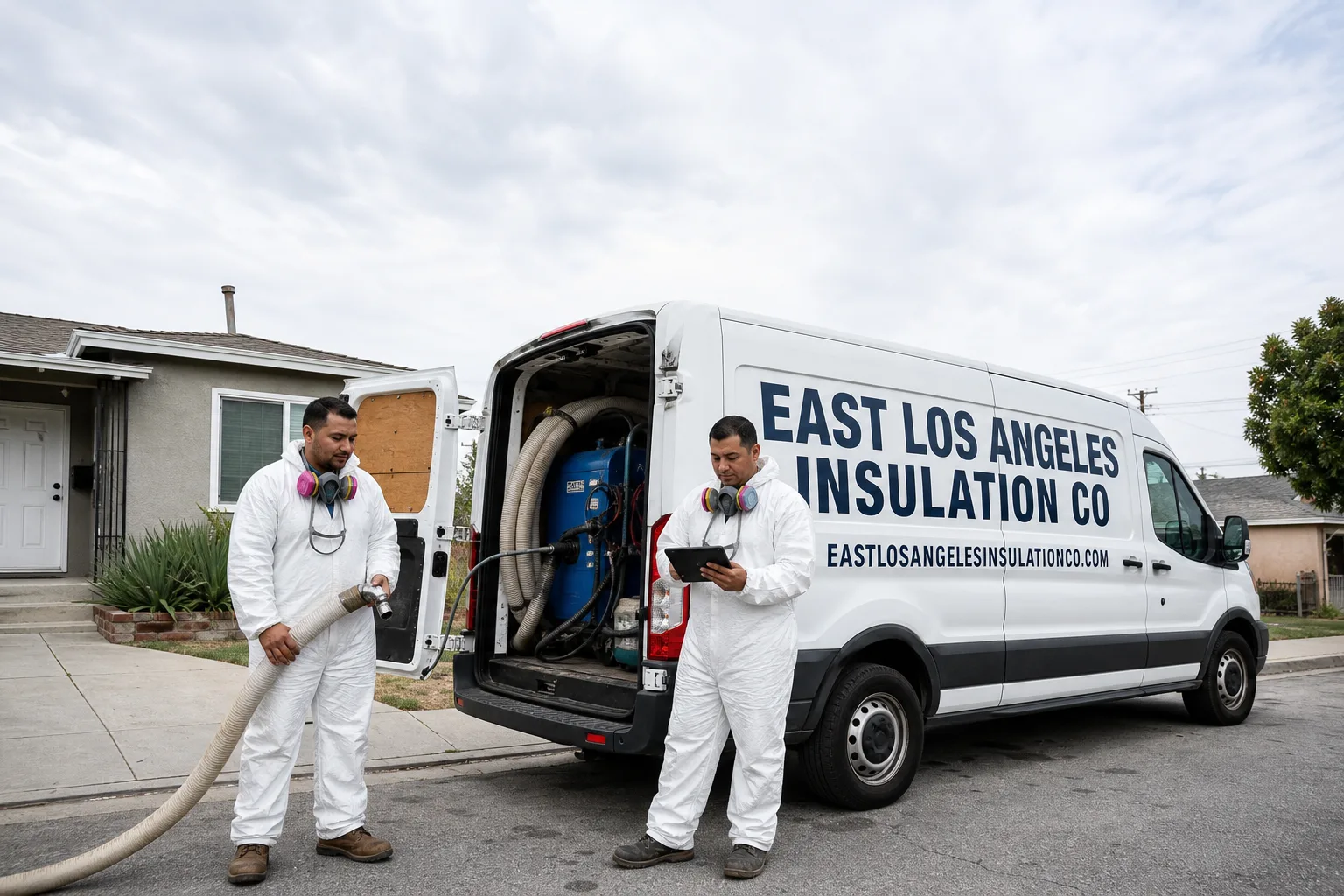
Fast, Reliable Attic Insulation Across Highland
Attic insulation in Highland, CA typically runs $3,200 – $8,900 for a full removal-and-replacement on a 1,500-square-foot home, with top-ups of existing insulation falling between $1,100 and $2,600. We complete most Highland attic jobs in a single day, and our crew is on the road to the 92346 ZIP code within 45 – 60 minutes of your call. Highland’s foothill heat doesn’t wait, and neither do we. Call (866) 566-0304 and we’ll schedule a time that actually works for your schedule, not ours.
Highland sits in a tough spot for attics: summer heat radiating down from the San Bernardino Mountains and Santa Ana winds pushing fire risk into the foothills mean the insulation above your ceiling does real work every single day of summer. When it fails, you feel it in every upstairs bedroom and every August electric bill. We know Highland’s housing stock because we’ve spent years crawling through those 1970s tract-home attics off Base Line and Boulder, and we know what a Highland attic should look like versus what it usually does.
Why East Los Angeles Insulation Co Is Highland’s Preferred Attic Insulation Company
Most insulation companies in the Inland Empire treat attic work as an afterthought, a quick batts-and-go job between bigger projects. We don’t. Attic Insulation is what we do, day in and day out, and it shows in the way our Highland customers talk about us. Ruben Acosta started this company with a simple rule: the right insulation for the home, not just whatever we happened to stock that month. That’s why we carry eight brands, why we train on all three installation methods, and why an attic in Highland gets the same diagnostic attention as an attic in East LA, where we started.
We’re not a general contractor splitting time across trades. Insulation is the only trade we touch. That focus matters when you’re standing in a 1978 ranch off Base Line Road with original R-11 batts and a utility bill that climbs every July. We’ve seen that exact attic dozens of times, in dozens of Highland homes, and we know what it takes to fix it right. Our customers in Highland call us back because the quote we give is the price they pay, and because the crew that shows up knows the difference between a top-up and a full replacement without having to check a manual.
Getting to Highland is easy for us: we’re up the 210 and across the 30, and we keep daily routes through San Bernardino and Redlands anyway. You won’t wait a week for a scheduled visit that turns into a reschedule. You’ll get a straight time window, a specialist in the attic, and an honest answer about what you need and what you don’t.
Attic Ventilation in Highland
Attic Ventilation in Highland is the difference between a hot attic and a punishing one, especially in those 1970s tract homes where the original soffit vents are half-painted-over or plugged with decades of dust and nesting material. A properly ventilated Highland attic moves superheated air out and pulls cooler outside air in, dropping the temperature above your ceiling by 30 to 50 degrees in August. That’s the difference between your insulation fighting the heat and your insulation just sitting there cooking.
Ventilation work in Highland typically runs $700 – $2,100 depending on vent count, roof configuration, and whether we’re adding baffles to keep the airflow channel open along your eaves. It’s not the most expensive part of an attic upgrade, but it’s often the most important. Insulation without ventilation still leaves the attic as a heat sink, especially in Highland’s long dry summers.
Attic Baffles & Ventilation Prep
Before we blow in new insulation, we make sure your airflow channels are clean and open. Baffles keep insulation from blocking the soffit vents, which is the most common ventilation mistake in Highland attics, especially ranch-style homes with low roof pitches and shallow eaves. We install baffles as part of most insulation replacements, not as a separate upcharge, because a correctly ventilated attic is the entire point.
Heat-Ready Vent Calculations
Highland’s summer heat is exceptional, and the vent math matters. We balance intake and exhaust air volume based on square footage and roof geometry, not a generic one-size-fits-all formula. Many Highland attics were originally ventilated for a much cooler climate pattern, and upgrading to high-flow ridge or gable vents plus additional soffit intake makes a real difference in ceiling temperature.
Radiant Barrier in Highland
Radiant Barrier in Highland is the most direct way to cut attic heat gain, and it’s a solution that makes particular sense for foothill homes where the roof deck bakes under full inland sun. A radiant barrier reflects radiant heat before it ever reaches your insulation, which means less heat radiating down into your living space. In a Highland summer, that can lower attic temperatures by 20 to 30 degrees on the hottest afternoons.
Installing radiant barrier in an existing Highland home generally runs $1,800 – $4,200 for a typical 1,500 to 2,000 square-foot attic, depending on whether we install it across the floor joists or staple it to the underside of the roof deck. It’s often paired with an insulation top-up, because the two work together: the barrier stops radiant heat, the insulation resists what gets through.
Roof Deck Application
For most Highland attics, we staple radiant barrier to the underside of the roof deck. That keeps the barrier cooler and more effective while leaving the attic floor accessible for insulation work. The reflectivity holds up for years, and it’s one of the few upgrades that pays for itself faster in Highland than in coastal or valley cities, because your attic heat load is so much higher.
Floor Application for Storage Attics
Some Highland homes use the attic for storage, especially newer infill builds with higher roof pitches. For those, we lay radiant barrier across the joists and cover it with decking. It’s less effective than roof-deck application at reducing attic air temperature, but it protects whatever you’re storing from direct radiant heat and helps keep the rooms below cooler.
Trusted Brands We Service in Highland
We carry the products we carry because they perform, and because Highland’s heat requires better-than-basic materials. Owens Corning fiberglass is our workhorse for blown-in and batt work, holding its R-value through decades of hot-attic conditions. Demilec closed-cell spray foam gives Highland homeowners who want air-sealing plus high R-value per inch a proven option for cathedral ceilings and tight attic spaces. And GreenFiber recycled-content blown-in is on hand for Highland customers who want low-VOC, eco-conscious insulation that still handles the heat. We stock enough local material for fast turnaround on any Highland job, and we don’t push a single brand because we don’t have to. Eight brands, three methods, one specialist team.
Common Attic Insulation Problems We See in Highland Homes
- Baked-out R-11 batts from the 1970s and ’80s. The original fiberglass in these attics was rated R-11 when new, but after 40-plus years of 100°F+ attic temperatures, it’s often sitting at R-4 or less near the roof deck, scorched and crumbly. You can’t fluff it back to life; it has to come out.
- Scorched insulation near the roof deck. Highland’s summer heat doesn’t just degrade insulation. We regularly pull out material that’s blackened and disintegrated from years of radiant heat. That failed insulation isn’t just useless; it’s also packing down and reducing any air-sealing benefit your attic once had.
- HVAC equipment overwhelmed by attic heat. When the attic above your ductwork hits 140 degrees, even a properly sized AC system struggles. We see Highland homes where the ducts are sweating or the AC runs constantly, and the real problem is the uninsulated or under-insulated attic above it.
- Ember entry through old soffit and gable vents. Highland’s fire history, including the 2003 Old Fire through these foothill neighborhoods, makes this a real concern. Older vents with wide mesh or degraded screening let wind-driven embers into the attic. We recommend upgrading to ember-resistant venting whenever we’re doing ventilation or insulation work in Highland.
Pricing for Attic Insulation in Highland, CA
A basic blown-in top-up on a 1,500-square-foot Highland home runs $1,100 – $2,600, depending on how much material you need to reach R-38 or R-49. Full removal of failed insulation and replacement with new blown-in fiberglass typically lands between $3,200 and $6,800 for that same home. Add radiant barrier, and you’re looking at $5,000 – $9,000 all-in for the whole attic upgrade. Ventilation work runs $700 – $2,100 depending on your existing setup. The biggest cost driver in Highland is whether your old insulation has actually failed; if it has to come out, that’s labor and disposal on top of new material. We give free estimates so you know exactly what you’re looking at before anything gets scheduled. Call (866) 566-0304 and we’ll come take a look.
We Also Serve Cities Near Highland
We run daily crews through San Bernardino, Muscoy, Redlands, and Loma Linda, so if you’re just outside the 92346 ZIP code, give us a call anyway. Our Highland routes regularly include stops in the surrounding foothill communities. Same day service is often available across the whole corridor.
Serving Highland, CA - Our Local Coverage Area
We serve Highland and nearby communities. Use the map below to see the area we cover. If you’re nearby, we can almost certainly help.
FAQs About Attic Insulation in Highland
Look for three signs: uneven room temperatures between the first and second floor, rising summer electric bills that don’t match your AC usage, or visible scorching and crumbling if you peek into the attic. We often find original R-11 batts in Highland homes that have baked down to R-4 or less in the hottest zones. Call (866) 566-0304 and we’ll do a free attic inspection and tell you exactly what you’re working with.
Insulation itself isn’t typically the ember entry point, but your vents are. In Highland, we recommend ember-resistant screening on all soffit and gable vents as part of any attic insulation job, especially in foothill neighborhoods. It’s a small add-on that matters in a city with this fire history. Ask us about it when you call.
The combination that works best in Highland is upgraded insulation plus radiant barrier plus proper ventilation. Insulation resists conductive heat, the radiant barrier reflects radiant heat before it reaches the insulation, and ventilation removes the superheated air. Each one alone helps. Together, they drop your attic temperature by 30 – 50 degrees on the worst days.
Santa Ana winds push embers into vulnerable attic vents and drive dry heat against the building envelope. For Highland homes, we recommend insulation that won’t degrade from heat, plus ember-resistant vent covers and, in many cases, air-sealing to keep smoke and ash from being sucked into the home through top plates and penetrations.
Sometimes, yes. If the original batts aren’t scorched, water-damaged, or pest-infested, we can blow new insulation directly over them to reach R-38 or R-49. But in many 1970s Highland homes we inspect, the original insulation has already failed to the point where removal is the right call. We’ll show you photos from your attic before deciding anything together.
Ready to get your Highland attic working again? Call (866) 566-0304 for a free estimate. We cover every street in 92346, from the older tract homes off Base Line and Boulder to the newer foothill builds near the mountains. You’ll get a specialist, not a general contractor, and an answer you can trust.
Written by Ruben Acosta, Owner at East Los Angeles Insulation Co, serving Highland and the surrounding Inland Empire communities.