
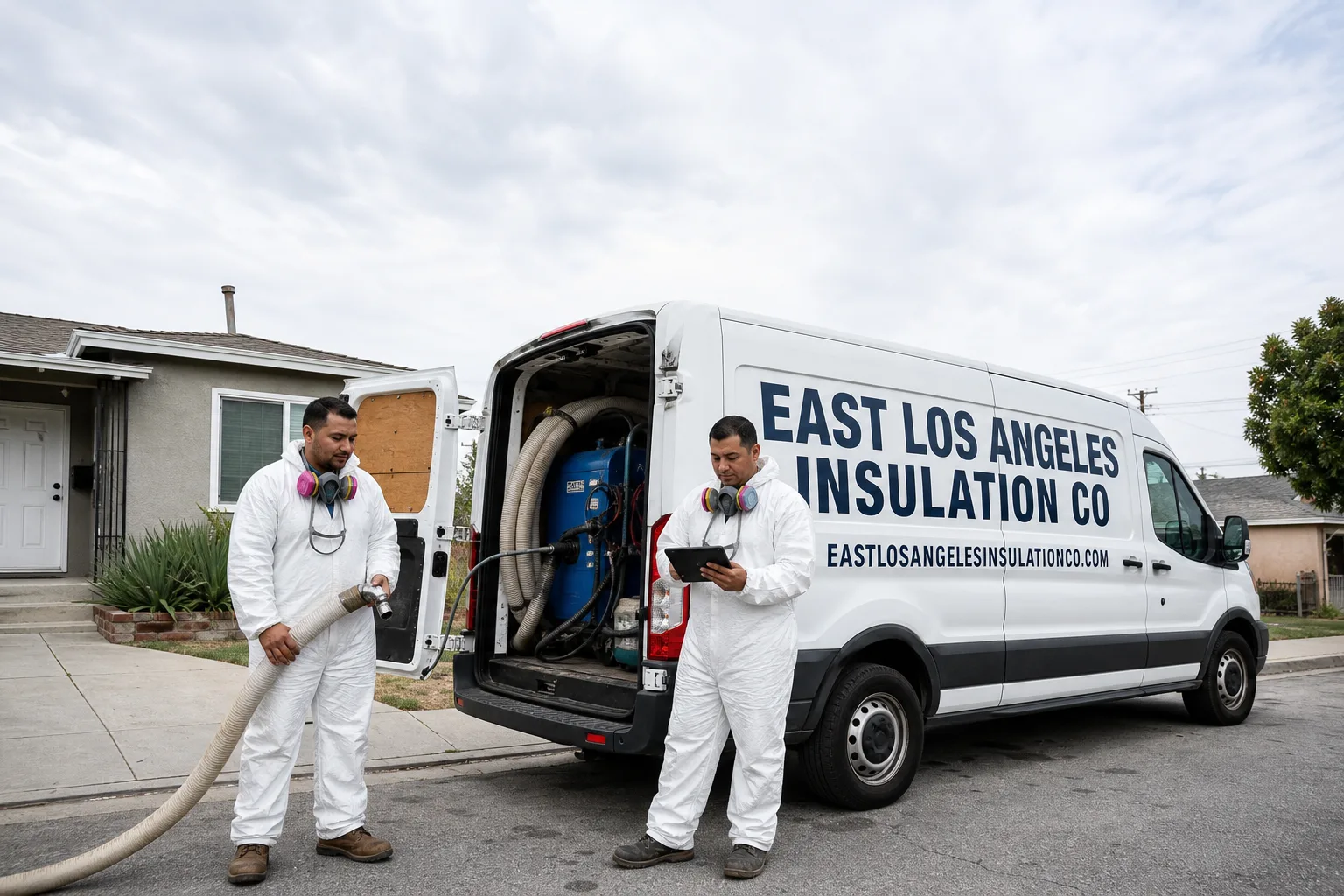
Fast, Reliable Attic Insulation Across Rowland Heights
Most Rowland Heights attics hold 1960s-to-1980s builder fiberglass that has sagged, compressed, or slipped off the joists after decades of Santa Ana heat cycles. The result is an attic that reads as “insulated” but performs far below its labeled R-value, usually between R-11 and R-19 when current code recommends R-38 and up. We fix that. Our crew knows the tract subdivisions off Colima Road, Fullerton Road, and Pathfinder Road, and we can usually reach any 91748 address same day or next morning. If your upstairs rooms spike in late afternoon or your cooling bill climbs every July, call Ruben Acosta’s team at (866) 566-0304 for a free attic assessment.
Why East Los Angeles Insulation Co Is Rowland Heights’s Preferred Attic Insulation Company
We are a dedicated Attic Insulation contractor, not a general handyman crew that adds insulation to a job list. That focus matters in Rowland Heights because this housing stock has specific problems. We have worked inside enough 1970s tracts here to know what a sagging R-11 batt looks like before we even open the scuttle hole. We also know which streets in the hillside subdivisions take the hardest afternoon sun on south- and west-facing roofs.
Homeowners across Rowland Heights call us because we carry eight brands and install all three methods: blown-in, spray foam, and batts. When Ruben Acosta walks your attic, he does not ask which product we happen to have on the truck. He asks what your roof orientation is, what your ductwork looks like, whether you have recessed can lights, and whether smoke intrusion during fire season is a concern. Then he recommends based on that. For most Rowland Heights tract homes, the answer is air-sealing plus re-leveling existing fiberglass and adding depth, not a full tear-out. That kind of honesty is why we get repeat calls and referrals from neighbors on the same block.
Attic Ventilation in Rowland Heights
Attic Ventilation in Rowland Heights is the difference between an attic that sheds heat and one that bakes it into your living space. The shallow-pitch roofs common to 1960s-1980s tract construction leave little room for airflow, and the original vents are often undersized, painted over, or blocked by years of dust and debris. In the hillside subdivisions rising toward the Puente Hills, a black-shingled roof with poor ventilation can push attic temperatures past 130°F on a July afternoon. Your insulation cannot do its job when the space above it is an oven.
Most Rowland Heights attics need either a ridge-and-soffit vent pairing or a solar-powered attic fan to move air consistently without adding to your electric bill. We also check that existing baffles are not crushed against the roof deck, a common failure in shallow attics. Expect to pay $450 to $1,300 for a typical ventilation upgrade depending on roof pitch, run length, and whether we are retrofitting vents or a powered fan.
Signs Your Rowland Heights Attic Ventilation Fails
Upstairs rooms that hold heat well past sunset are the classic tell. You may also notice shingles curling early on the south side, or painted surfaces peeling faster than expected. If you place a hand near the ceiling on a hot afternoon and feel radiant heat pushing down, the attic is not venting. We diagnose this with a thermal check during our attic assessment, then match the fix to your roof geometry.
Ventilation Work We Do in Shallow Attics
On tight-pitch Rowland Heights roofs, we often combine a low-profile ridge vent with new soffit intakes to get crossflow without major roof surgery. For homes where the original soffits are solid stucco with no intake, a solar fan gable-mounted is sometimes the cleaner retrofit. Both approaches give the hot air somewhere to go instead of radiating into your ceiling drywall.
Radiant Barrier in Rowland Heights
Radiant Barrier in Rowland Heights is not always the first product people ask for, but it is often the one that makes the biggest difference. A radiant barrier is a reflective foil installed under the roof deck or over existing attic insulation that bounces radiant heat back before it can load your insulation and ceiling. In Rowland Heights, where Santa Ana events can push dry, hot air against attics for days, blocking that heat at the source is a direct fix for late-afternoon temperature spikes in west-facing rooms.
We install radiant barrier as a supplement, not a replacement, to insulation. The foil handles radiant gain; the fiberglass or blown-in material handles conductive heat. Together they cut summer cooling load more than either alone. A typical radiant barrier install in a Rowland Heights attic runs $900 to $2,200 depending on attic square footage, roof pitch, and how much existing insulation needs to be moved or topped. Homes with steep hillside roof lines and lots of southern exposure sit at the higher end.
Where Radiant Barrier Helps Most in Rowland Heights
The tract homes climbing the Puente Hills toward Pathfinder Road take direct afternoon sun with almost no shade. Black-shingled south and west roofs absorb that heat and radiate it straight down. We routinely measure 30 to 40 degree differences between a radiant-barrier attic and an untreated one on the same street. If your second floor is consistently 8 to 10 degrees warmer than the first in summer, this is usually part of the fix.
Radiant Barrier vs. Adding More Insulation
If your attic already has R-30 or better but still bakes, adding another six inches of fiberglass will not solve the problem. Radiant heat is not stopped by mass insulation; it is reflected or absorbed. This is why some Rowland Heights homeowners who keep topping up insulation see no change. We would rather diagnose that honestly than sell you material that will not help. Call (866) 566-0304 and we will tell you which one your house actually needs.
Trusted Brands We Service in Rowland Heights
We stock and install CertainTeed, Icynene, Demilec, and GreenFiber, among others, because each earns its place for a specific Rowland Heights situation. CertainTeed blown-in fiberglass is our go-to for topping up and re-leveling old batts in 1970s attics. Icynene and Demilec open- and closed-cell spray foam come out when we are air-sealing irregular shallow attics, rim joists, or the underside of a roof deck that will not carry batts. GreenFiber serves homeowners who want recycled-content, low-VOC blown-in insulation. We keep local stock and can pull what your job needs without waiting on a distributor. If you know the brand you want, we will tell you honestly whether it is the right match for your roof and orientation.
Common Attic Insulation Problems We See in Rowland Heights Homes
- Sagging and compressed original batts. The R-11 and R-19 fiberglass installed when these tracts were built has been pushed flat by decades of heat cycling and sometimes slid off the joists entirely. That leaves bare top plates and thermal bypasses that let hot attic air pour into wall cavities.
- Bare top plates and unsealed can lights. In the 1960s and 1970s build-outs around Rowland Heights, top plates were never sealed before drywall. Hot attic air moves straight through them into rooms. Recessed can lights without sealed housings do the same thing, and they show up constantly in these older homes.
- South- and west-facing roof heat loading. Hillside lots with black shingles and no shade drive attic temps past the point where fiberglass performs. We have measured attic spaces hot enough that the insulation itself is heat-soaked and radiating downward into bedrooms.
- Wildfire-season smoke and heat intrusion. Thin or missing wall insulation behind stucco lets smoke push through cracks and gaps when Santa Ana winds carry it into the Puente Hills. Air-sealing the attic plane stops a lot of that intrusion, which is why we never skip it before adding insulation depth.
Pricing for Attic Insulation in Rowland Heights, CA
A full attic air-seal and top-up for a typical 1,200 to 1,600 square foot Rowland Heights tract home runs $1,800 to $3,400. That includes re-leveling existing batts, sealing top plates and can light housings, and blowing additional fiberglass to bring the attic up to R-38. A full removal and replacement of contaminated or pest-damaged insulation runs $3,200 to $5,500 depending on attic access and depth. Radiant barrier adds $900 to $2,200 as covered above. Attic ventilation work sits at $450 to $1,300. Blown-in only without air-sealing costs less but we rarely recommend it in these older homes because you will still leak conditioned air. Every estimate is free, and Ruben Acosta gives you a line-item scope so you can see exactly what you are paying for. Call (866) 566-0304 to schedule.
We Also Serve Cities Near Rowland Heights
Our crews cover Rowland Heights daily and regularly run jobs in South San Jose Hills, Walnut, Valinda, and Hacienda Heights. If you live in one of those nearby communities, give us a call and we will get you on the schedule. For more detail on our service area, see Attic Insulation in Rowland Heights and the surrounding region.
Serving Rowland Heights, CA - Our Local Coverage Area
We serve Rowland Heights and nearby communities. Use the map below to see the area we cover. If you’re nearby, we can almost certainly help.
FAQs About Attic Insulation in Rowland Heights
Usually not. Most 1960s-1980s Rowland Heights attics have fiberglass that is still recoverable but sagging, compressed, or shifted. We can re-level it, air-seal the attic plane, and add blown-in depth on top to reach R-38. Full removal is only needed if insulation is water-damaged, pest-infested, or contaminated. Call (866) 566-0304 and we will tell you which camp your attic falls into.
Insulation slows conductive heat transfer, but it does not stop radiant heat from a black-shingled south-facing roof. In Rowland Heights, those roofs can push attic temperatures past 130°F, heat-soaking whatever fiberglass is up there. The fix is usually a combination of ventilation and a radiant barrier, not more insulation alone.
Yes, especially when the attic plane is air-sealed before insulation is added. Sealing top plates, can light housings, and wire penetrations blocks the paths smoke uses to enter living spaces when Santa Ana winds push it through the Puente Hills. Insulation depth alone does not stop smoke if the gaps are still open.
We install CertainTeed blown-in fiberglass for top-ups and re-leveling, Icynene and Demilec spray foam for air-sealing irregular shallow attics, and GreenFiber for homeowners wanting recycled-content material. Ruben Acosta will recommend the right one after seeing your attic, not before.
Yes, and by a wide margin. Rowland Heights cooling loads dwarf heating loads because of inland summer heat, Santa Ana events, and direct sun on hillside roofs. A properly air-sealed and insulated attic typically cuts summer cooling usage meaningfully in these homes. Call (866) 566-0304 for a free assessment and we can show you where your heat loss is actually happening.
Written by Ruben Acosta, Owner at East Los Angeles Insulation Co, serving Rowland Heights and the San Gabriel Valley.