
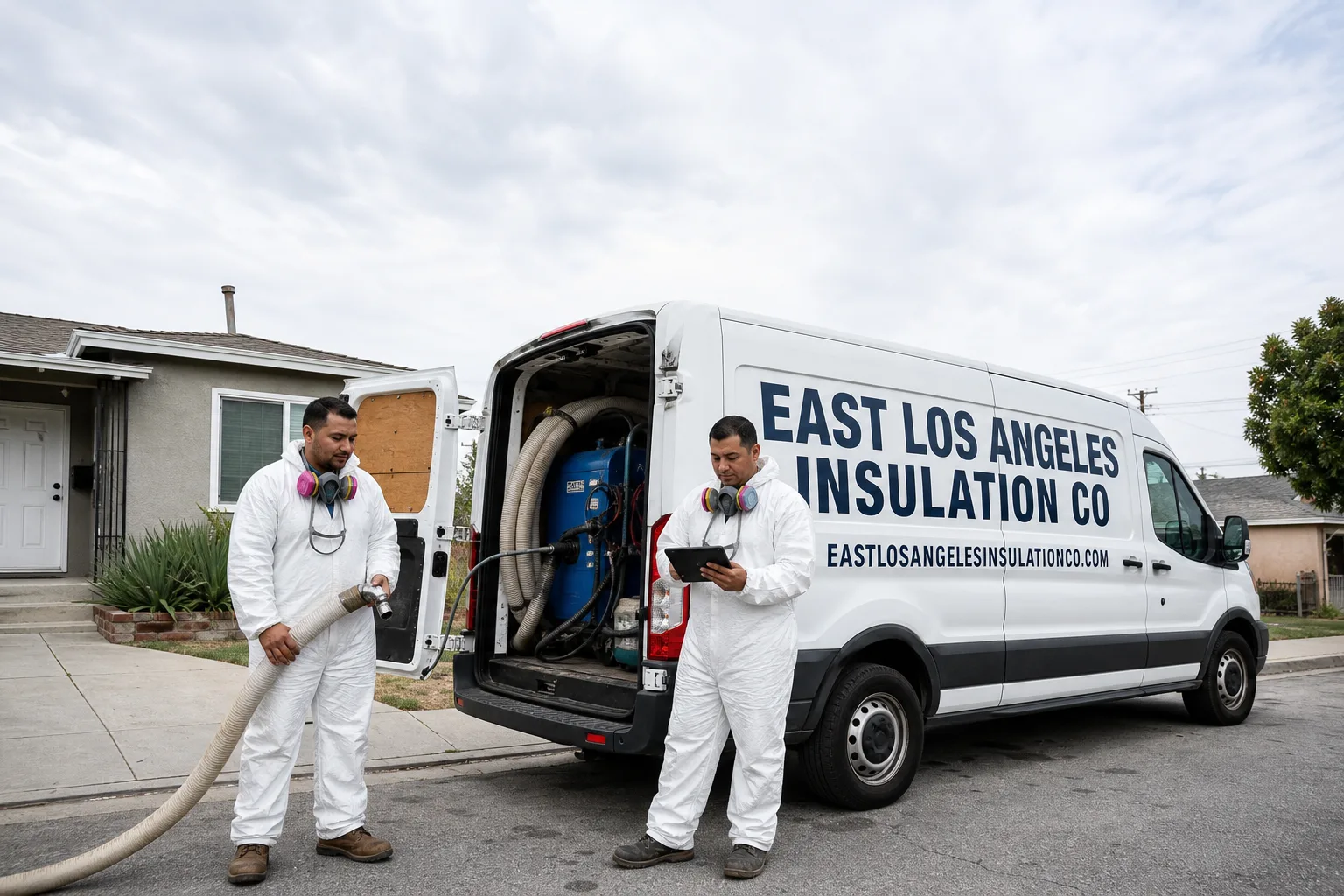
Fast, Reliable Attic Insulation Across South San Gabriel
Attic insulation in South San Gabriel typically costs $1,800 to $4,200 for a full retrofit on the 1,200 – 1,800 square foot tract homes that dominate this area, with blown-in fiberglass running $1.50 – $2.50 per square foot and spray foam landing at $3.50 – $6.00 per square foot. Most jobs take one to two days, and we’re usually in South San Gabriel within 24 hours of your call. If your home was built in the 1950s or 60s and still has its original insulation, it’s likely underperforming badly. Call (866) 566-0304 for a free estimate from a team that knows this neighborhood’s housing stock well.
South San Gabriel’s older homes were built to a different standard. Back then, energy was cheap and insulation was an afterthought. Today, those thin batts and empty wall cavities mean you’re paying for every degree of cooling your home loses through the attic. We don’t just blow in new material and leave. We diagnose the whole envelope, fix the air leaks, and make sure your attic is actually holding the temperature you’re paying for.
Why East Los Angeles Insulation Co Is South San Gabriel’s Preferred Attic Insulation Company
Led by Ruben Acosta, our team knows the difference between a correctly insulated 1958 stucco tract home and one that just looks like it has insulation. That matters in South San Gabriel, where original construction left wall cavities empty and attics with a single thin layer of fiberglass that has since settled and degraded under 150°F summers. We’ve worked on enough of these homes off San Gabriel Boulevard to recognize the signs of unpermitted additions, converted garages, and poorly connected insulation envelopes before we even get into the attic.
Our Attic Insulation team is a dedicated insulation crew, not a general contractor splitting attention across five trades. When you call for an estimate in South San Gabriel, the person who shows up knows exactly what they’re looking at: the stucco exterior, the age of the framing, the way the attic vents were originally cut. That’s the difference between guessing and diagnosing. Ruben Acosta built this company around that level of focus, and it shows in every attic we open.
We carry eight brands, but we won’t lead with a product. We lead with what your South San Gabriel home actually needs. Sometimes that’s Air-Web-aired fiberglass blown to R-49. Sometimes it’s dense-packed cellulose through the original stucco. Sometimes it’s a radiant barrier to knock down the 150°F attic temperatures that wreck older insulation. You get the right product for your situation, not just what we happen to stock.
Attic Ventilation in South San Gabriel
Attic ventilation in South San Gabriel is not a nice-to-have. It’s what keeps your attic from becoming an oven that cooks your insulation and radiates heat into your living space. In our climate, a poorly vented attic can hit 150°F or more in July and August, which accelerates the breakdown of fiberglass batts and makes your air conditioner work harder than it should. Proper ventilation means balanced intake at the eaves and exhaust at the ridge, sized for your attic’s square footage and the way your home was originally built. In South San Gabriel, that typically runs $400 to $1,500 depending on whether we’re adding soffit vents, baffles, a ridge vent, or correcting a system that was never quite right to begin with.
When Your Attic Is Working Against You
If your South San Gabriel home gets noticeably hotter upstairs than downstairs in summer, or if you see condensation on the underside of the roof deck in winter, your ventilation isn’t doing its job. Older tract homes here were often built with minimal eave venting, and many have since been covered by newer roofing or remodeled additions that blocked airflow. We correct that before adding insulation, because new insulation in an unvented attic is just trapping heat you don’t want.
Baffles, Eaves, and the Original Framing
Homes in the tight side streets off San Gabriel Boulevard often have shallow eaves and irregular rafter spacing, which means off-the-shelf baffles don’t always fit cleanly. We cut and fit baffles to your actual rafters, not to a spec sheet. That’s detail work most crews skip, and it’s the difference between an attic that breathes and one that doesn’t. Expect to pay $300 to $800 for baffle and venting work on a typical South San Gabriel attic.
Radiant Barrier in South San Gabriel
Radiant barrier in South San Gabriel works by reflecting heat away before it can penetrate your attic insulation. In our climate, where summer attic temperatures routinely exceed 150°F, a radiant barrier can cut that heat load by 20 – 30°F, which translates directly into lower cooling costs and longer insulation life. We install radiant barrier on the underside of the roof deck or over existing insulation, depending on your attic’s layout. For a typical South San Gabriel tract home, radiant barrier installation runs $800 to $1,800, with the cost driven by attic size, accessibility, and whether we’re also handling ventilation or insulation at the same time.
Why South San Gabriel’s Heat Load Is Different
South San Gabriel doesn’t get the coastal breeze that cools homes just 15 miles west. Our summers are long, dry, and hot, and Santa Ana winds in the fall push that heat into attics from new directions. A radiant barrier handles radiant heat, the biggest single source of attic heat gain here. It won’t fix air leaks or replace old insulation, but combined with proper ventilation and air-sealing, it’s one of the most cost-effective upgrades available for our climate.
What a Radiant Barrier Actually Does
A radiant barrier reflects heat, it doesn’t absorb it. That’s the entire point, and it’s why we install it carefully, with proper air gaps and no shortcuts. In an attic with blown-in insulation on the floor, the barrier goes on the rafters. In a finished attic or one with stored items, we can install it differently. Ruben Acosta personally insists on inspecting every radiant barrier install before we call it done. If the reflectivity isn’t working, we’ll know.
Trusted Brands We Service in South San Gabriel
We stock and install three insulation product lines for South San Gabriel attics: CertainTeed fiberglass for consistent thermal performance in blow-in and batt applications, Icynene spray foam for air-sealing and high-R-value enclosures, and GreenFiber recycled-content blown-in for homeowners who want lower embodied energy. Each brand does something specific well. CertainTeed holds its loft in dry, hot attics. Icynene air-seals the irregular envelopes common in South San Gabriel’s converted garages and room additions. GreenFiber offers a low-VOC, recycled-content option that fits older homes where we’re dense-packing through stucco. Because we carry these brands locally and run South San Gabriel jobs regularly, turnaround on parts and materials is fast, not two weeks out.
Common Attic Insulation Problems We See in South San Gabriel Homes
- Settled and degraded original batts. Homes built in the 1950s and 60s typically got R-11 or less, and 60+ years of 150°F attic heat has reduced that to near nothing. Large gaps and thermal bridging are common in every original South San Gabriel attic we open.
- Uninsulated exterior walls under original stucco. Most South San Gabriel tract homes have empty wall cavities. Air-sealing and adding dense-packed insulation requires drilling through exterior stucco, which most insulation crews in neighboring cities rarely do.
- Unpermitted additions and converted garages. These create irregular insulation envelopes with disconnected top plates, missing vapor barriers, and airflow paths that bypass insulation entirely. We see this on nearly every side street off San Gabriel Boulevard.
- Poor ventilation combined with unsealed recessed lights. Hot attic air pushes through unsealed top plates and light fixtures into your living space, bypassing whatever insulation is there. We air-seal those gaps before we add new material.
Pricing for Attic Insulation in South San Gabriel, CA
Here’s what you can expect to pay in South San Gabriel, based on our recent jobs in the 91755 ZIP code:
| Service | Typical Range (South San Gabriel) |
|---|---|
| Attic insulation top-up (blown-in fiberglass, R-30 over existing) | $900 – $1,600 |
| Full attic insulation replacement (remove, air-seal, R-49 blow-in) | $1,800 – $3,500 |
| Spray foam attic (open-cell, roof deck) | $3,500 – $6,000 |
| Attic ventilation correction (baffles, soffit vents, ridge vent) | $400 – $1,500 |
| Radiant barrier installation | $800 – $1,800 |
| Exterior stucco drilling for wall dense-pack (per wall cavity) | $60 – $120 per access hole |
Your actual number depends on attic square footage, whether you have existing insulation to remove, the condition of your ventilation, and whether we’re dealing with unpermitted additions that need air-sealing first. We give firm quotes upfront, not ranges that balloon later. Call (866) 566-0304 for a free estimate. South San Gabriel jobs get scheduled and quoted within 48 hours.
We Also Serve Cities Near South San Gabriel
We work regularly in South San Gabriel and the surrounding communities, including Monterey Park, Montebello, East Los Angeles, and Rosemead. If you’re in one of these areas and need attic insulation, the same crew and the same brands apply. Your home might be older, newer, stucco or frame, but the diagnostic process is the same: we find where you’re losing conditioned air, and we stop it.
Serving South San Gabriel, CA - Our Local Coverage Area
We serve South San Gabriel and nearby communities. Use the map below to see the area we cover. If you’re nearby, we can almost certainly help.
FAQs About Attic Insulation in South San Gabriel
Because these 1950s and 60s tract homes were built with empty exterior wall cavities behind original stucco, and the only practical way to add insulation is to drill access holes through the stucco from outside and dense-pack the cavities. Most insulation crews in neighboring cities don’t have this technique, but we do it regularly on South San Gabriel side streets off San Gabriel Boulevard. If your walls feel cold in winter and hot in summer, this is likely the repair. Call (866) 566-0304 and ask about stucco drilling for wall insulation.
South San Gabriel attics regularly hit 150°F in summer, which degrades fiberglass batts over time and makes under-insulated homes unbearably hot upstairs. Heat also drives thermal expansion, which loosens the bond between insulation and the framing it should be covering. Proper ventilation and a radiant barrier reduce that heat load, and newer insulation holds its R-value longer in those conditions. If your upstairs is 10°F warmer than downstairs in August, your insulation is failing.
Yes, we do this frequently. Unpermitted additions and converted garages create irregular envelopes with disconnected top plates, missing air barriers, and airflow paths that make insulation less effective. We air-seal those gaps and work around the existing framing, but you’ll want a plan for bringing the space up to code before final inspection. We’ll tell you what we see and what’s practical, not what sounds good on a sales sheet.
We use CertainTeed fiberglass for blown-in and batt applications, Icynene spray foam for air-sealing and high-R-value enclosures, and GreenFiber recycled-content blown-in for dense-packing wall cavities and attics in older homes. Each brand is chosen for a specific job, not for what’s in stock. We’ll recommend the right one after we see your attic and understand your heat load.
Santa Ana winds push hot, dry air into attic venting and around any exterior gaps, driving heat gain and air infiltration that bypasses insulation entirely. That’s why we air-seal top plates, recessed lights, and any exterior penetrations as part of every South San Gabriel job. Without that sealing step, new insulation alone won’t deliver the comfort you’re paying for. We quote and schedule within 48 hours for South San Gabriel calls; reach us at (866) 566-0304.
Written by Ruben Acosta, Owner at East Los Angeles Insulation Co, serving South San Gabriel and the surrounding 91755 area.