
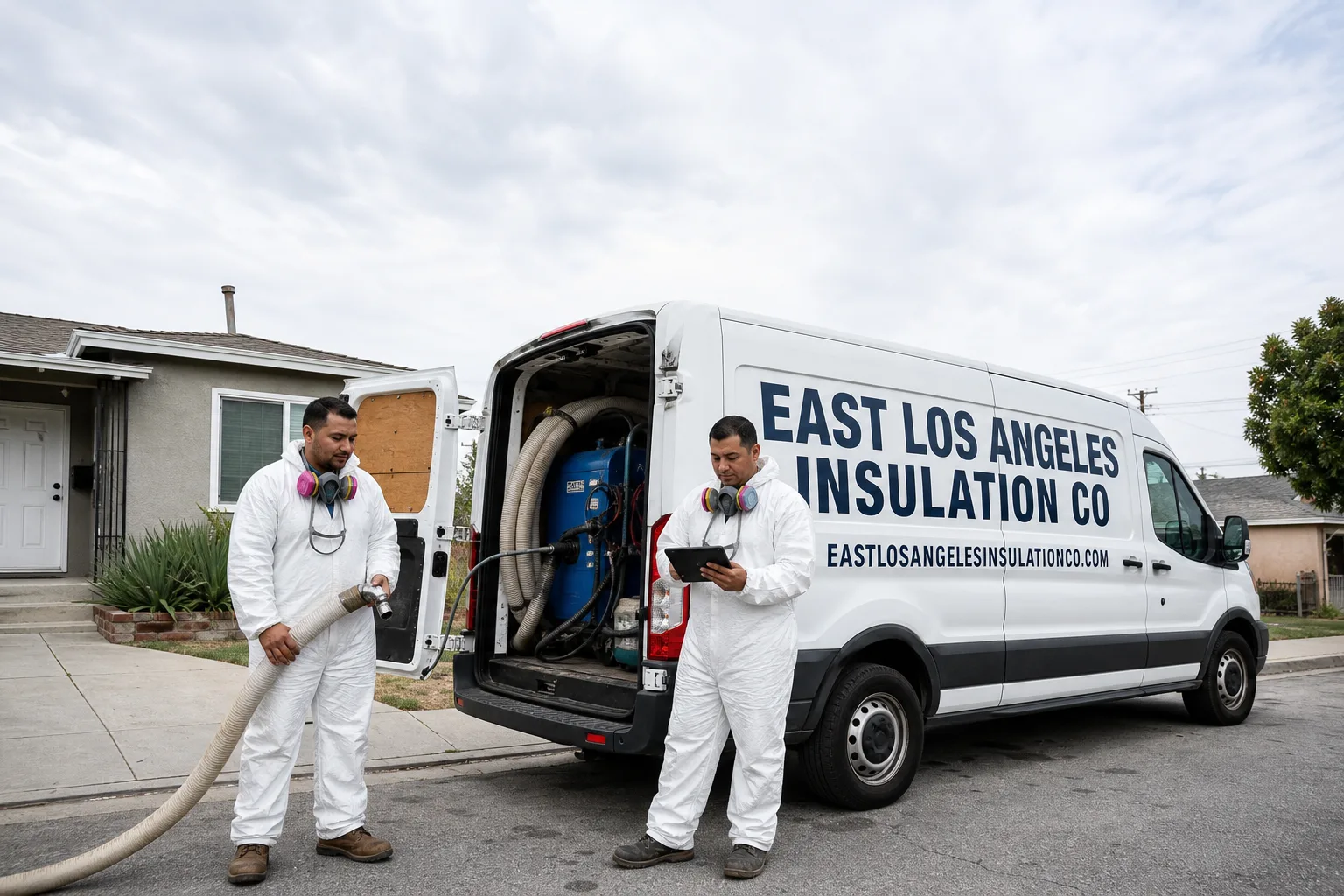
Fast, Reliable Attic Insulation Across West Hollywood
Attic insulation in West Hollywood runs $1,800 – $4,300 for a typical bungalow top-up or full replacement, with blown-in GreenFiber on the lower end and spray foam on the higher end. Most jobs in the 90069 blocks take one day. We’re a dedicated insulation contractor based in East Los Angeles, and we run crews into West Hollywood weekly, so we know the tight crawl spaces, the flat-roof additions, and the tenant-access rules that make this city different. Call (866) 566-0304 for a free estimate.
West Hollywood isn’t a city where you can just show up with a truck full of batts and start stapling. The housing stock is old. The lots are tight. And a good chunk of the rental inventory sits under rent-stabilization rules that affect how upgrade work gets scheduled. Ruben Acosta and our team have spent years working these blocks, from the 1920s bungalows just north of Santa Monica Boulevard to the low-rise apartment buildings scattered through the city’s 1.9 square miles. We know what’s behind those walls because we’ve opened them.
Why East Los Angeles Insulation Co Is West Hollywood’s Preferred Attic Insulation Company
Most insulation companies stock one or two product lines and install whatever they happen to have on the shelf. We carry eight: Owens Corning, Johns Manville, Knauf, Rockwool, CertainTeed, Icynene, Demilec, and GreenFiber. That matters in West Hollywood because no two attics here are alike. A 1920s lath-and-plaster cavity needs a different density strategy than a 1970s apartment building with truss framing. Having all three installation methods in-house – blow-in, spray foam, and batts – means we’re choosing based on your house, not our inventory.
We’ve worked enough West Hollywood jobs to know the local failure patterns before we even open the hatch. Undersized venting. Settled blown-in from a previous crew that rushed. Flat-roof additions with no insulation at all. When homeowners call us after a previous insulation job failed, it’s usually because the wrong product went into the wrong cavity. That’s what choosing a specialist fixes.
Response time matters here. We schedule West Hollywood jobs within the same week typically, and our crews know the parking and access constraints on the narrow residential streets off Santa Monica and Sunset. You won’t be waiting around for a crew that doesn’t know how to work a zero-lot-line property.
Insulation Contractors in West Hollywood
Insulation Contractors in West Hollywood have to solve a coordination problem before they ever solve an R-value problem. The city’s 1.9 square miles pack roughly 15,000 housing units into one of the densest cities in Los Angeles County. Many of those are 1920s and 1930s bungalows and duplexes on small lots, with attic access hatches barely big enough for a determined raccoon. A serious West Hollywood insulation job means staging materials on a street with permit parking, working around tenant schedules in rent-stabilized buildings, and getting density right in cavities that weren’t framed for modern insulation.
What does the work actually involve here? For a typical West Hollywood attic, we diagnose the existing insulation depth and condition, check whether the passive ventilation can handle the added thermal barrier, and then install based on what the cavity actually looks like. A straightforward blown-in top-up on a small bungalow runs $1,800 – $2,600. A full removal and re-insulation with closed-cell spray foam in an attic with flat-roof additions runs $3,000 – $4,300.
Blown-In Density Control on Older Cavities
The single biggest failure we see in West Hollywood attics is blown-in insulation that settled into the seams between original lath-and-plaster walls and the framing of a later flat-roof addition. Those voids let summer heat pour into the rooms below. We install GreenFiber at a controlled density and verify coverage before we close up.
Batch Work in Rent-Stabilized Buildings
Owners of rent-stabilized multi-family buildings in West Hollywood often can’t empty a whole building for a one-day job. We’ve learned to sequence attic insulation work unit by unit, documenting the before and after so the owner has what they need for the city’s rent-stabilization office and their tenants know what to expect.
Attic Ventilation in West Hollywood
Attic Ventilation in West Hollywood is the difference between insulation that works and insulation that rots your framing. The city’s coastal-Mediterranean climate means hot, dry summers followed by a winter marine layer that pushes cool, damp air into unconditioned attics. When you add modern insulation to a 1920s bungalow without fixing the passive venting, you trap that moisture against cold framing all winter. In the spring you get condensation. In a few years you get mold and dry rot.
Older West Hollywood bungalows were built with minimal venting because nobody in 1932 was trying to hold R-38 in an attic. The math changed. Ruben Acosta and our crew check intake and exhaust venting on every attic job. If the soffit vents are painted over, which we see constantly, we add baffles and rebalance the airflow before any insulation goes in. Undersized venting is the top reason new insulation fails here.
Marine-Layer Moisture Management
The winter marine layer in West Hollywood doesn’t freeze anything, so homeowners think they don’t have a moisture problem. They do. It condenses. Rebalancing intake and exhaust vents costs $400 – $900 on a typical bungalow and is worth every dollar when the alternative is a rot repair in three years.
Flat-Roof Addition Venting
Enclosed sunrooms and flat-roof additions change the attic’s air volume without adding venting. We see this constantly in 90069. When we insulate around a flat-roof addition, we recalculate the venting for the added volume before closing up.
Trusted Brands We Service in West Hollywood
We stock and install several Attic Insulation product lines specifically because they solve West Hollywood problems. GreenFiber blown-in works well in the patchy cavities of old bungalows because it can be density-adjusted to prevent settling voids. Owens Corning batts are our standard for open attics with consistent framing spacing. And Demilec closed-cell spray foam handles the flat-roof additions where air sealing matters as much as R-value. Having all three means we don’t force a product into a cavity it wasn’t designed for. If a previous contractor ran out of GreenFiber and stuffed fiberglass batts into an uneven cavity, you’re the one paying for the void left behind.
Common Attic Insulation Problems We See in West Hollywood Homes
- Blown-in settling at the flat-roof seam. The seam where an original lath-and-plaster cavity meets a modern flat-roof addition framing almost always develops a void over time. That void becomes a heat channel from the roof straight into the living space, and the rooms below never cool down in August.
- Undersized passive venting on older bungalows. The 1920s houses off Santa Monica Boulevard were built with whatever venting the original builder bothered to install. Add insulation on top and the winter marine-layer moisture gets trapped, condensing on cold framing all season.
- Over-compressed batts in tight 90069 attics. Zero-lot-line lots and shallow attic clearances tempt crews to force R-38 batts into a cavity that can only hold R-19 without compression. Over-compressed batts lose their rated R-value. You paid for performance you’re not getting.
- Piecemeal jobs in rent-stabilized buildings. When a tenant access issue delays part of a building’s attic work, owners sometimes get only partial coverage installed. Half an attic insulated means half the building still bakes in summer. We document sequencing so the job stays complete even when it has to happen in stages.
One job that stays with us: a 1920s bungalow just north of Santa Monica Boulevard in 90069 where our tech found a rear flat-roof addition with no insulation at all beside the original lath-and-plaster attic cavity. We split the job. GreenFiber blown-in at carefully controlled density over the addition, then a separate pass through the old cavity to avoid settling voids. The owner was working under West Hollywood’s rent-stabilization rules, so we documented the before and after thoroughly enough that the upgrade could be justified to the tenants below. That’s a coordination problem, not just an insulation problem.
Pricing for Attic Insulation in West Hollywood, CA
Here’s what West Hollywood homeowners actually pay. A blown-in GreenFiber top-up on a standard 1920s bungalow attic runs $1,800 – $2,600. Full batt replacement with Owens Corning in a consistent-framing attic runs $2,200 – $3,400. A complete re-insulation with Demilec closed-cell spray foam, including flat-roof addition work and venting rebalance, runs $3,000 – $4,300. Attic ventilation prep and baffle installation adds $400 – $900. The main cost drivers are attic accessibility, how much old insulation needs removal, and whether you’re under rent-stabilization rules that require phased work. Call (866) 566-0304 for a free site estimate. We’ll walk the attic with you and give a number you can actually plan around.
We Also Serve Cities Near West Hollywood
Our West Hollywood crews also cover Beverly Hills, Century City, Hollywood, and Universal City. Same brands, same team, same attention to old housing stock. If you’re in one of those neighborhoods, give us a call and we’ll schedule the same week.
Serving West Hollywood, CA - Our Local Coverage Area
We serve West Hollywood and nearby communities. Use the map below to see the area we cover. If you’re nearby, we can almost certainly help.
FAQs About Attic Insulation in West Hollywood
Yes, and we do it regularly in 90069. The challenge is that flat-roof additions are usually framed differently than the original 1920s structure, so we adjust our density and product selection for each section of the attic. We often blow GreenFiber at a controlled density over the addition and run a separate pass through the original lath-and-plaster cavity. The job takes longer than a standard attic, but the result is full coverage with no settling voids. Call (866) 566-0304 and we’ll tell you exactly what your attic needs.
Because the winter marine layer pushes damp air into unconditioned attics, and when that moisture hits cold framing it condenses. In West Hollywood’s coastal climate, a high R-value with no ventilation is a moisture trap. We rebalance intake and exhaust on every job before the insulation goes in.
Yes, it affects scheduling and documentation. Rent-stabilized buildings in West Hollywood often can’t be vacated for a full-day job, so we sequence the attic work unit by unit. We also provide documented before-and-after evidence so you can justify the upgrade through the city’s rent-stabilization process. Call (866) 566-0304 and we’ll walk you through how sequencing works for your building.
We plan material staging and access around the constraints. That means smaller equipment, more passes, and careful density control so we’re not over-compressing batts or forcing the wrong product into a shallow cavity. We’ve done enough of these tight attics that the access doesn’t surprise us.
We install Owens Corning, Johns Manville, Knauf, Rockwool, CertainTeed, GreenFiber, Icynene, and Demilec. For most West Hollywood attics, we lean on GreenFiber for blown-in density control, Owens Corning batts for consistent framing, and Demilec spray foam for flat-roof additions that need air sealing. The right product depends on your attic, not on what we happen to have in the truck.
Ruben Acosta and the team at East Los Angeles Insulation Co know West Hollywood attics because we’ve opened hundreds of them. If your energy bills are climbing or some rooms never cool down, call (866) 566-0304 for a free estimate. We’ll tell you what’s in your attic, what it needs, and what it costs.
Written by Ruben Acosta, Owner at East Los Angeles Insulation Co, serving West Hollywood homeowners with dedicated attic insulation, spray foam, and blown-in work.