
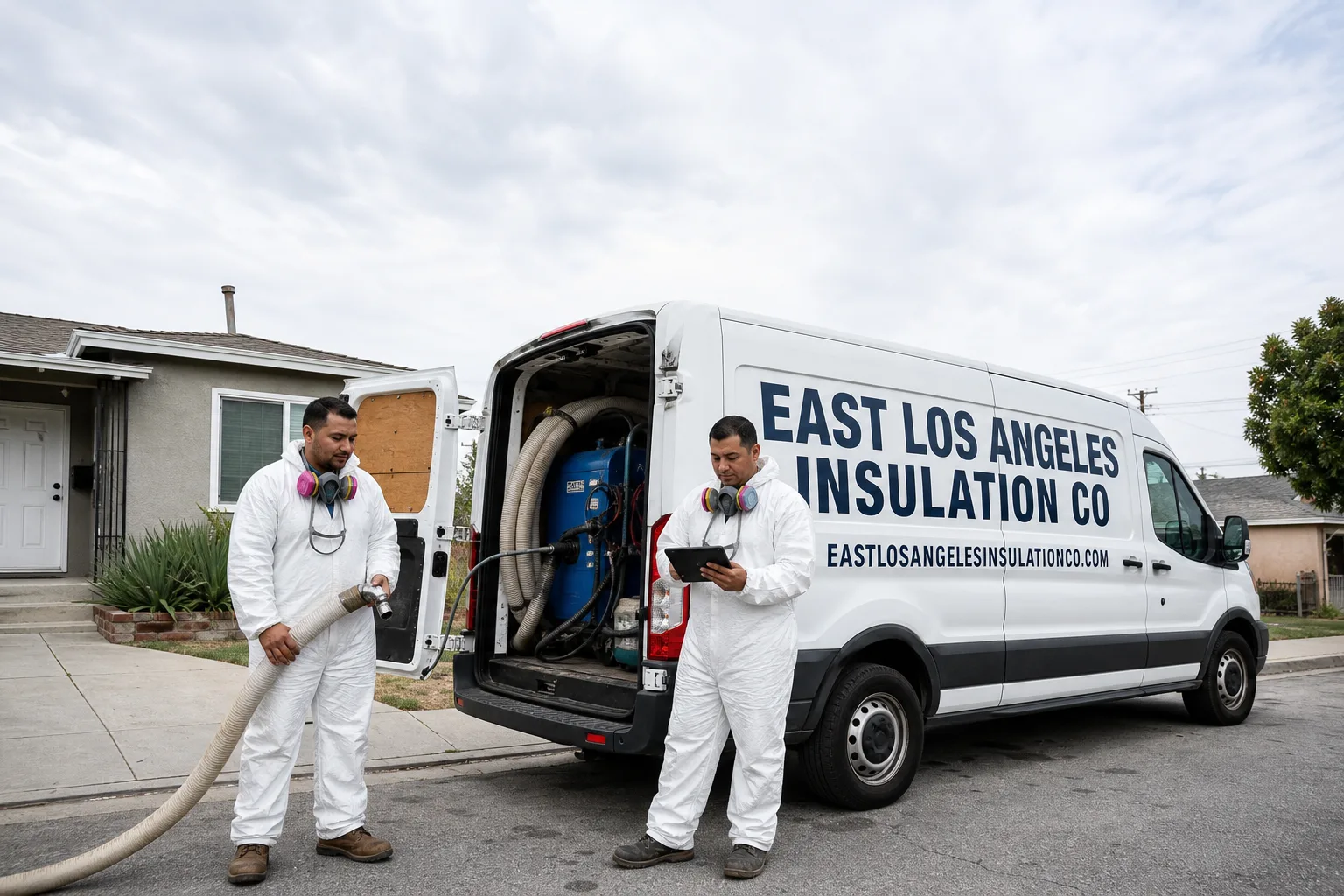
Fast, Reliable Spray Foam Insulation Across Crestline
Spray foam insulation in Crestline costs between $2,100 and $7,800 for a typical cabin or mountain home, with closed-cell running $2.80 – $4.50 per board foot and open-cell at $1.10 – $2.30 per board foot. That’s the honest range we quote for this market, where 4,500 feet of elevation changes everything about how insulation needs to perform. We’re East Los Angeles Insulation Co, and we’ve spent enough time on Crestline’s winding roads and in its mid-century cabins to know what actually works up here. Call us at (866) 566-0304 if you’re tired of feeding a propane tank all winter.
Why East Los Angeles Insulation Co Is Crestline’s Preferred Spray Foam Insulation Company
Crestline homeowners tend to ask sharper questions than folks down the hill. They’ve lived through a February where the pipes froze, or they bought a cabin that had been a weekend retreat since 1962 and discovered the walls hold about as much heat as a tent. We show up ready for those conversations. Ruben Acosta leads our team, and he’s the one walking your attic and crawlspace before we ever quote a number. We don’t send a salesman who’s never touched a foam gun.
Our response time to Crestline is usually same-week for estimates, and we schedule installations around mountain weather, not against it. That matters when a cold snap is coming and you need the work done before the snow line drops. We’ve handled enough Lake Gregory Drive cabins and properties off Waters Drive to know which homes fight wind-driven snow and which ones just need better air sealing around the rim joists.
We’re a dedicated Spray Foam Insulation contractor, not a generalist juggling HVAC calls and roofing jobs. That focus is why Crestline homeowners call us when they want the job done right in one trip, with foam that actually bonds to cold mountain wood.
Closed Cell Spray Foam Insulation in Crestline
Closed Cell Spray Foam Insulation is the workhorse for Crestline homes because it’s the only foam that delivers both high R-value per inch and a rigid air barrier that stands up to freeze-thaw cycles at 4,500 feet. We typically install it in rim joists, crawlspace walls, and the undersides of roof decks. A standard Crestline cabin rim joist and crawlspace package runs $2,800 – $4,600. Full roof deck applications on a 1,200-square-foot home land between $5,500 and $7,800.
At Crestline’s elevation, closed-cell earns its price. It sheds bulk water, which matters when snowmelt works its way into places it shouldn’t. And it adds structural rigidity to older wood framing, something mid-century cabins can genuinely use after sixty years of mountain weather.
Winter-Grade Substrate Prep
Closed-cell foam needs wood that’s warm enough to bond. In Crestline winters, that’s often below 40°F, and cold foam doesn’t cure right. We pre-warm the substrate before we spray. It’s slower, but it’s the difference between foam that seals and foam that peels off a rim joist by March.
Rim Joist and Crawlspace Sealing
Most Crestline heat loss happens where the house meets the crawlspace. We seal rim joists tight against wind-driven snow and close off the gaps that let cold mountain air pour through mid-century framing. Homeowners notice it within the first cold snap.
Open Cell Spray Foam in Crestline
Open Cell Spray Foam is what we install in Crestline attics where the goal is filling irregular rafter bays and stopping air movement without the higher cost of closed-cell. A typical attic application runs $1,800 – $4,200 depending on square footage and rafter depth. It expands aggressively, so it reaches the corners and pockets that old batt insulation never touched in cabins built before energy codes existed.
Open-cell also handles Crestline’s wide temperature swing well. It isn’t a vapor barrier, which is actually the right call for many older wood-framed cabins that need to breathe rather than trap moisture. We pair it with careful air sealing so snowmelt doesn’t get trapped behind the foam.
Converting Seasonal Cabins to Year-Round Comfort
Many Crestline homes started as summer retreats. When owners convert them to full-time living, open-cell foam in the attic is usually the first fix. The difference in propane use after one winter is what keeps people talking about it.
Filling Irregular Rafter Bays
Old cabins have framing that doesn’t line up in neat 16-inch centers. Open-cell foam doesn’t care. It flows around odd angles and fills the cavities that leave thin batt insulation useless against wind-driven snow.
Trusted Brands We Service in Crestline
We carry Icynene and Demilec spray foam because both hold up in cold-climate applications, which is exactly what Crestline demands. Demilec’s closed-cell formulations perform well on properly pre-warmed winter substrates, and Icynene’s open-cell expands cleanly into the tight rafter bays we see in older mountain cabins. For Crestline homeowners who prefer alternative approaches, we also install CertainTeed batt products and GreenFiber blown-in where they make sense. We don’t push one brand on every house. We stock what works at 4,500 feet, and we can usually start your project within two weeks of the estimate.
Common Spray Foam Insulation Problems We See in Crestline Homes
- Foam sprayed on cold substrates in winter. When temperatures drop below 40°F, many crews spray anyway and the foam fails to adhere, leaving voids behind the finished surface. We pre-warm the wood and verify surface temperature before the gun ever fires.
- Snowmelt trapped behind improperly sealed foam. Crestline’s freeze-thaw cycle pulls moisture into every gap in mid-century wood framing. If the foam isn’t sealed correctly at the edges, that moisture sits against the wood and starts rot you won’t see for years.
- Thin, uneven foam in irregular attic framing. Cabins built in the 1950s and 1960s have rafter spacing that varies noticeably. A quick, thin pass leaves gaps that wind-driven snow finds immediately. We spray to full depth on every bay, not just the easy ones.
- Open crawlspaces letting mountain air under the floor. Many Crestline homes have crawlspaces that are essentially outside. Sealing rim joists and crawlspace walls with closed-cell foam stops the cold-air wash that makes floors feel like ice in January.
Pricing for Spray Foam Insulation in Crestline, CA
A typical Crawlspace and rim joist package in Crestline runs $2,800 – $4,600. Attic spray foam on a standard single-story cabin lands between $1,800 and $4,200 for open-cell, or $5,500 – $7,800 for closed-cell roof deck work. What moves the number: square footage, accessibility of the attic, whether we’re removing old batt insulation first, and how much air sealing the home actually needs around its rim joists and penetrations. Our estimates are free, and Ruben walks through the pricing with you line by line before any work starts. Call (866) 566-0304 for an exact quote on your home.
We Also Serve Cities Near Crestline
Our service area covers Crestline and the mountain communities around it, including Lake Arrowhead, where similar elevation and snow load concerns apply. We also run crews down to San Bernardino, Highland, and Muscoy for homeowners who want mountain-grade insulation expertise on valley homes. If you’re in Crestline or any nearby community in the San Bernardino Mountains, we can get to you quickly with a free estimate.
Serving Crestline, CA - Our Local Coverage Area
We serve Crestline and nearby communities. Use the map below to see the area we cover. If you’re nearby, we can almost certainly help.
FAQs About Spray Foam Insulation in Crestline
Yes, but only with proper substrate preparation. Closed-cell and open-cell spray foam both require the wood surface to be warm enough for proper adhesion. In Crestline winters, that often means pre-warming the rim joists, crawlspace walls, or roof deck before spraying. We don’t spray on cold wood. We check surface temperature with an infrared gun, warm the substrate if needed, and use winter-grade formulations that cure correctly at lower ambient temperatures. Call (866) 566-0304 to schedule a winter installation we’ll do right.
Closed-cell spray foam performs best because it’s rigid, resists bulk water, and adds structural strength to the roof deck and framing. At 4,500 feet, snow loads press on roofs and freeze-thaw cycles pull moisture into every gap in older wood framing. Closed-cell seals those gaps and sheds water rather than absorbing it. Open-cell handles the attic air sealing but needs to be paired with proper vapor management so snowmelt doesn’t get trapped. We can walk you through which foam fits your roof profile when we inspect it.
Yes, and that’s the most common job we do in Crestline. Many cabins off Lake Gregory Drive and throughout the 92325 ZIP code were built as summer retreats with thin batt insulation or none at all. We’ve found attics with nothing but a dusty layer of old fiberglass and crawlspaces open to mountain air. Spray foam fills the irregular framing cavities that batt insulation can’t, and closed-cell seals the rim joists and crawlspace walls against wind-driven snow. Homeowners typically notice the difference in the first cold snap after installation.
Most Crestline spray foam jobs finish in one to two days. A rim joist and crawlspace package usually takes one day, while a full attic with rafter bays or a closed-cell roof deck can run two days depending on access and how much old insulation we’re removing first. We schedule around mountain weather, so if snow is forecast we plan for the window that lets the foam cure properly before the temperature drops again.
Yes. We use Icynene and Demilec spray foam specifically because both brands offer formulations that perform well in cold-climate and high-elevation applications. Ruben Acosta selects the product based on your home’s substrate condition, seasonal timeline, and whether you need open-cell for attic fill or closed-cell for air sealing and moisture resistance. We also carry GreenFiber blown-in and CertainTeed batts when spray foam isn’t the right fit for a particular cavity. Call (866) 566-0304 and we’ll tell you honestly which one your cabin needs.
If you’re ready to stop burning propane like it’s free, call East Los Angeles Insulation Co at (866) 566-0304 for a free, no-pressure estimate. We serve all of Crestline, from Lake Gregory Drive to the cabins off Waters Drive, and we’ll come up the hill to see your home in person.
Written by Ruben Acosta, Owner at East Los Angeles Insulation Co, serving Crestline and the San Bernardino Mountains.