
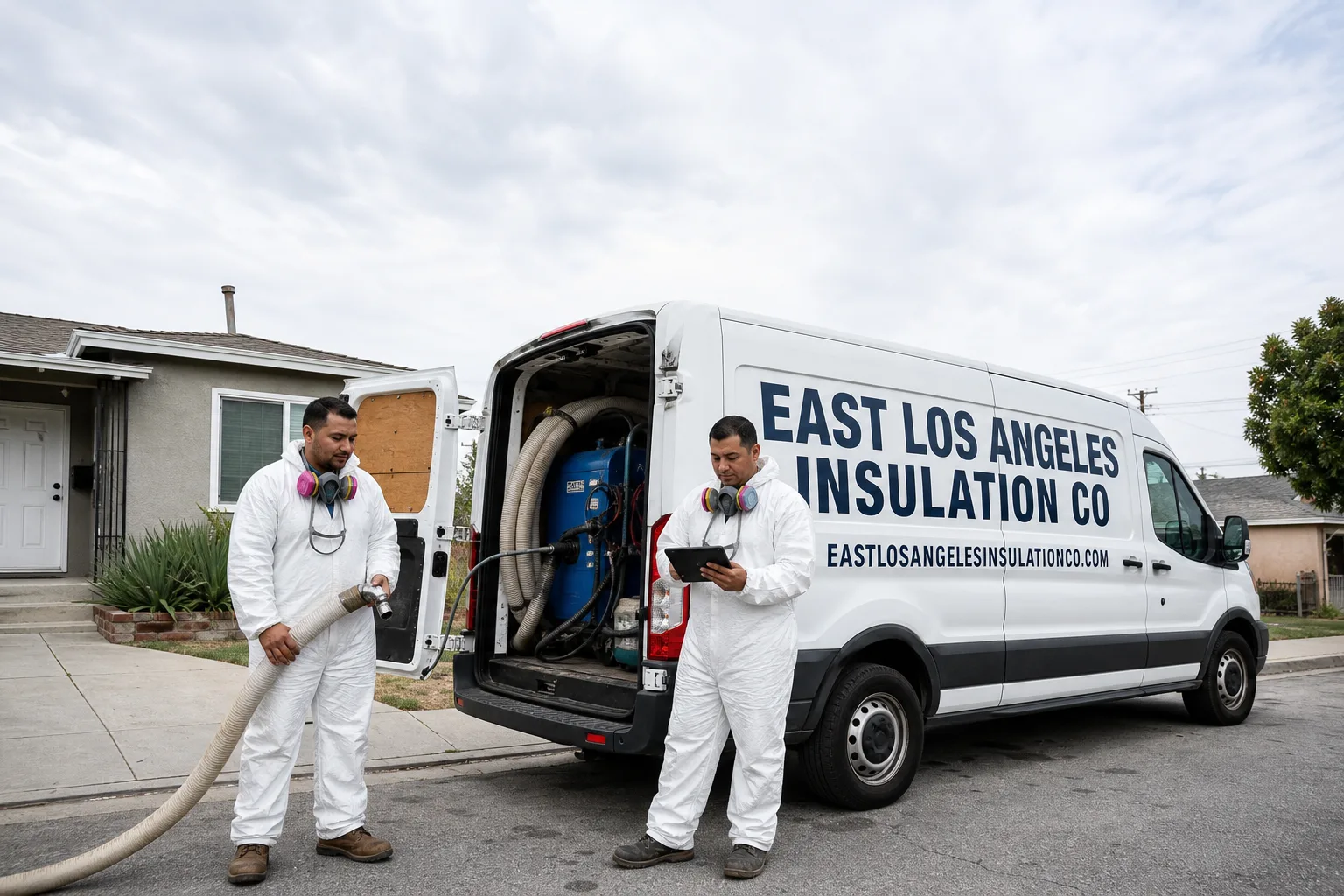
Fast, Reliable Spray Foam Insulation Across Mead Valley
Spray foam insulation in Mead Valley runs $2,200 – $6,800 for a typical single-story home, depending on whether you need open-cell or closed-cell and how many structures are on the parcel. We get to Mead Valley fast, usually within a day or two, because we know the 92570 ZIP and the acreage properties off Harvill Avenue and Cajalco Road well. Most Mead Valley jobs here involve more than one building, so we plan for the whole property, not just the house. Call (866) 566-0304 and we’ll give you a straight answer on what your place actually needs.
Why East Los Angeles Insulation Co Is Mead Valley’s Preferred Spray Foam Insulation Company
Mead Valley homeowners call us because we show up ready to handle a multi-building job in one trip. A tract subdivision home in Perris might need one attic done. A ranchette in Mead Valley off Brown Street often has a 1960s ranch, a detached shop with open rafters, and a manufactured home on the back parcel, all fighting the same August heat. We stock eight brands, including Icynene, Demilec, and GreenFiber, so we’re not pushing whatever’s left on the truck. Ruben Acosta runs our crew, and his rule is simple: foam the right structure with the right product, and don’t make the homeowner call three different companies to finish the job.
Spray Foam Attic Insulation in Mead Valley
Spray foam attic insulation in Mead Valley targets the hottest part of your home first. By midday in summer, attics here routinely bake past 130 – 140°F, and that heat sits on top of your ceiling all afternoon. A closed-cell Icynene foam application on the roof deck keeps that heat from ever entering the attic in the first place. For older ranch homes with unconditioned attics and years of settled fiberglass, this is the single highest-impact change you can make before touching the AC. We also air-seal penetrations so wind-blown dust from the Perris Valley corridor stops pulling into the living space every afternoon.
Closed-Cell Roof Deck Work
When the roof deck is foamed, the attic becomes semi-conditioned space. That matters in Mead Valley because ductwork running through that attic is no longer sitting in a 140°F oven. Cooler ducts mean cooler air arriving at the registers. Closed-cell also adds racking strength, which helps older ranch homes built before modern shear-wall standards.
Open-Cell for Interior Ceilings
For vaulted ceilings or interior walls where you want sound control plus thermal performance, open-cell foam works well and costs less per board foot than closed-cell. We use Demilec open-cell on some jobs where the roof deck already has a radiant barrier and the homeowner wants extra air sealing. The choice depends on what your attic actually looks like at 2 p.m. in July, and we’ll show you that before quoting.
Spray Foam Wall Insulation in Mead Valley
Spray foam wall insulation in Mead Valley addresses the second-biggest loss point after the attic: walls that were never insulated or have settled batts behind the drywall. Many older ranch and manufactured homes in the 92570 ZIP have 2×4 framing with thin or zero cavity insulation. On a 105°F day, those west-facing walls radiate heat into bedrooms by early evening. Injection or cavity spray foam fills the gaps and eliminates the convective loops that fiberglass can’t stop. We do more wall foam retrofits in Mead Valley than anywhere else we work, because so much of the housing stock predates modern energy codes.
Rim Joist and Belly Work on Manufactured Homes
Manufactured homes on Mead Valley parcels often lose a surprising amount of cooling through the rim joist and underbelly. Foam on the rim joist stops the stack effect that pulls hot attic air down through wall cavities. We foam the belly too when the existing underbelly material has torn or settled, which is common on older mobile homes that have been through a few Perris Valley wind seasons.
Detached Shop and Garage Walls
A detached shop off the main house is usually the last place anyone insulates, but it’s often the hottest structure on the property. Foaming the walls and ceiling of a shop with a roll-up door changes it from an oven into usable workspace. On ranchette properties, we typically quote the shop as part of the same visit as the house, because our rig is already on site and the foam is already warm.
Trusted Brands We Service in Mead Valley
We install and service Icynene closed-cell, Demilec open-cell, and GreenFiber blown-in on Mead Valley properties. We carry these because they perform, not because a distributor gave us a deal. Icynene closed-cell handles the intense radiant load on Mead Valley roof decks. Demilec open-cell gives us a strong air-seal option for interior work. GreenFiber recycled-content blown-in works well for attics where a homeowner wants a lower-cost fill with good coverage. Since we keep multiple products on the truck, we can match the foam to the structure on the first visit, which matters when you’re an hour from the nearest supplier.
Common Spray Foam Insulation Problems We See in Mead Valley Homes
- Open-cell foam specified for a 140°F attic. In Mead Valley’s summer radiant heat, open-cell alone on an unconditioned roof deck doesn’t stop the heat transfer the way closed-cell does. We see this from previous installers who applied a coastal-climate plan to an inland desert climate.
- Detached shop foamed without air-sealing the roll-up door. Foam on the shop ceiling helps, but dust still pulls in around the door gaps on windy afternoons. We seal the door perimeter and any penetrations before or during the foam pass.
- Only the main house done, manufactured home and garage ignored. On a multi-structure Mead Valley parcel, foaming just the ranch house leaves the manufactured home’s belly and the add-on garage leaking cooled air. Half the problem stays put.
- Previous foam work with no vapor management in unconditioned attics. Closed-cell against the roof deck without proper ventilation planning can trap moisture in older homes. We check the existing roof assembly before quoting, because Mead Valley’s dry climate still has winter dew points that matter.
Pricing for Spray Foam Insulation in Mead Valley, CA
Spray foam attic insulation in Mead Valley typically runs $2,200 – $4,800 for a standard single-story house. Wall cavity foam retrofits usually land between $1,800 and $3,500 depending on square footage and access. Detached shop ceilings or rim joist work add $900 – $2,400 per structure. Open-cell runs $1.10 – $1.80 per board foot installed; closed-cell runs $1.80 – $3.00 per board foot. Multi-building parcels get quoted as a whole project, and we’ll itemize each structure so you see exactly where the money goes. Estimates are free, and we don’t charge extra for Mead Valley travel on a full-property job. Call (866) 566-0304 for a number that reflects your actual buildings, not a square-footage guess.
We Also Serve Cities Near Mead Valley
Our Spray Foam Insulation crew works throughout western Riverside County, so if you’re in Perris, Good Hope, Canyon Lake, or Meadowbrook, we can usually be there within the same week. That said, Spray Foam Insulation in Mead Valley is where we spend a lot of our time, because the multi-building acreage work here keeps us busy and the results are measurable on the first hot day after install.
Serving Mead Valley, CA - Our Local Coverage Area
We serve Mead Valley and nearby communities. Use the map below to see the area we cover. If you’re nearby, we can almost certainly help.
FAQs About Spray Foam Insulation in Mead Valley
Yes, a detached shop or garage on a Mead Valley parcel is often the hottest structure on the property and a fast win for spray foam. We foam open-rafter shop ceilings with closed-cell Icynene so the roof deck stops radiating heat into the workspace. Call (866) 566-0304 and we’ll quote the shop as part of the whole-parcel job, not a separate upcharge.
Yes, air sealing with spray foam stops wind-blown Perris Valley dust from pulling into your living space around ceiling penetrations, wall plates, and rim joists. Foam expands into gaps that fiberglass can’t touch, which closes the dust pathways. This is one of the most noticeable changes Mead Valley homeowners report after a roof-deck foam job.
Yes, foam the attic first. A Mead Valley attic at 130 – 140°F forces your AC to work against heat the unit was never sized to handle. Once the roof deck is foamed and air-sealed, the existing system may actually keep up, and if you do replace it, you can size it correctly for a sealed attic instead of a hot one. A free attic inspection tells you which way to go; call (866) 566-0304.
Yes, a manufactured home in Mead Valley can be spray foamed at the rim joist and underbelly, and many of them need it as much as a site-built ranch. Older mobile homes here often have torn belly material and unsealed rim joists that leak cooled air. We foam those areas during the same visit as the main house and any detached structures.
We plan for the entire parcel: main house attic, detached shop, manufactured home belly, and garage ceiling in a single trip. Our rig carries multiple foam types on board, so we can switch from closed-cell on a shop ceiling to open-cell on interior walls without a second visit. This is the whole-parcel approach that suits Mead Valley’s acreage layout, and it saves you on mobilization costs. Call (866) 566-0304 for a whole-property estimate.
Call for a Free Spray Foam Estimate in Mead Valley
If you’re in the 92570 ZIP, on or off the paved grid, call (866) 566-0304 and tell us what structures you have on your parcel. We’ll come out, check the attic temps, walk the shop and the manufactured home if you have them, and give you a line-item quote for the whole property. No pressure, no product push. Just a straight plan for getting your cooling bill under control before the next heat spike hits.
Written by Ruben Acosta, Owner at East Los Angeles Insulation Co, serving Mead Valley and western Riverside County.