
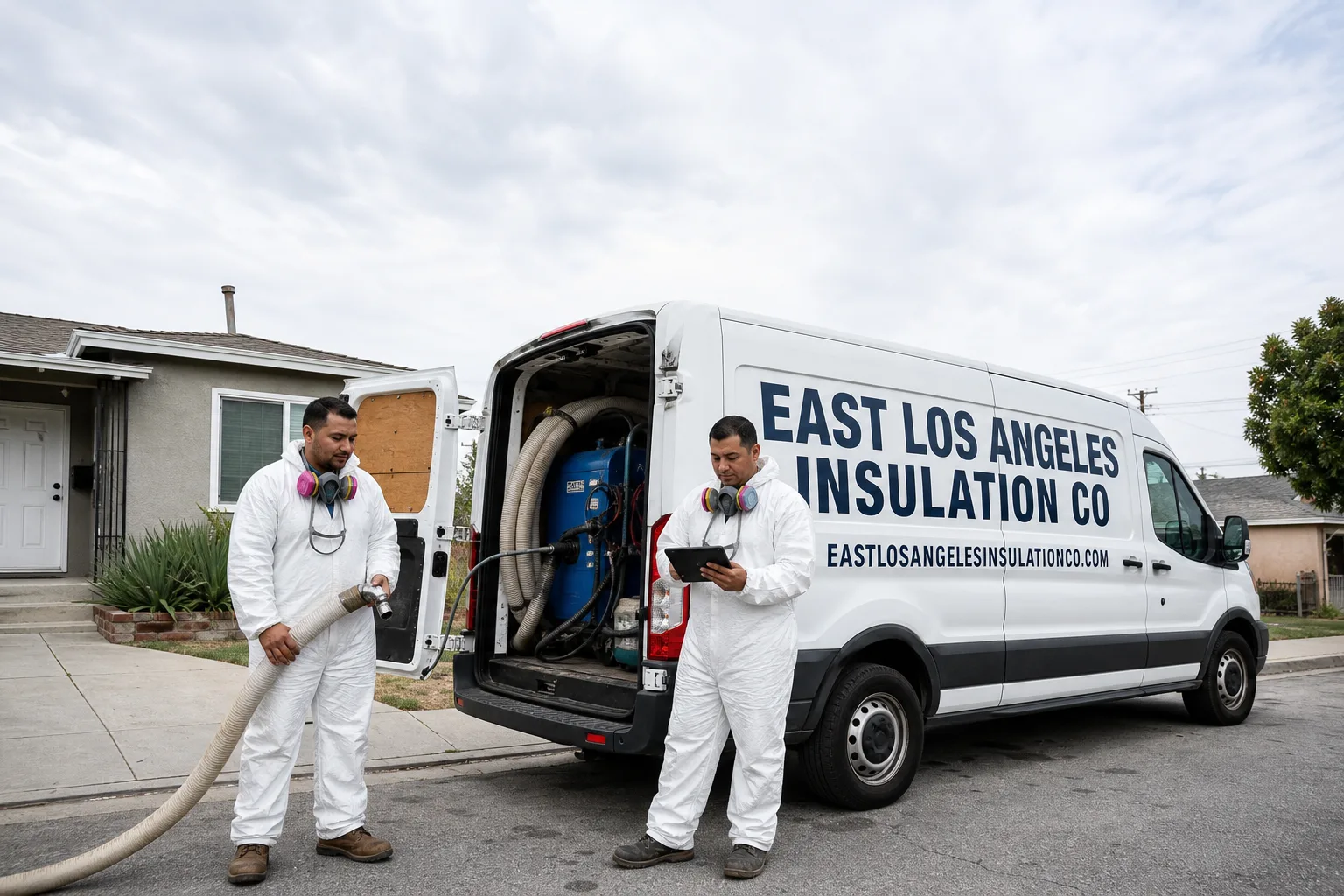
Fast, Reliable Attic Insulation Across Apple Valley
Attic insulation in Apple Valley has to work harder than almost anywhere else in Southern California. Summer attics here routinely climb past 140°F by noon, then winter nights drop below freezing. That 30-plus-degree swing between day and night means your insulation isn’t just keeping heat out or keeping heat in – it’s doing both, often in the same 24 hours. Our Attic Insulation crews know exactly what that does to fiberglass batts, radiant barriers, and air seals in the 92307 and 92308 subdivisions. Need someone out this week? Call (866) 566-0304 and we’ll schedule a free estimate around the heat, not during it.
Why East Los Angeles Insulation Co Is Apple Valley’s Preferred Attic Insulation Company
We’re a dedicated insulation contractor. That’s all we do, so when we pull up to a home off Bear Valley Road or in the tract subdivisions near Rincon Road, we’re not splitting attention between HVAC, roofing, and a half-dozen other trades. Attic insulation is our specialty, not an upsell.
Homeowners in Apple Valley call us because we carry eight insulation brands – Owens Corning, Johns Manville, Knauf, Rockwool, CertainTeed, Icynene, Demilec, and GreenFiber – and we install all three methods in-house: blown-in, batts, and spray foam. Most insulation companies stock one or two products and push whatever’s on the truck. We’d rather match the product to your attic, your roof pitch, and your energy bills.
Our response time to Apple Valley is typically same-week, and we schedule attic work at dawn for good reason. By 10 a.m. in July, an attic in 92308 can be 120°F and climbing. We start early, work efficiently, and get out before the heat turns the space into an oven. That’s not a marketing line – that’s how you actually install insulation well in the High Desert. Led by Ruben Acosta, our team has spent years dialing in the right material choices for this specific climate, and we’re happy to walk you through what we’d recommend and why before you spend a dollar.
Attic Insulation Removal in Apple Valley
Attic Insulation Removal in Apple Valley is the starting point for a lot of homes built in the 1980s, 1990s, and early 2000s. Those attics were filled with builder-grade fiberglass batts that, after two or three decades of High Desert heat, have settled, compressed, and lost a meaningful chunk of their R-value. Before we can improve anything, the old material has to come out.
A typical attic insulation removal in Apple Valley runs $1.00 to $2.00 per square foot of attic floor, so a 1,500-square-foot attic usually lands between $1,500 and $3,000 before new insulation goes in. That gets the old batts or blown-in material vacuumed or bagged out, the attic floor swept, and any debris or rodent evidence documented. If your insulation is water-damaged, pest-infested, or so compacted that it looks like a doormat, removal isn’t optional – it’s the only way to start clean.
When Removal Is the Right Call
You don’t always need full removal. If your batts are dry, intact, and still close to their original depth, a top-up may be enough. But Apple Valley attics bake. Sun-baked fiberglass that’s lost half its loft or has pulled away from the top plates isn’t doing much anymore. We’ll tell you honestly which side of that line your attic falls on.
What Removal Involves in Desert Homes
Removal in Apple Valley often includes pulling failed radiant barrier facing off the roof deck. That foil layer degrades under years of intense sun and turns from a reflector into a dark heat absorber. We remove it along with the insulation so your new system starts as a clean slate – attic floor, top plates, and roof deck all ready for what comes next.
Insulation Contractors in Apple Valley
Insulation Contractors in Apple Valley aren’t all the same, and the difference shows up fast when you ask about products. We install eight brands and three methods because no single product handles every High Desert attic. Some homes need blown-in fiberglass for complete coverage over a vented attic. Some need Rockwool mineral wool for fire resistance and moisture performance. Some need spray foam to air-seal a vaulted or awkward ceiling.
As a dedicated insulation contractor, we don’t sub out spray foam work or turn down blown-in jobs because we don’t stock the equipment. Our crews are trained on Icynene and Demilec open- and closed-cell foams, Owens Corning and Johns Manville batt products, and GreenFiber recycled-content blown-in. That’s the difference between a company that installs insulation and a company that actually understands it.
Products We Recommend for Apple Valley Attics
For most vented attics over single-story 92307 and 92308 tract homes, we lean toward blown-in fiberglass with air-sealing and a radiant barrier. That combination handles both the scorching afternoon sun and the cold nighttime air. For homes with ductwork in the attic or cathedral ceilings, closed-cell spray foam often makes more sense.
How We Quote in Apple Valley
Estimates are free, and we price by square footage, material, and labor – no vague lump sums. You’ll get a written quote that breaks down what we’re installing, what R-value you’re getting, and why we chose that product over the alternatives. Call (866) 566-0304 to set one up.
Trusted Brands We Service in Apple Valley
We stock and install Owens Corning, Johns Manville, and Demilec products for Apple Valley customers, and we carry GreenFiber for homeowners who want recycled-content blown-in insulation with low-VOC performance. Each brand earns its place on our trucks. Owens Corning blown-in fiberglass covers vented attics evenly and won’t settle nearly as much as old batts. Johns Manville batts give us a dense, consistent option for crawl spaces and rim joists. Demilec closed-cell foam air-seals and insulates in one step, which matters when your HVAC ducts are running through a 140°F attic for months at a time. We keep local inventory moving through Apple Valley jobs regularly, so turnaround is fast and you’re not waiting on a special order from a distributor in San Bernardino.
Common Attic Insulation Problems We See in Apple Valley Homes
- Compressed, sun-baked fiberglass batts. In the Navajo Vista area and throughout 92307, we routinely find builder-grade batts compressed to half their original depth. When fiberglass loses its loft, it loses R-value, and gaps open at joists and top plates where conditioned air leaks straight through.
- Failed radiant barrier facing. Desert sun is brutal on foil facing. What starts as a reflective surface bakes off the roof deck over a decade or two and becomes a dark heat sink that radiates down into the living space all afternoon.
- Missing air-sealing at top plates and penetrations. Around can lights, plumbing vents, and top plates, the 30-degree nighttime drop pulls warm air out of the house all winter. Most Apple Valley attics we open have never been properly air-sealed since the day they were built.
- Insufficient depth for current code recommendations. A lot of 1990s homes were insulated to R-30 or less, which was the standard at the time. For Apple Valley’s year-round demand, we usually recommend R-38 to R-49 in the attic, and the extra depth makes a measurable difference in both summer and winter bills.
Pricing for Attic Insulation in Apple Valley, CA
What you’ll pay depends on the scope, but here are the ranges we quote most often in Apple Valley. Blown-in attic insulation to R-38 typically runs $1.50 to $3.00 per square foot installed, including air-sealing prep. Batt insulation lands between $1.75 and $3.50 per square foot depending on brand and R-value. If removal is needed first, add $1.00 to $2.00 per square foot. A full removal plus new blown-in insulation to R-38 on a 1,500-square-foot attic usually totals $3,500 to $6,500 in the 92307 and 92308 areas.
Spray foam costs more upfront – closed-cell runs $2.50 to $4.50 per board foot – but it air-seals while it insulates, which matters a lot in Apple Valley where top-plate leakage is a major source of energy loss. We give written quotes that break all of this down so you can see exactly where your money goes. Estimates are free. Call (866) 566-0304 and we’ll come measure your attic properly.
We Also Serve Cities Near Apple Valley
Our Apple Valley coverage extends to the surrounding High Desert communities. We serve Mountain View Acres, Spring Valley Lake, Victorville, and Hesperia with the same dawn-scheduled attic work and the same eight-brand product selection. High Desert homes across the Victor Valley share similar construction and climate challenges – if you’re a mile or ten beyond the Apple Valley line, we’ve likely already worked on homes just like yours.
Serving Apple Valley, CA - Our Local Coverage Area
We serve Apple Valley and nearby communities. Use the map below to see the area we cover. If you’re nearby, we can almost certainly help.
FAQs About Attic Insulation in Apple Valley
A 30-plus-degree diurnal swing means your attic insulation has to block heat gain during the afternoon and resist heat loss before dawn. That’s a dual-demand condition. Most insulation products do one or the other well, but in Apple Valley you need a system – typically blown-in fiberglass with air-sealing and a radiant barrier – that handles both directions. Call (866) 566-0304 and we’ll assess what your attic is actually dealing with.
High-desert sun beats directly onto dark composition shingle roofs for 10-plus hours a day with almost no cloud cover or coastal haze. Attics under those roofs become ovens, and sustained 140°F-plus heat compresses fiberglass, bakes radiant barrier facing off the roof deck, and accelerates the breakdown of air-seal materials. It’s the single biggest reason Apple Valley attics need rework sooner than coastal homes.
We install Owens Corning, Johns Manville, Knauf, Rockwool, CertainTeed, Icynene, Demilec, and GreenFiber. For most Apple Valley vented attics we recommend Owens Corning blown-in fiberglass with a radiant barrier, but Demilec closed-cell foam is often the better fit for cathedral ceilings or attics with HVAC equipment. We’ll match the product to your house, not the other way around.
In this climate, we recommend evaluating your attic every 15 to 20 years, even if the insulation was quality material when it went in. Apple Valley’s heat ages insulation faster than mild coastal climates, and by year 20 most fiberglass batts have settled enough to justify removal and a fresh install. If your home was built in the 1980s or 1990s and hasn’t had attic work done, it’s time for an inspection.
Because by midday an unventilated attic in Apple Valley can be 140°F or hotter, which is dangerous for our crew and hard on some insulation materials during installation. We start early, typically before 7 a.m., finish the bulk of the work while the attic is still under 100°F, and leave before the space becomes unsafe to work in. It also means less heat transfers into your living space during the install.
Ready to get your Apple Valley attic working for you instead of against you? Call (866) 566-0304 for a free estimate. Ruben Acosta and the team will schedule around the heat, assess what’s actually in your attic, and give you a straight answer on what needs to change – and what doesn’t.
Written by Ruben Acosta, Owner at East Los Angeles Insulation Co, serving Apple Valley and the High Desert with dedicated insulation expertise.