
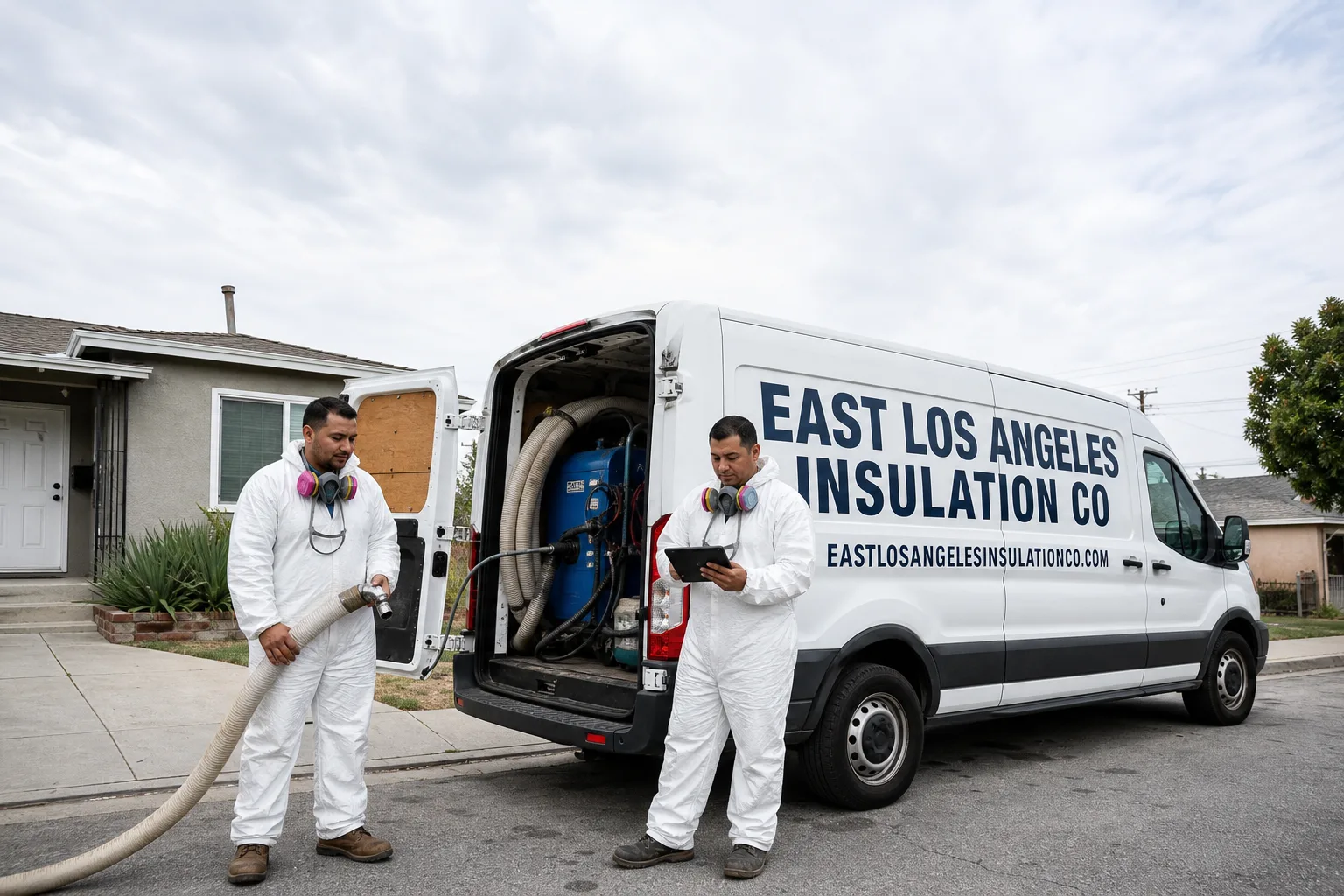
Fast, Reliable Attic Insulation Across Artesia
Attic insulation in Artesia usually costs between $1,400 and $3,800 for a full retrofit of a typical 1950s tract home, with blown-in projects on the lower end and air-sealing plus radiant barrier on the higher end. Most jobs are done in a single day, and we’re working in Artesia every week, so scheduling is usually a matter of days, not weeks. Call (866) 566-0304 and we’ll give you a straight answer on what your attic actually needs, based on what’s under your roof right now.
Artesia’s housing stock is different from what you’ll find ten minutes north. The single-story stucco ranchers built off Pioneer Boulevard in the 1950s and 60s share the same bones: low-pitch roofs, shallow attic cavities, and original insulation that’s been stepped on, compressed, and ignored for sixty years. We know those attics because we’ve been inside hundreds of them. The crawl-through access, the tight joist bays, the knob-and-tube-era framing – none of it surprises us anymore.
That local familiarity matters when the difference between a good retrofit and a wasted afternoon is knowing how to move through a 22-inch attic without putting a boot through the ceiling.
Why East Los Angeles Insulation Co Is Artesia’s Preferred Attic Insulation Company
We’re a dedicated insulation contractor, not a generalist. That’s not a slogan. It means attic insulation is what our crews do every single day, and when we’re in Artesia, we’re not there to bid a roof, sell an HVAC system, or upsell you into a remodel. We’re there to diagnose exactly why your upstairs bedrooms bake in August and what to do about it.
Artesia homeowners repeatedly tell us the same thing: other companies quoted them one product and one price, period. We carry eight brands – Owens Corning, Johns Manville, Knauf, Rockwool, CertainTeed, Icynene, Demilec, and GreenFiber – and we install all three methods in-house: blown-in, batts, and spray foam. The right insulation for your home, not just what we happen to stock. Ruben Acosta built the company around that principle, and it’s why our Artesia referrals come from neighbors who saw the difference in their July electric bill.
We maintain crews staged out of East Los Angeles, which puts Artesia within a dependable same-day or next-day service window for most calls. When a homeowner off Artesia Boulevard calls with a failed attic inspection report from escrow, we can usually get someone there within 48 hours.
Attic Ventilation in Artesia
Attic ventilation in Artesia is not optional once you understand how hot these low-pitch roof cavities get during the inland-coastal summer. When outside air crosses 90 degrees at noon, the attic above your stucco rancher can hit 140 or higher, and without proper airflow that heat radiates straight down through the ceiling. Most 1950s Artesia homes have the original passive venting – a couple of small gable vents or a run of static louvers – and that was inadequate even when the homes were built.
A proper ventilation job on a typical Artesia single-story runs $600 to $1,500 depending on how much soffit repair and baffle installation the roof structure will allow. We check the soffit intake first. If the soffits are sealed over with stucco or painted shut, balancing intake and exhaust is the first fix, before adding insulation.
Baffle Installation and Soffit Repair
In Artesia’s older truss-framed attics, the soffit bays are often blocked by years of blown-in debris or were never properly vented to begin with. We install baffles before blowing insulation to keep the intake path open, which prevents the exact problem that ruins ventilation jobs: insulation stacked over the soffit vents, choking airflow at the source.
Exhaust Balancing for Low-Pitch Roofs
Low-pitch roofs hold heat closer to the living space than a steeper roof. On these Artesia homes, even correctly installed ridge vents underperform if the intake area is undersized. We calculate the net free vent area for the attic footprint and match exhaust to intake rather than guessing.
Radiant Barrier in Artesia
Radiant barrier in Artesia addresses the main heat problem these homes actually have: radiant gain from the sun beating down on a shallow roof deck all summer, not conductive heat loss in winter. A radiant barrier stapled to the underside of the rafters reflects much of that radiant heat before it ever reaches the attic air. On Artesia’s 1950s ranchers with single-pane windows and minimal wall insulation, that reflective layer makes a noticeable difference in how hard the rooms below fight to stay cool.
Installing radiant barrier in a typical 90701 or 90702 attic costs $900 to $2,100 depending on roof complexity and whether we’re installing it during a re-insulation job or as a standalone project. We recommend it most often for Artesia homes where the air conditioner runs through the afternoon even when the thermostat is set at 78.
Staple-Up Foil Installation
For Artesia’s shallow attics with exposed rafters, the standard method is staple-up foil across the underside of the roof deck. It’s labor-intensive on hands and knees, but it stays put and does not interfere with future attic work. We leave clear space at the ridge so ventilation still functions.
Combined Radiant Barrier and Insulation
When we’re already in an Artesia attic replacing crushed batts, adding radiant barrier costs less than doing it as a separate trip. The combination handles both radiant and conductive heat, which is what these inland-coastal homes need most. You get a cooler attic, less strain on the AC, and a more even temperature from the front bedroom to the back.
Trusted Brands We Service in Artesia
We install CertainTeed fiberglass batts and loose fill, Icynene and Demilec spray foam, and GreenFiber recycled-content blown-in insulation, and we stock enough inventory to service Artesia jobs without ordering delays. When a homeowner in 90702 wants mineral wool for its non-combustible rating or moisture resistance, we bring Rockwool. When an escrow timeline forces a fast turnaround in Artesia, we can typically source and install without the two-week wait a single-brand contractor would need. Attic Insulation is our core service, and carrying these brands means Artesia customers get a real choice instead of whatever product happens to be on the truck.
Common Attic Insulation Problems We See in Artesia Homes
- Compressed original R-11 batts. On the older blocks off Pioneer Boulevard, decades of HVAC and cable installers walking the joists have crushed the original batts down to two or three inches. Those compressed batts lose most of their rated R-value, and the fix is removing what’s left, air-sealing, then blowing in new fill to a consistent depth.
- Shallow, low-pitch attic cavities. Artesia’s 1950s and 60s ranchers were built with roof pitches that leave barely enough room to move. When crews have to work on hands and knees, careless blow-in jobs end up uneven, with gaps at the eaves and over-blown ridges. We measure depth continuously as we go.
- Marine-layer humidity wicking into old insulation. Night and morning marine fog rolls up through the LA Basin and into Artesia, and that moisture finds its way into compressed batts and wall cavities. Once insulation is damp, its thermal performance drops. We check for moisture staining before adding any new material over the top.
- Knob-and-tube wiring left under old insulation. Some original Artesia homes still have active knob-and-tube circuits in the attic. Burying those in insulation creates a fire risk. We flag it, coordinate with a licensed electrician where needed, and never blow over an unsafe wiring condition.
Pricing for Attic Insulation in Artesia, CA
A blown-in attic insulation job for a standard 1,000 to 1,400 square foot Artesia rancher typically runs $1,400 to $2,600. If we’re removing compressed old batts first and air-sealing the top plates and penetrations, expect $2,200 to $3,800 for the full job. Attic batts alone come in around $1,800 to $3,000 depending on R-value and access. Radiant barrier adds $900 to $2,100 as a standalone, less when combined with a blow-in job. Attic baffles and ventilation prep add $300 to $700 on most Artesia homes.
Your exact number depends on the size of the attic footprint, how much old material has to come out, and whether we’re adding ventilation or radiant barrier at the same time. Call (866) 566-0304 for a free estimate – we’ll come out, get in the attic, and give you a number that covers the whole scope, no surprises.
We Also Serve Cities Near Artesia
Our crews cover the surrounding communities on both sides of the 605 from our East Los Angeles base. If you’re in Cerritos, La Palma, Hawaiian Gardens, or Norwalk, we’re a short drive away and schedule the same week for most calls. Read more about our Attic Insulation in Artesia coverage, or call (866) 566-0304 to check our current schedule in your neighborhood.
Serving Artesia, CA - Our Local Coverage Area
We serve Artesia and nearby communities. Use the map below to see the area we cover. If you’re nearby, we can almost certainly help.
FAQs About Attic Insulation in Artesia
Because the original R-11 batts in those 1950s and 60s attics have almost always been compressed to a fraction of their original thickness by decades of workers walking the joists. Instead of simply blowing new fill over the top, which traps the crushed material against the drywall and still leaves thermal gaps at the joist edges, we remove the old batts where needed, air-seal, and then blow in new material to a consistent depth. If you live off Pioneer Boulevard, odds are your attic falls into this category.
Yes. A low-pitch roof leaves less vertical space, so blowing insulation evenly means the crew is working on hands and knees, checking depth frequently, and using baffles to keep the soffit vents clear. It’s slower work than a steep-roof attic, and it rewards the installer who’s done it hundreds of times. We measure as we go so the final depth is even at the eaves, the center, and the ridge. Call (866) 566-0304 to schedule an attic inspection and we’ll tell you what your roof pitch means for the job.
For most Artesia homes, yes, because the dominant problem is summer heat gain through the roof, not winter heat loss. A radiant barrier reflects solar heat before it enters the attic, which keeps the whole ceiling assembly cooler and reduces how hard the AC works in the afternoon. It’s most effective paired with good ventilation and the right level of insulation underneath. Call (866) 566-0304 and we’ll tell you if your roof orientation and attic configuration make radiant barrier a strong fit for your home.
The marine layer that rolls up into Artesia at night brings moisture that can settle into exposed insulation, especially older compressed batts. Once fiberglass or cotton-based insulation gets damp, its thermal performance drops and it can hold that moisture against framing. On a small-lot 1950s stucco rancher just off Pioneer Boulevard, we found the original R-11 batts flattened to about three inches where years of installers had walked the joists, and the shallow pitch had us working on hands and knees the whole run. We air-sealed the top plates and penetrations first, then blew in Owens Corning loose fill to bring the flat, compacted field back up to a consistent depth. The homeowner noticed the back bedrooms stop baking by mid-afternoon, with the marine-layer humidity no longer wicking into the old compressed batts.
Yes, but we won’t blow insulation over live knob-and-tube wiring. In Artesia’s original homes, some attic circuits have never been updated, and burying them creates heat buildup at the wire. We’ll do the air-sealing and batts where the wiring is clear, flag anything that needs an electrician, and finish the blow-in once any unsafe circuits are addressed. The extra step adds a day or two to the project but keeps your home safe. Call (866) 566-0304 for a free estimate and we’ll walk your attic with you.
Written by Ruben Acosta, Owner at East Los Angeles Insulation Co, serving Artesia since the company’s founding.