
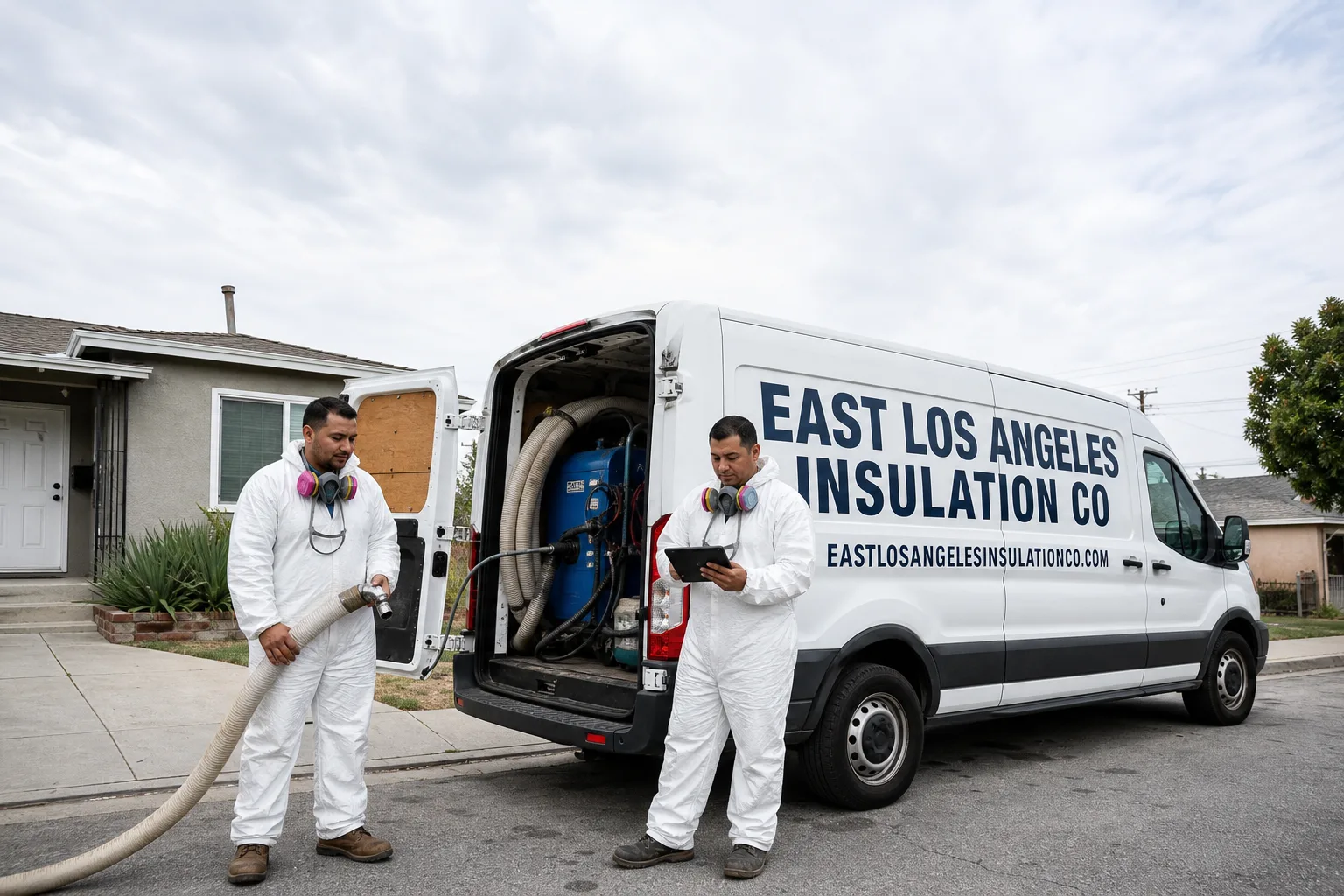
Fast, Reliable Attic Insulation Across Home Gardens
Attic insulation in Home Gardens isn’t a one-size-fits-all job. The unincorporated neighborhoods around 92879 deal with July attic temperatures that climb past 140°F under flat and low-slope roofs, which means the fiberglass batts most homes were built with sag, compress, and lose their R-value decades ahead of schedule. We’re East Los Angeles Insulation Co, and we’ve spent years retrofitting Home Gardens attics with dense-pack cellulose and radiant barriers because that’s what actually works here, not just what’s on the truck. If your upstairs rooms bake by 3 p.m. or your AC can’t keep pace after noon, call Ruben Acosta’s team at (866) 566-0304. We’ll diagnose what’s in your attic and tell you straight what needs to change.
Why East Los Angeles Insulation Co Is Home Gardens’s Preferred Attic Insulation Company
We’re a dedicated insulation contractor, which matters. Plenty of general contractors will “do insulation” as a line item between a bathroom remodel and a roof patch. That’s not us. Attic insulation is the entire job, every day, and that focus shows up in the details Home Gardens homeowners notice: we show up with the right equipment, we know what a melted vapor barrier looks like, and we don’t have to call someone else for the hard parts. Our Attic Insulation crew handles all three installation methods in-house, so when a retrofit calls for spray foam in the band joists and dense-pack cellulose in the attic floor, one team does both.
Home Gardens homeowners call us because we carry eight brands, not two. Owens Corning and Johns Manville for standard batt work, Demilec for closed-cell spray foam, GreenFiber for recycled-content blown-in. If a product performs better in a 140°F attic, we stock it. If a cheaper version fails, we don’t offer it. It’s that simple.
Ruben Acosta built this company on the idea that a Home Gardens homeowner deserves to know *why* we recommend one material over another. The answer is always tied to the house itself: roof pitch, attic depth, existing ventilation, and how the home handles inland heat. No scripts, no upselling.
Attic Ventilation in Home Gardens
Attic Ventilation in Home Gardens is the difference between an attic that’s hot and an attic that’s dangerously hot. Under the low-pitch and flat roofs common across the older ranch-style homes near Indiana Avenue and Magnolia Avenue, heat gets trapped, and without proper airflow, temperatures spike above 140°F. That heat radiates down through the ceiling all afternoon, warps framing over time, and forces your AC to fight a battle it can’t win. Ventilation work involves installing or upgrading ridge vents, soffit vents, and sometimes powered attic fans to pull that heat out before it soaks into your living space.
Signs Your Home Gardens Attic Needs Ventilation Work
If your ceiling feels warm to the touch in late afternoon, or your AC runs nonstop from noon to eight, your attic isn’t ventilating. Home Gardens homeowners sometimes notice shingles curling on the edges or paint peeling on the ceiling near exterior walls, both signs of trapped heat and moisture. We check ridge and soffit vents first, because many of the mid-century tract homes around here were built with inadequate venting from day one, and decades of dust and debris have choked what little existed.
Ventilation Before Insulation, Not After
If you’re adding insulation to a Home Gardens attic, ventilation has to come first or alongside. Insulation slows heat transfer, but it doesn’t remove heat already trapped under the roof deck. Adding R-38 without addressing ventilation just bakes the new material. We rebuild ventilation as part of the retrofit: clean or replace soffit vents, verify ridge vent coverage, and seal gaps that pull air from the wrong places.
Typical attic ventilation work in Home Gardens runs $350 to $950 depending on the number of vents and the roof configuration, and it’s folded into any insulation project we do.
Radiant Barrier in Home Gardens
Radiant Barrier in Home Gardens is one of the highest-return upgrades you can make to a home with a flat or low-slope roof. A radiant barrier is a reflective material installed on the underside of the roof deck or rafters, and its job is to reflect radiant heat back toward the roof rather than letting it radiate into the attic. In a Home Gardens July, when the underside of your roof deck hits 130 to 150°F, a radiant barrier can cut attic air temperature by 20 to 30 degrees. That’s not a marginal improvement; it’s the difference between a bedroom that keeps its cool and one that doesn’t.
Why Flat-Roof Home Gardens Homes Benefit Most
Flat and low-slope roofs have less airspace between the roof deck and the attic floor, so heat transfers faster and lingers longer. Radiant barriers work best in exactly those conditions, where convection alone can’t do the job. We install radiant barriers in attics alongside dense-pack cellulose and blown-in fiberglass, and the combination addresses both radiant heat and conductive heat in one pass.
What Radiant Barrier Installation Costs Here
A radiant barrier retrofit in Home Gardens typically runs $0.90 to $1.75 per square foot of attic floor area, so a 1,200-square-foot attic falls between $1,080 and $2,100. The material itself is affordable; the labor depends on the attic’s accessibility and whether old insulation needs to be removed first. Most Home Gardens retrofits land somewhere in the middle because of the older, tighter attic spaces we work in.
Trusted Brands We Service in Home Gardens
We carry Owens Corning and Johns Manville for standard batt and blown-in applications, Demilec for closed-cell spray foam where air sealing matters most, and GreenFiber for recycled-content dense-pack cellulose, which we lean on heavily in Home Gardens because it performs so well under flat roofs. We stock local materials for Home Gardens customers, which means most retrofit jobs start within days, not weeks. If your attic needs a specific product match, like matching an existing Owens Corning batt layout or switching to GreenFiber for a full removal, we can pull it from our inventory and get it done. We carry brands because they perform; we’ll tell you which one fits your roof pitch and your heat load.
Common Attic Insulation Problems We See in Home Gardens Homes
– Melted and rotted vapor barriers under flat roofs. Attic temperatures above 140°F cause the thin plastic vapor barriers used in mid-century construction to melt, stick to joists, and stop doing their job. The result is moisture in the attic and insulation that’s no longer performing. This is the single most common problem we find in the ranch-style homes around Home Gardens.
– Sagging, compressed fiberglass batts with R-values nowhere near code. After 20 or 30 years of inland heat, the original R-19 batts in many Home Gardens attics have settled to an effective R-6 or R-8. Homeowners see high bills and hot rooms and assume the AC is failing. The attic is the problem.
– Smoke and ember intrusion during Santa Ana wind season. Unsealed penetrations around recessed lights, top plates, and vent stacks let smoke and embers work into the attic during the Santa Ana winds that push through the river basin each fall. Air sealing and dense-pack cellulose both reduce this risk substantially.
– Bonus rooms and converted attics that were never insulated properly. Home Gardens has plenty of homes where the attic was converted to living space decades ago without addressing the floor or ceiling insulation. Those rooms bake in summer and freeze in winter, and the fix requires opening walls or ceilings to do it right.
Pricing for Attic Insulation in Home Gardens, CA
We Also Serve Cities Near Home Gardens
Our Home Gardens team runs jobs throughout the surrounding Inland Empire corridor. We cover Corona, Eastvale, Norco, and El Cerrito Corona with the same crew and the same eight brands. If you’re in one of those cities and your attic’s been cooking under a flat roof all summer, call (866) 566-0304 and we’ll schedule a walkthrough.
Serving Home Gardens, CA - Our Local Coverage Area
We serve Home Gardens and nearby communities. Use the map below to see the area we cover. If you’re nearby, we can almost certainly help.
FAQs About Attic Insulation in Home Gardens
Why do attic insulation jobs in Home Gardens often require removing old insulation rather than just adding more?
Because the old material is usually compromised beyond saving. Under Home Gardens’ flat and low-slope roofs, attic temperatures exceed 140°F in July, which melts vapor barriers and causes fiberglass batts to compress and lose their R-value. Adding new insulation on top of failed material just buries the problem. We remove the degraded layer, air-seal the attic floor, and install fresh material. Call (866) 566-0304 and Ruben Acosta’s team will inspect your attic and tell you whether removal is necessary or if a top-up will do.
How does the Santa Ana wind season affect attic insulation needs in Home Gardens?
Santa Ana events push wind-driven smoke and embers through the unsealed gaps in attics across Home Gardens. Recessed light housings, top plates, and vent stacks all leak air, and during wind season that leakage pulls outdoor air straight into the house. We air-seal those penetrations and install dense-pack cellulose, which resists airflow and reduces ember intrusion better than standard fiberglass batts. If your home borders open land or the river basin, this matters more.
What R-value do you recommend for attics in Home Gardens given the 100°F+ summers?
We recommend R-38 as the minimum for attics in Home Gardens, with R-49 preferred under flat roofs where the roof deck sits close to the ceiling. The old R-19 and R-30 installations common in mid-century ranch homes around Indiana Avenue and Magnolia Avenue simply don’t hold up against weeks of 100°F weather. We spec R-38 or better on every retrofit we quote in the 92879 zip code.
Can a radiant barrier really make a difference in a Home Gardens home with a flat roof?
Yes, and in flat-roof homes the difference is often bigger than anywhere else. With less airspace between the roof deck and the attic floor, radiant heat transfers faster. A radiant barrier reflects that heat before it becomes attic air temperature, and homeowners routinely see a 20 to 30 degree drop inside the attic. We’ve measured a 12°F drop in peak afternoon room temperature after a Home Gardens retrofit that included a radiant barrier and dense-pack cellulose.
What brands of insulation do you use for Home Gardens retrofits?
We stock Owens Corning and Johns Manville for batt and blown-in applications, Demilec for closed-cell spray foam, and GreenFiber for dense-pack cellulose. GreenFiber is our default recommendation in Home Gardens because it air-seals as it fills, holds its R-value under heat, and uses recycled content. We carry all eight brands we install, so we’re picking from a full shelf, not pushing whatever’s left over.
Written by Ruben Acosta, Owner at East Los Angeles Insulation Co, serving Home Gardens and surrounding Inland Empire communities.