
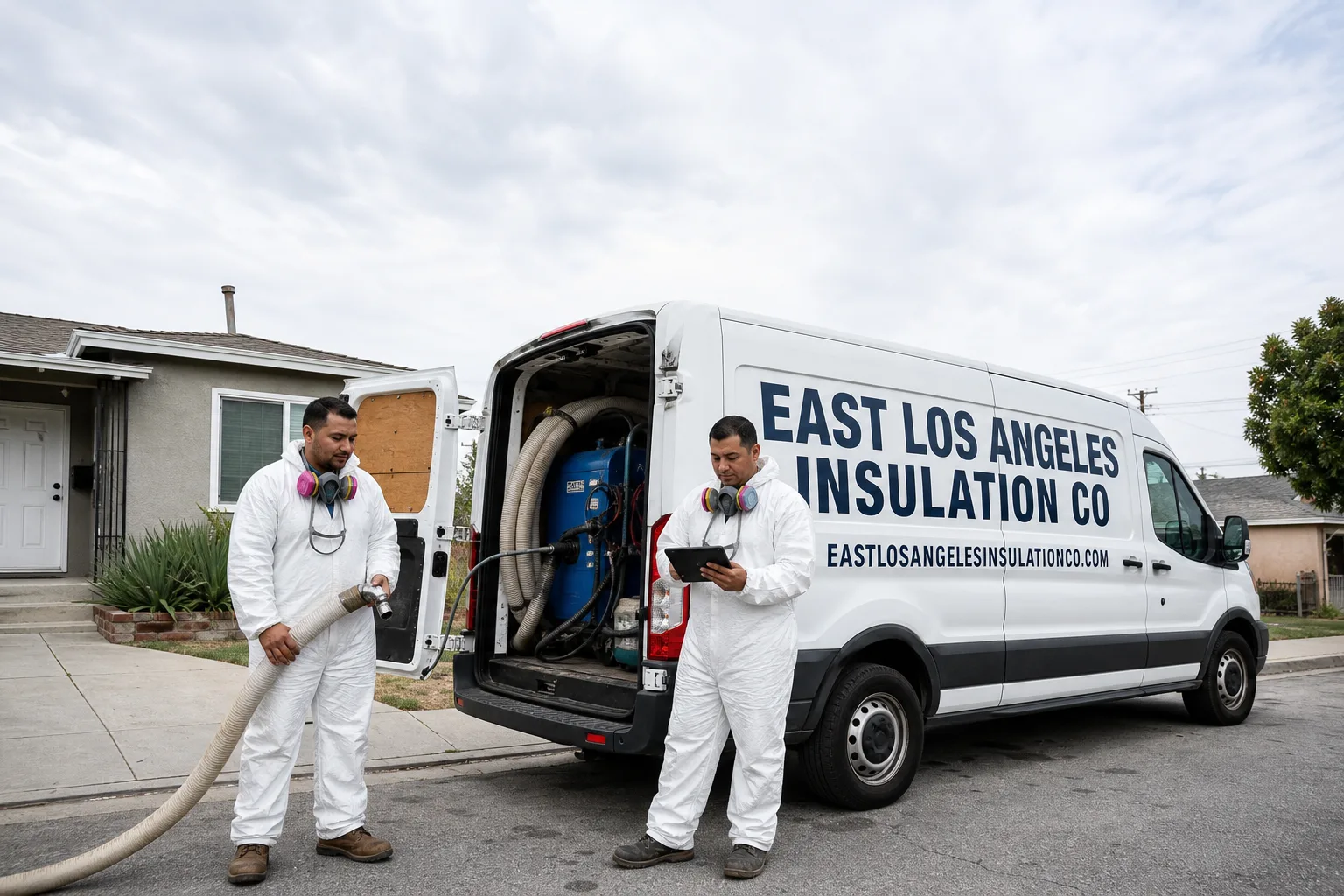
Fast, Reliable Attic Insulation Across March Air Force Base
Attic insulation in March Air Force Base isn’t a cosmetic upgrade. It’s the single highest-leverage fix for homes in the 92551 corridor, where July attic temperatures regularly push past 150°F and settled 1940s-era fiberglass quietly stops doing its job. Ruben Acosta and our team at East Los Angeles Insulation Co work this specific housing stock every week, and we know what it takes to bring a mid-century military-era home up to a level that actually holds up through triple-digit summers and Santa Ana wind events. If your energy bills spike every August while your bedrooms stay hot, call (866) 566-0304 for a free attic assessment. We’ll tell you exactly what’s up there and what it’s costing you.
Why East Los Angeles Insulation Co Is March Air Force Base’s Preferred Attic Insulation Company
We’ve worked enough attics in the 92551 area to know that military-era houses off Cactus Avenue behave differently from tract homes in Moreno Valley. The framing layouts are tighter, the original insulation is usually under-installed, and the roof deck has been baking for five or six decades. That’s why our crews approach each job as a diagnostic first, not a drop-and-go install. Ruben Acosta built the company around a simple position: carry the right products and match them to the house, not the other way around. For March Air Force Base homeowners, that means we can offer blown-in, batts, and radiant barrier options from brands like GreenFiber, Icynene, and Demilec, and we’ll explain why one fits your roof better than another.
Our attic work here isn’t a sideline. It’s a dedicated service. That focus shows up in how we handle the details that matter most in this corridor: air sealing top plates, baffling vents correctly, and wrapping fire-rated penetrations to meet wildfire-zone standards. We know the 92551 inspection expectations and the failure patterns specific to these homes. When neighbors ask us where we’ve been working, March Air Force Base addresses come up constantly. The best reviews we get are the ones where someone tells us their upstairs finally stays under 80°F in July.
Response time matters when you’re dealing with a blown-out attic situation or a home sale that won’t close without an insulation certificate. We schedule within days for most March Air Force Base jobs, not weeks. Call (866) 566-0304 and we’ll lock in a time that works around base traffic and your schedule.
Attic Ventilation in March Air Force Base
Attic Ventilation in March Air Force Base is the difference between an insulation job that performs and one that cooks itself into irrelevance. Our team treats ventilation as a required step, not an upsell. In the 92551 area, the combination of intense solar load and dry Santa Ana winds means stale, superheated air builds up fast if your baffles are clogged or your soffit vents are blocked. When we open an attic here, we check the actual airflow path from soffit to ridge. Many of the 1940s-1970s homes were built with minimal venting, and decades of dust and debris have made it worse.
Air Sealing Before Insulation
Air leaks through top plates and utility penetrations let superheated attic air push down into the living space. In March Air Force Base’s summer, that’s not a minor nuisance; it’s the main reason upstairs rooms feel like ovens. We air seal before we insulate or ventilate further. It’s the only order that makes sense.
Baffle Repair and Soffit Flow
Crushed or missing baffles block the air channel from soffit vents to the attic. We replace them and verify the intake path is clear. In homes near the former base, dust and grit from dry winds reduce airflow through these channels over time. Rebuilding that path is often the cheapest performance gain you can make in a March Air Force Base attic.
A typical attic ventilation and baffle correction job in March Air Force Base runs $450 to $1,200 depending on how much of the existing system is salvageable. Full ventilation overhauls with new baffles and air sealing usually land between $1,500 and $3,000 on these older tract homes.
Radiant Barrier in March Air Force Base
Radiant Barrier in March Air Force Base homes does the heavy lifting during the months when the roof deck turns into a broiler. This corridor regularly sees attic temperatures above 150°F in July, and radiant heat is the driver. A properly installed radiant barrier reflects that heat before it ever reaches your insulation. That’s why we recommend it as a companion to blown-in insulation here, not as a replacement. On a 1950s single-story military-family home off Cactus Avenue in the 92551 area, our crew found original fiberglass batts settled to about half their nominal thickness while radiant heat pushed attic temps past 150°F. We air-sealed the top plates, blew in GreenFiber to a high R-value, and added a radiant barrier, then wrapped the fire-rated penetrations so the upgrade met the area’s ember-resistant detailing. That’s the full sequence these houses need.
How Radiant Barrier Works in Extreme Heat
Radiant barrier reduces the heat gain from the roof deck by reflecting thermal radiation. In a 100°F outside day, the roof surface can reach 160°F or higher in direct sun. Without a barrier, that heat radiates down into the insulation and eventually into your ceilings. With one, the insulation stays dramatically cooler and does its job.
When Radiant Barrier Makes Sense Here
If your home was built before the 1980s in the 92551 area and you’re already adding insulation, adding a radiant barrier adds roughly $0.50 to $1.00 per square foot. In this climate, that’s the clearest payback in the attic category. For March Air Force Base customers on a fixed budget, we often recommend doing the barrier with blown-in insulation in the same visit rather than doing insulation alone and paying for a second trip later.
Radiant barrier installation in March Air Force Base typically runs $1,500 to $3,500 for a standard single-story home, depending on roof deck condition and access.
Trusted Brands We Service in March Air Force Base
We stock and install GreenFiber, Icynene, and Demilec here because they perform in exactly the conditions March Air Force Base throws at them. GreenFiber’s recycled-content blown-in insulation settles predictably and fills the odd framing cavities in these military-era homes. Icynene and Demilec spray foam give us the air-sealing power these houses desperately need when we’re doing an attic replacement or new construction infill near the former base. Because we carry multiple brands, we’re not trying to make your house fit a product we happen to have on the truck. We keep local stock in the region so turnarounds for March Air Force Base customers stay fast.
Common Attic Insulation Problems We See in March Air Force Base Homes
- Settled and compacted 1940s-1970s fiberglass batts. The original insulation in these military-era homes has compressed to roughly half its initial R-value. That loss shows up exactly when triple-digit July solar load peaks, and it’s the first thing we look for in 92551 attics.
- Poor baffle installation and blocked ventilation. Dry Santa Ana winds and desert-edge dust push debris into the soffit channels. Once those clog, the attic stops breathing and the underside of the roof deck cooks, degrading shingles from below.
- Wildfire-zone ember intrusion through vents and unsealed penetrations. Even a well-insulated attic here can fail during fire season if embers get in through unprotected gable vents or gaps around electrical and plumbing penetrations. Coastal LA installers rarely deal with this; we plan for it on every March Air Force Base job.
- Undersized insulation in ceiling cavities and pull-down stair gaps. Many of these tract homes were built with minimal R-value and no air sealing at the attic access. We check those gaps every time because they quietly leak conditioned air year-round.
Pricing for Attic Insulation in March Air Force Base, CA
This is a market where honest numbers matter. A blown-in attic insulation top-up on a standard 1,000 to 1,400 square foot single-story home in the 92551 area runs $1,800 to $3,200. Attic insulation replacement with air sealing and baffle correction runs $3,500 to $6,500 depending on depth of removal and whether radiant barrier is included. Radiant barrier alone lands between $1,500 and $3,500. Batts installed in new ceiling cavities run $1.50 to $2.50 per square foot. Every estimate includes an attic inspection, a written scope, and a free breakdown of what each layer costs. Call (866) 566-0304 and we’ll give you a real number for your house, not a range.
We Also Serve Cities Near March Air Force Base
Our Attic Insulation team covers the full Inland Empire corridor around the base, including March Air Force Base, Moreno Valley, Woodcrest, Perris, and Good Hope. If you’re a few minutes down Cactus Avenue or across the freeway in one of the neighboring communities, we’ll bring the same local approach we use in the 92551 area.
Serving March Air Force Base, CA - Our Local Coverage Area
We serve March Air Force Base and nearby communities. Use the map below to see the area we cover. If you’re nearby, we can almost certainly help.
FAQs About Attic Insulation in March Air Force Base
Because the 92551 corridor sits in an inland desert-edge climate with triple-digit summer days, intense solar exposure, and dry Santa Ana conditions, which drive attic temperatures far higher than coastal neighborhoods. That heat load is exactly what attic insulation is built to resist. Add in the 1940s-1970s housing stock with original, settled batts, and the performance gap here is larger than almost anywhere else in the region. Call (866) 566-0304 to see what’s actually in your attic.
Yes, blown-in insulation can be installed directly over settled existing batts, which is the most common approach for these homes. We first inspect for moisture, rodent damage, and vent blockages. If the existing batts are dry and uncontaminated, we air seal and then blow in GreenFiber to the target R-value. On a Cactus Avenue home we worked on, the original batts had settled to half their thickness and were fine to leave in place under the new blown-in layer.
Yes, it adds a layer of ember and fire-resistant detailing that most insulation installers skip. That means sealing penetrations, adding ember-resistant vent covers where required, and sometimes using a mineral wool product like Rockwool at the eaves or penetrations because it doesn’t burn. This is standard practice for us on every March Air Force Base job, not an add-on.
A radiant barrier reflects the intense solar radiation beating down on your roof deck before it can reach your insulation and heat your ceilings. In the 150°F-plus attic conditions common in July here, it can cut attic temperatures significantly and reduce the workload on your insulation. We recommend pairing it with blown-in insulation for the best result.
The most common issues are collapsed or missing baffles, clogged soffit vents from Santa Ana dust, and attic access doors that leak like sieves. These houses were built when ventilation was an afterthought, and five or six decades of wind-blown grit has made it worse. We check the full airflow path on every visit. Call (866) 566-0304 and we’ll take a look.
If your attic has never been inspected or you’re tired of an upstairs that won’t cool down, call East Los Angeles Insulation Co at (866) 566-0304. Ruben Acosta and our team serve March Air Force Base daily with free attic assessments, straight answers, and insulation built for this specific climate.
Written by Ruben Acosta, Owner at East Los Angeles Insulation Co, serving March Air Force Base and the 92551 corridor.