
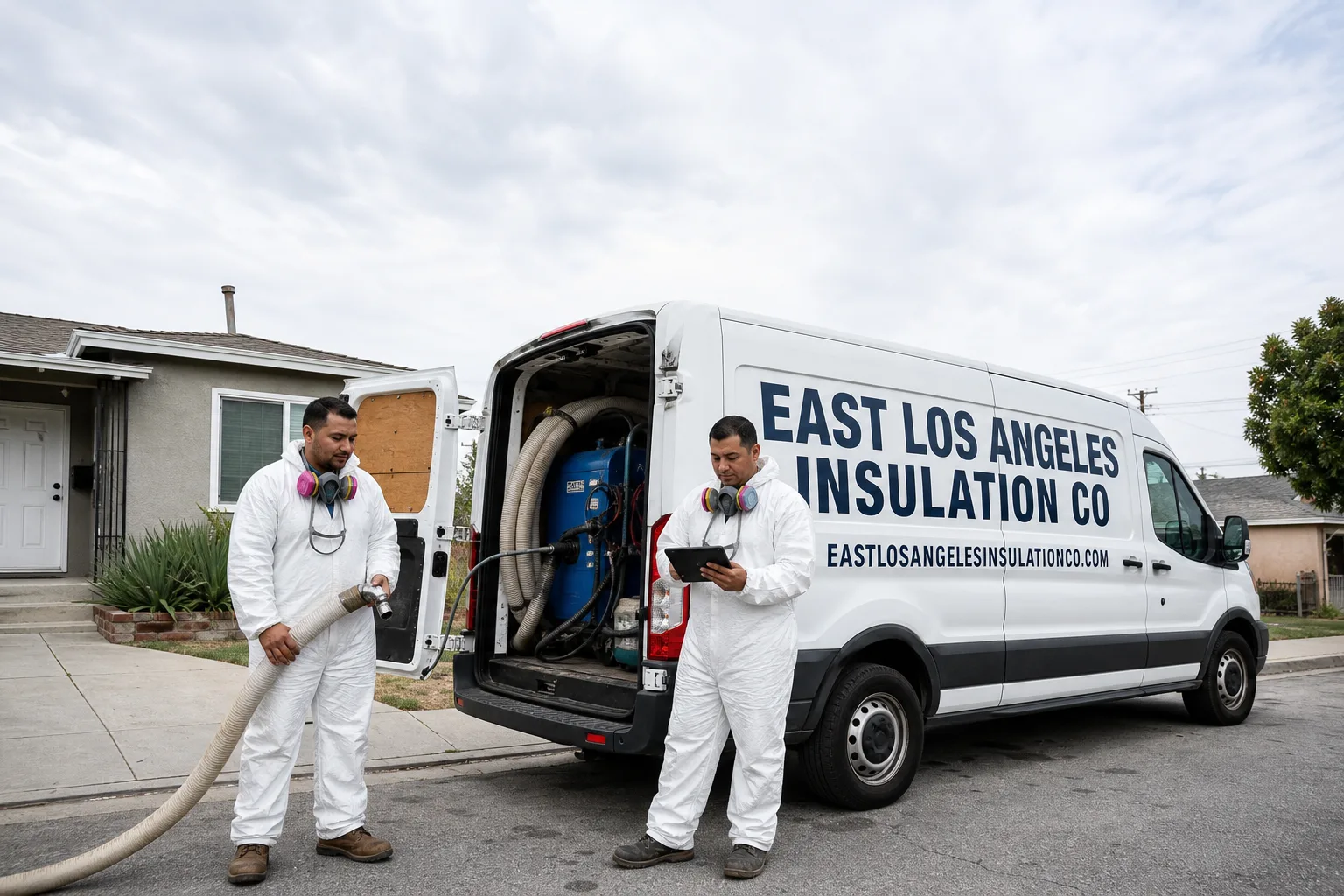
Fast, Reliable Attic Insulation Across Running Springs
Attic insulation in Running Springs costs most homeowners between $1,800 and $4,200 for a typical full-attic job on a mountain cabin, with smaller top-up or bay-fill work running $900 – $1,700. Most Running Springs attics we inspect have either failed original insulation or gaps that are costing real money every winter night. Call us at (866) 566-0304 and we’ll give you a straight answer on what your place actually needs.
We know Running Springs. The cabins off Live Oak Drive, the older builds along Rim of the World Drive, the second homes near Snow Valley that sit cold all week and get used on weekends. At 6,000 feet, a poorly insulated attic isn’t a small inefficiency. It’s ice dams forming at the eaves, condensation dripping from the cold-side roof deck, and heating bills that climb every time the temperature drops below freezing. Our Attic Insulation crew works on these homes constantly, and we understand how the housing stock here differs from what you’d find down the hill in Redlands or San Bernardino. Old cabins. Vaulted ceilings. Gaps where no one thought to insulate in 1972. That’s the work we do.
Why East Los Angeles Insulation Co Is Running Springs’s Preferred Attic Insulation Company
Ruben Acosta leads our insulation team, and he’s built a company around one principle: stock the products that actually perform, then match them to the house in front of you. Most insulation contractors carry one or two brands. We install Owens Corning, Johns Manville, Knauf, Rockwool, CertainTeed, Icynene, Demilec, and GreenFiber. That matters in Running Springs because a 1970s open-beam cabin needs a different solution than a 1990s ranch with a flat attic deck. We don’t pretend one product solves everything.
We’re a dedicated insulation contractor, not a generalist handyman service splitting attention across plumbing and roofing. Attic insulation is the specialty. When we show up in Running Springs, we’re there to diagnose the attic, not upsell you on unrelated work. Homeowners tell us they appreciate that focus. The questions we get are specific, and they should be. What happened to the old batts? Can you work around the knob-and-tube? Will the snow load matter? We answer all of it with the same precision we’d want in our own homes.
Response time matters when you’ve got frost in the attic. We schedule Running Springs work the same week most calls come in, and we’ll tell you honestly if weather is going to delay us. Snow and ice on Rim of the World Drive can push a job a day or two, and we don’t pretend otherwise. You’ll know when we’re coming, what we’re doing, and what it costs before we start.
Attic Insulation Removal in Running Springs
Attic Insulation Removal in Running Springs is a job we handle regularly because so much of the housing stock dates back to the 1960s and 1970s, and the original insulation has usually failed. Mineral wool batts sag off the ceiling plane and lose contact with the surface they’re supposed to insulate. Blown fiber settles and drifts, leaving bare patches at the ridge and the knee-wall bays. Vermiculite is a separate conversation entirely, and we’ll flag it immediately if we find it. Old insulation in these cabins isn’t just underperforming. It’s often holding moisture, mouse debris, and decades of roof grit.
A full removal in Running Springs typically runs $1,200 – $2,600 depending on attic size and access. Vaulted open-beam attics are harder to work in than flat decks, which pushes labor up. We use HEPA-filtered equipment and contain the work area before we start pulling material. You don’t want old fiberglass dust circulating through a mountain cabin that’s closed up tight for winter.
Rafter Bay Cleanout
When we remove insulation from a vaulted open-beam ceiling, we’re working between exposed rafters, not across a flat floor. Each bay gets cleaned individually. That’s slower work, but it’s the only way to get the surface ready for dense-packing or for your electrician to address any wiring we flag before new insulation goes in.
Pre-Retrofit Prep
Removal matters most when you’re about to upgrade the whole attic. Old material has to come out before we can baffle the rafter bays and seal the air leaks that are actually driving your heat loss. In Running Springs cabins, we almost always find the rim joists and recessed lights leaking air. Those problems stay hidden until the old insulation is out of the way.
Insulation Contractors in Running Springs
Insulation Contractors in Running Springs are not all the same, and the difference shows up when you look at the hardware on the truck. We stock three installation methods in-house: attic blow-in, spray foam, and batts. That means the recommendation you get is based on what your cabin actually needs, not what we happen to have in the warehouse. A home near the Snow Valley approach with a traditional flat attic deck might be perfect for blown-in GreenFiber. A 1970s vaulted cabin needs dense-packed batts in the rafter bays. A knee-wall space with air leaks benefits from closed-cell spray foam. We install all of it.
Running Springs homeowners searching for insulation contractors often don’t realize that so many crews are just generalist handymen subcontracting the work. That’s how you get a crew that’s never done a freeze-thaw attic blowing fiber into open-beam bays and calling it done. We’re insulation specialists. It’s the only trade we work in. It means our diagnostics are sharper and our recommendations are based on actual building science, not on whatever the local big-box store had on sale this month.
Dense-Packing Rafter Bays
For Running Springs cabins with vaulted open-beam construction, dense-packing is often the right call. We baffle each bay to hold a vent channel at the roof deck, then pack insulation in tight so it stays in contact with the ceiling plane. Blown fiber alone just drifts and settles unevenly at the ridge. That’s what leaves half the attic effectively uninsulated.
Rim Joist Sealing
Most Running Springs cabins leak more air through the rim joists and cantilevered floors than through the attic hatch. We find gaps you can see daylight through. Air sealing those joints before insulating makes a bigger difference than adding another 6 inches of fiber to the deck. This is the kind of detail generalist contractors skip because it’s slow and unglamorous.
Trusted Brands We Service in Running Springs
We carry GreenFiber for homeowners who want recycled-content, low-VOC blown-in insulation. Icynene and Demilec are our spray foam brands, both with established field performance records and manufacturer product warranties. Owens Corning Fiberglas is the workhorse we use for dense-packing rafter bays and standard flat-attic blow-ins. We don’t stock these brands because they’re easy to get. We stock them because we’ve seen how they perform in mountain cabins with freeze-thaw cycles and vaulted ceilings. If you have an existing brand in your attic and want to match it, we can usually do that too. Call us at (866) 566-0304 and tell us what you’ve got.
Common Attic Insulation Problems We See in Running Springs Homes
- Drifting blown fiber in vaulted ceilings: Open-beam cabins don’t have a continuous flat deck to blow onto. The fiber settles unevenly, leaving the ridge and knee-wall bays bare while the flat center reads as insulated. We fix this with rafter baffles and dense-packing.
- Sagging mineral wool batts: Homes built in the 1960s through early 1980s often have original mineral wool that’s lost its loft and pulled away from the ceiling plane. Convective loops form behind the gaps, frosting the roof deck and dripping condensation during freeze-thaw cycles.
- Knob-and-tube wiring buried under insulation: Old Open-beam cabins frequently still have live K&T in the joist bays. Blowing insulation over it without clearance boxes overheats the wire and buries the biggest air leak at the rim joist. We flag it, clear it, and work with your electrician before we touch the blower.
- Recessed lights without air barriers: Every can light in a Running Springs ceiling is a hole through the thermal boundary. Insulating around them without sealing the fixture makes the problem worse, not better. We build clearance boxes and seal the housing before insulating.
Pricing for Attic Insulation in Running Springs, CA
A standard flat-attic blow-in job in Running Springs runs $1,800 – $3,400 for a typical cabin footprint. Dense-packing vaulted rafter bays costs more, usually $3,200 – $4,800 because the work is slower and more labor-intensive. Attic insulation removal runs $1,200 – $2,600 as a standalone job or less when bundled with a new install. Rim joist sealing and air sealing work adds $600 – $1,500 depending on how much access we have. These are honest local ranges for the 92382 market, not national averages. Every Running Springs home is different. Yours might need just a top-up on the flat deck, or it might need full removal and dense-pack. Call (866) 566-0304 and we’ll give you a real number after looking at the attic. Free estimates, no obligation.
We Also Serve Cities Near Running Springs
Our crews route from East Los Angeles up the 330 and the 18 regularly, so we also handle Running Springs jobs and cover the neighboring mountain and foothill communities: Lake Arrowhead, Crestline, Highland, and Mentone. Same crew, same brands, same attention to detail.
Serving Running Springs, CA - Our Local Coverage Area
We serve Running Springs and nearby communities. Use the map below to see the area we cover. If you’re nearby, we can almost certainly help.
FAQs About Attic Insulation in Running Springs
We can, but loose-fill fiber alone drifts and settles unevenly between exposed rafters, leaving the ridge and knee-wall bays bare. The right method is baffling each rafter bay to hold a vent channel at the roof deck, then dense-packing the bays so insulation stays in contact with the ceiling plane. In most Running Springs cabins with vaulted ceilings, dense-packing outperforms a standard blow-in. Call (866) 566-0304 and we’ll tell you which approach fits your ceiling.
We don’t blow or pack insulation over live knob-and-tube wiring. The wire needs to be cleared, flagged for your electrician, and addressed before insulation touches the joist bays. We work with licensed electricians in Running Springs to get that handled, then we come back and insulate properly. Overheating old wiring under a blanket of fiber is a fire risk, and we won’t do it.
Yes. Mineral wool batts from that era have lost their loft and pulled away from the ceiling plane, which creates convective loops and frost on the roof deck. It’s not performing, and it’s often holding moisture from freeze-thaw condensation. Removal runs $1,200 – $2,600 in Running Springs and sets you up for a proper dense-pack or blow-in that actually works. Leaving failed insulation in place just wastes the money you’re spending on new material above it.
Cold attic framing hits warm air leaking from the living space below, and the moisture in that air condenses on the cold wood. In Running Springs cabins, the air leaks are usually at recessed lights, rim joists, and the gaps around the attic hatch. The fix is air sealing before insulation, not just adding more fiber on top. Once the air leaks are closed, the condensation stops because the warm air never reaches the cold framing.
Rim joists and cantilevered floors, recessed lights, attic hatches, and any plumbing or wiring penetrations through the ceiling. Open-beam vaulted construction makes the problem worse because there’s no continuous air barrier at the ceiling plane. Air sealing those leak paths usually makes a bigger difference to comfort and heating cost than adding insulation alone. Call us at (866) 566-0304 and we’ll walk your attic with you and show you where the air is going.
Written by Ruben Acosta, Owner at East Los Angeles Insulation Co, serving Running Springs and the San Bernardino Mountains with dedicated attic insulation expertise.
Call (866) 566-0304 for a free estimate on attic insulation in Running Springs. We’ll look at your attic, tell you what it needs, and give you a straight number. No pressure, no guesswork.