
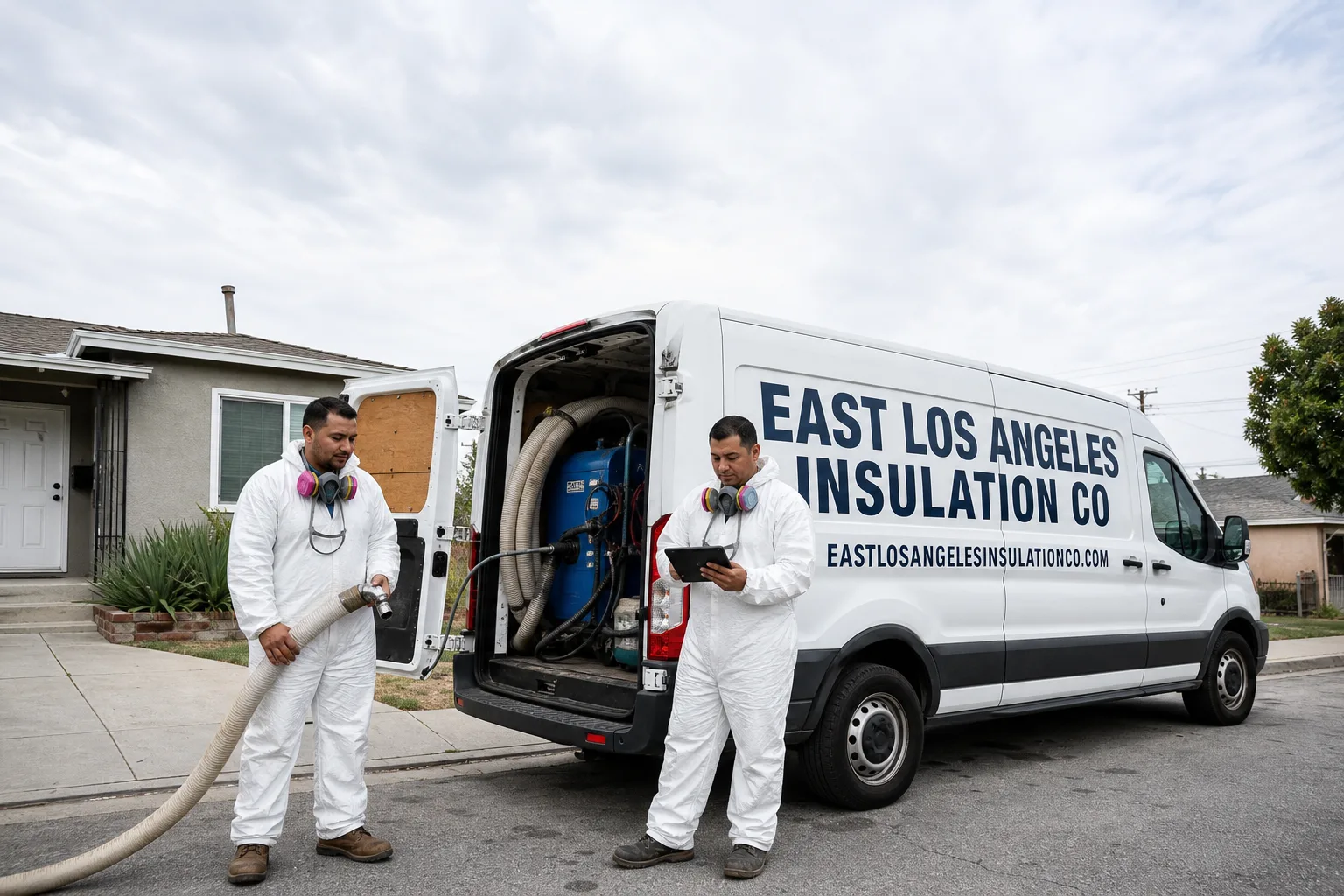
Fast, Reliable Attic Insulation Across San Antonio Heights
If your San Antonio Heights home runs hot upstairs in summer and cold in winter, the problem is almost never your HVAC. It’s what’s sitting above your ceiling. Attic insulation in this 91784 foothill enclave runs $1,800 to $6,500 depending on whether we’re topping up settled loose-fill or stripping out 1960s-era material and starting fresh. Most jobs take a single day. Call Ruben Acosta’s crew at (866) 566-0304 for an honest read on what your attic actually needs.
We work the hillside properties from Euclid Avenue up toward the San Gabriel Mountain boundary regularly. Not as a side job. This is what we do, and we do it with products most insulation crews don’t stock.
Why East Los Angeles Insulation Co Is San Antonio Heights’s Preferred Attic Insulation Company
The homes up here aren’t tract housing. They’re custom mid-century builds on large lots with vaulted ceilings, open beams, and rooflines that climb the alluvial fan. That changes the insulation conversation. You’re not getting a one-size-fits-all bid from us. You’re getting a diagnostic look at what your specific roofline, attic depth, and ventilation setup actually demand.
Ruben Acosta and our crew have worked enough San Antonio Heights attics to know exactly what we’ll find before we open the hatch: loose-fill from the original build settled to dust over the drywall lid, missing baffles at the eaves, and gable vents that double as ember entry points in fire season. We quote the real scope, not an upsell. Homeowners in the Heights keep our number because we flag what matters and don’t invent work.
When you call, you’ll get someone who knows the difference between a valley-facing slope and a ridge that catches every Santa Ana gust. That matters up here. Call (866) 566-0304 and ask for a free attic assessment. We’re on the road to 91784 most weeks.
Insulation Contractors in San Antonio Heights
Insulation contractors who don’t work San Antonio Heights regularly miss what makes this pocket different. The neighborhood sits on the alluvial fan at the base of the San Gabriel Mountains, so a single property can have a low, valley-facing roofline and an upper ridgeline that takes full wind and sun exposure. That means the insulation spec changes from one section of the roof to the next. A valley crew quoting from a flat-rate sheet will get it wrong. We won’t.
When a San Antonio Heights homeowner calls us in, it’s usually one of three triggers: energy bills climbing, rooms that never hold temperature, or a remodel that exposed what’s actually up there. A full attic insulation project here for a typical 1,800 to 2,600 square foot hillside home runs $2,400 to $6,500. A top-up on flat-framed sections runs $1,800 to $3,200.
Attic Top-Up and Settlement Correction
We find settled loose-fill in nearly every 1960s-era San Antonio Heights home. Original fiberglass or mineral wool drops from R-19 to R-4 or worse after five decades of compression, especially under vaulted sections where the material was never deep to begin with. We add blown-in depth where the framing allows and leave the tight vaulted bays alone rather than forcing product where it can’t perform.
Full Replacement for Aging Attics
Some older attics have contamination, rodent damage, or material so degraded that topping up is throwing good money after bad. In those cases we remove what’s there, air-seal the lid, and install fresh product matched to the roof assembly. Full replacement in San Antonio Heights typically runs $3,800 to $6,500 including removal and disposal.
Attic Ventilation in San Antonio Heights
Attic ventilation up here isn’t a checkbox. It’s a fire-safety conversation and a performance conversation at the same time. San Antonio Heights sits in a high-wildfire foothill zone, so every eave vent, gable vent, and ridge opening we touch has to be evaluated for ember entry. Run-of-the-mill ventilation prescriptions fall apart when the next Santa Ana event pushes embers against your fascia.
We see attics in 91784 where daytime heat loads push interior temps past 140 degrees in summer, then nighttime temps at elevation drop hard enough to cause condensation swings. Good ventilation paired with proper insulation depth is what evens that out. Ventilation prep, including baffle installation and vent correction, runs $600 to $1,800 depending on roof pitch and access.
Baffles and Eave Vent Preparation
Most older San Antonio Heights homes were built without baffles at the eaves. That means insulation has been blocking airflow at the soffit for decades, turning the attic into a stagnant heat box. We install baffles before adding insulation depth so the assembly actually breathes the way it’s supposed to.
Ember-Resistant Venting
If your gable or eave vents have open mesh or no screening at all, a top-up job should pause there. We flag open vents as ember paths before we touch the fire-rated assembly. The fix is ember-resistant vent covers, and we won’t insulate around a known fire vulnerability without telling you it’s there.
Trusted Brands We Service in San Antonio Heights
We stock and install Owens Corning, Icynene, GreenFiber, and Demilec, among others, so a San Antonio Heights homeowner never has to settle for whatever single brand happens to be on the installer’s truck. Icynene and Demilec spray foam make sense for open-beam cathedral sections where batt or loose-fill can’t hold depth. GreenFiber’s recycled-content blown-in works well on flat-framed hillside sections. Owens Corning batts are our go-to for standard attics with accessible joist bays. We keep product stocked for fast turnaround in 91784, and if a brand fits your roof assembly better than another, you’ll hear why from us directly.
Common Attic Insulation Problems We See in San Antonio Heights Homes
- Settled loose-fill from original 1960s builds: The material has compressed to an inch or less over decades, especially under vaulted and cathedral sections. Heat pours through those spots year-round, and the fix is adding depth where framing allows rather than packing tight bays.
- Day-night temperature swings opening new gaps: Elevation and alluvial-fan exposure mean hot days and cold, wind-driven nights. The expanding and contracting works gaps open at the drywall lid and rafter-to-plate joints faster than valley tract homes see.
- Open gable and eave vents as ember entry paths: In this high-wildfire foothill zone, a simple attic top-up can turn into a conversation about ember-resistant vent covers. We won’t insulate over a known fire vulnerability without flagging it first.
- Missing or collapsed baffles at the eaves: Without baffles, insulation blocks soffit airflow and the attic becomes a stagnant heat trap. Most original San Antonio Heights builds were never fitted with them, so ventilation has been compromised since day one.
Pricing for Attic Insulation in San Antonio Heights, CA
Here’s what San Antonio Heights homeowners should expect for attic insulation work in 91784. A top-up on a standard accessible attic runs $1,800 to $3,200 depending on square footage and target depth. Full removal and replacement runs $3,800 to $6,500. Baffle installation and ventilation prep adds $600 to $1,800. Vaulted or open-beam sections where spray foam is the right call add $4,000 to $9,000 depending on square footage and whether we’re using open-cell Icynene or closed-cell Demilec. Roof pitch, access, and the condition of existing venting all move the number. Call (866) 566-0304 and we’ll give you a free assessment with real numbers, not a vague range.
We Also Serve Cities Near San Antonio Heights
Our crews work San Antonio Heights properties every week, and we regularly run jobs in Upland, Claremont, Rancho Cucamonga, and Montclair. If you’re up in the foothills or down toward the valley floor, the same team handles the whole route. Our Attic Insulation specialists cover the broader area with the same multi-brand approach, so you’re never stuck with a single-product installer.
Serving San Antonio Heights, CA - Our Local Coverage Area
We serve San Antonio Heights and nearby communities. Use the map below to see the area we cover. If you’re nearby, we can almost certainly help.
FAQs About Attic Insulation in San Antonio Heights
Yes. We don’t pack vaulted bays with material that can’t hold depth. For open-beam cathedral sections, we typically use spray foam from Icynene or Demilec applied directly to the underside of the roof deck between beams. For flat-framed sections on the same house, blown-in or batt insulation gets the depth it needs without touching the vaulted structure. The two-roofline reality of hillside homes here means we spec each section separately, not the whole address at once. Call (866) 566-0304 and we’ll walk your specific roof assembly.
San Antonio Heights sits on the alluvial fan above the valley floor, so your attic deals with more intense sun exposure during the day and colder, wind-driven nights than a Upland or Montclair tract home. That spreads the daily temperature swing, which stresses the insulation and opens new gaps faster. Older 1960s loose-fill compresses under those conditions until it’s doing almost nothing. The fix is matched depth on flat sections and a realistic conversation about what the vaulted areas can actually hold.
Yes, and directly. Open eave and gable vents up here pull double duty as ember entry points during Santa Ana events. We won’t add insulation depth over a vent that’s inviting embers into your attic. Expect a conversation about ember-resistant vent covers and fire-rated assemblies before we touch the insulation. That’s standard practice in 91784, not an upsell.
It depends on the framing. For a standard 1960s attic with accessible joist bays, Owens Corning fiberglass batts or GreenFiber blown-in are the practical picks. For open-beam or cathedral sections, Icynene open-cell spray foam holds depth without adding structural load. Rockwool’s mineral wool makes sense when you want non-combustible material near a venting assembly, which matters in this fire zone. We’ll match the product to your roof assembly, not to what’s sitting in our warehouse. Estimates are free at (866) 566-0304.
Top up when the existing material is dry, clean, and just settled below target depth, especially on flat-framed sections. Retrofit when the old insulation is contaminated, rodent-damaged, or so far gone that a top-up won’t reach code or performance targets. In San Antonio Heights, we also push retrofit when ventilation needs a full rework, since the fire-zone considerations here make half-measures a bad idea. Call (866) 566-0304 and we’ll tell you which side of that line your attic falls on.
Written by Ruben Acosta, Owner at East Los Angeles Insulation Co, serving San Antonio Heights and the surrounding foothill communities.