
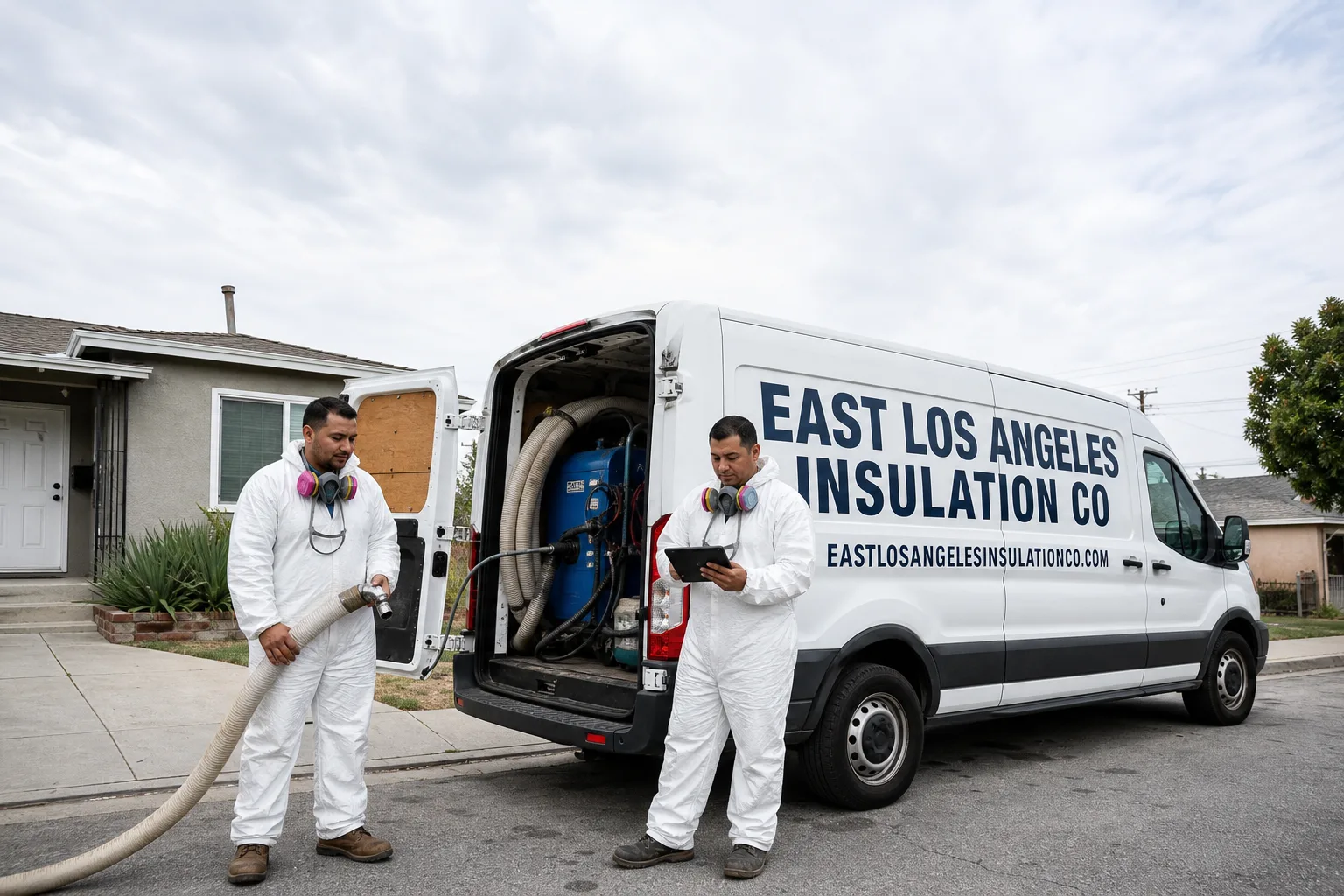
Fast, Reliable Spray Foam Insulation Across Century City
Spray foam insulation in Century City almost never looks like a typical residential job. If you manage a condo tower, office building, or mixed-use podium in the 90067 ZIP, the insulation scope is more likely in a mechanical penthouse, a below-grade parking level, or an interior demising wall than an attic. East Los Angeles Insulation Co handles that reality every week. We’re a dedicated insulation contractor carrying eight brands and all three installation methods, and our spray foam team works after-hours, freight-elevator-scheduled, and building-engineer-coordinated. Call (866) 566-0304 and Ruben Acosta will scope it directly.
Why East Los Angeles Insulation Co Is Century City’s Preferred Spray Foam Insulation Company
Century City property managers keep calling us back because we don’t waste their time pretending a high-rise mechanical room is a suburban attic. Our crew recently foamed the mechanical penthouse of a 1960s office tower near Century Plaza, applying closed-cell Icynene around chilled-water pipe risers and duct transitions to stop condensation drips that had been staining tenant ceilings below - similar to how Reflectix repair in Century City addresses thermal barrier issues in high-rise mechanical spaces. We worked a 3-night after-hours window, coordinating with the building engineer to lock out the freight elevator between midnight and 5 a.m., and the building manager reported zero new water stains in the following quarter. That’s what a Century City spray foam job actually looks like.
We carry eight brands, not one. Owens Corning, Johns Manville, Knauf, Rockwool, CertainTeed, Icynene, Demilec, and GreenFiber. We install spray foam, blown-in, and attic insulation in-house. No subcontracted crews, no “we’ll send a guy.” If your condo board is arguing about acoustic isolation between units, or your building engineer needs below-grade penetrations sealed against CO migration, we’re the contractor who can spec the right foam and actually get it installed on the building’s schedule.
Spray Foam Insulation Contractors in Century City
Spray foam insulation contractors working in Century City need a different playbook than anywhere else in Los Angeles. The district is essentially a single master-planned business-and-residential district built on 20th Century Fox’s old backlot: steel-and-concrete high-rises with curtain-wall facades, mechanical penthouses, and below-grade parking. So the work is acoustic insulation between condo units, fire-safety insulation in garage and shaft spaces, and duct or pipe insulation in mechanical rooms, not wall batts. A typical below-grade garage penetration sealing job in Century City runs $3,200 to $7,800 depending on footage and access. Mechanical room pipe and duct foaming runs $4,500 to $11,000. These are not prices you’ll see in Culver City or West Hollywood, because very few of those buildings exist there.
Below-Grade Garage Sealing and CO Mitigation
Closed-cell foam is spec’d in Century City parking structures specifically to seal penetrations where CO from vehicle exhaust migrates into occupied spaces. This is a fire-safety and air-quality scope, not an energy play. The foam must be closed-cell; open-cell will not stop gas migration at the same performance level, and any building engineer who has dealt with a CO alarm at 2 a.m. knows the difference.
Freight-Elevator Shaft Noise Dampening
High-rise condo towers in the 90067 ZIP have freight elevators that run through the core of the building. When the shaft wasn’t properly sealed or insulated during construction – and many of the older 1960s and 1970s towers weren’t – residents on multiple floors hear every run. Closed-cell foam applied to the shaft perimeter at each landing dramatically reduces the transmission. We’ve done this scope repeatedly for HOA boards that were told by other contractors to “just live with it.”
Spray Foam Attic Insulation in Century City
Spray foam attic insulation in Century City is a niche scope, not the main event. The district’s housing stock is dominated by high-rise condo towers and mixed-use podiums, not single-family homes with ventilated attics. But there are penthouses, mechanical lofts, and tenant-improvement build-outs where a roofline cavity or ceiling plenum does behave like an attic. In those spaces, closed-cell foam applied to the underside of the roof deck serves dual duty: it insulates the top-floor units from the sun load that hits those roof membranes, and it adds a layer of air sealing that reduces stack-effect drafts through elevator shafts and stair towers. A penthouse attic or roof-deck foam job in Century City typically runs $6,000 to $14,000, depending on access constraints.
Closed-Cell Roof Deck Application
When top-floor condo owners complain that their unit runs 8 to 10 degrees hotter than the units below, the culprit is almost always an uninsulated or under-insulated roof deck directly above. Closed-cell foam sprayed to the underside of that deck solves the problem in a single pass. It also adds structural rigidity to older deck assemblies, which matters in Century City where 60-year-old concrete roofs are the norm, not the exception.
Mechanical Loft and Plenum Sealing
Mixed-use buildings in Century City often have mechanical lofts or plenum spaces sandwiched between retail and residential floors. Unsealed penetrations in these spaces let air, noise, and sometimes odor bleed between uses. Foam applied to the full plenum boundary – walls, ceiling, and penetrations – creates a continuous air barrier that stops the bleed. This is not a job a general insulation crew from outside the district scopes correctly on the first walk-through.
Trusted Brands We Service in Century City
We install spray foam insulation using Icynene and Demilec products because both brands have field-proven records in commercial and high-rise applications. Icynene’s closed-cell formulation is our default for mechanical room pipe risers and below-grade garage sealing; Demilec’s product line covers higher-temperature plenum scopes where code requires a specific flame-spread rating. For acoustic isolation between condo units, we often pair closed-cell foam with Rockwool mineral wool in the same assembly. And for any Century City project where recycled-content or low-VOC material matters to a green building standard or HOA concern, GreenFiber is on our shelf. We keep common foam kits, sealants, and accessory stock locally, so a Century City follow-up visit doesn’t wait on a distributor shipment from the Inland Empire.
Common Spray Foam Insulation Problems We See in Century City Homes
- Fire-rated demising walls foamed without intumescent coating. Condo towers in Century City face fire-safety inspections that suburban single-family homes never see. Open-cell or closed-cell foam applied over a demising wall without the required intumescent coating will fail that inspection. We see this constantly from previous contractors who didn’t understand high-rise residential code. The fix is stripping and reapplying with the right system.
- Closed-cell foam trapping moisture on below-grade garage ceilings. The marine layer that rolls through Century City produces condensation on exposed concrete in parking levels. When closed-cell foam is sprayed directly onto that damp concrete, it traps the moisture and the concrete spalls. The right approach is to address the moisture source first, then apply a compatible foam system, and we spec that sequence, not just the foam.
- Attic or wall-cavity foam bids for what is actually a mechanical room duct problem. Century City’s real thermal and condensation problems live in chilled-water pipe risers, duct transitions, and plenum boundaries. We’ve walked into buildings where a previous bid proposed wall-cavity foam when the actual leak was condensation dripping off uninsulated pipes above a tenant ceiling. The foam never got near the problem.
- Freight-elevator shaft noise ignored entirely. Older towers in the 90067 ZIP have shafts with no acoustic treatment at landing penetrations. Residents complain, boards debate, and general insulation contractors don’t want the job because it requires after-hours scheduling. We do it as a matter of routine. It’s closed-cell foam, scoped per landing, coordinated with the building engineer and freight elevator lockout.
Pricing for Spray Foam Insulation in Century City, CA
Between $3,200 and $14,000 is the honest range for spray foam work in Century City, and the spread is driven by access, not by guesswork. Below-grade garage penetration sealing: $3,200 to $7,800. Mechanical room pipe and duct insulation: $4,500 to $11,000. Penthouse roof-deck or plenum foaming: $6,000 to $14,000. Fire-rated demising wall remediation: $5,000 to $12,000 depending on how much failed foam has to come off first. Factors that move the number: whether we need a manlift or scaffold, whether the building requires a freight-elevator operator, whether we’re working nights, and whether the existing foam has to be removed. We give written, line-item estimates before any work starts. Call (866) 566-0304 and Ruben Acosta will walk the project with you.
We Also Serve Cities Near Century City
Our crews cover Spray Foam Insulation in Century City and the surrounding west side. That includes Beverly Hills, Culver City, West Hollywood, and Santa Monica. Same after-hours capability, same brand selection, same dedicated insulation team. If your building sits just outside the 90067 ZIP, call us anyway.
Serving Century City, CA - Our Local Coverage Area
We serve Century City and nearby communities. Use the map below to see the area we cover. If you’re nearby, we can almost certainly help.
FAQs About Spray Foam Insulation in Century City
No. In an occupied Century City high-rise, spray foam work is scheduled after-hours, typically between 6 p.m. and 6 a.m., because the foam’s off-gassing window requires the space to be ventilated and unoccupied. This is a code and occupant-safety issue, not a preference. We coordinate with the building engineer, lock out the freight elevator, and work the overnight window. Most scoped projects run 1 to 3 nights. Call (866) 566-0304 to discuss your building’s specific schedule constraints.
Because Century City’s high-rise construction has very little cavity space for batts, and the actual insulating needs are air sealing, acoustic isolation, fire-rated penetrations, and condensation control. Closed-cell spray foam does all four in one application. Batts can’t seal a pipe riser penetration or stop a freight-elevator shaft noise complaint. If you’re a condo board or property manager, that’s the difference that matters.
Yes. Closed-cell spray foam, often paired with Rockwool mineral wool in the same wall or floor assembly, substantially reduces sound transmission between condo units. The foam seals the flanking paths – the small gaps and penetrations where sound leaks through – while the mineral wool adds mass and absorption in the cavity. For Century City high-rises where neighbor noise is the number one HOA complaint, this combination is the most reliable fix we install.
We stock and install Icynene and Demilec closed-cell and open-cell foam systems, both of which have established performance records in commercial and high-rise applications. Icynene is our default for mechanical room pipe risers and below-grade sealing. Demilec covers plenum and higher-temperature scopes. Both carry manufacturer product warranties that we pass through to the building owner. You’re not limited to whatever single brand a contractor happens to have in the truck.
Yes, in nearly every case. Century City falls under Los Angeles city building codes, and spray foam in a commercial or condo building typically requires a permit and a fire-safety inspection afterward, especially for demising walls, shaft penetrations, and below-grade garage applications. The intumescent coating requirement is the one previous contractors miss most often. We handle the permit path and inspection coordination as part of the job. Call (866) 566-0304 and we’ll tell you exactly what your building will need before we quote.
Need a Century City spray foam scope priced? Call (866) 566-0304 for a free estimate. Ruben Acosta will answer directly.