
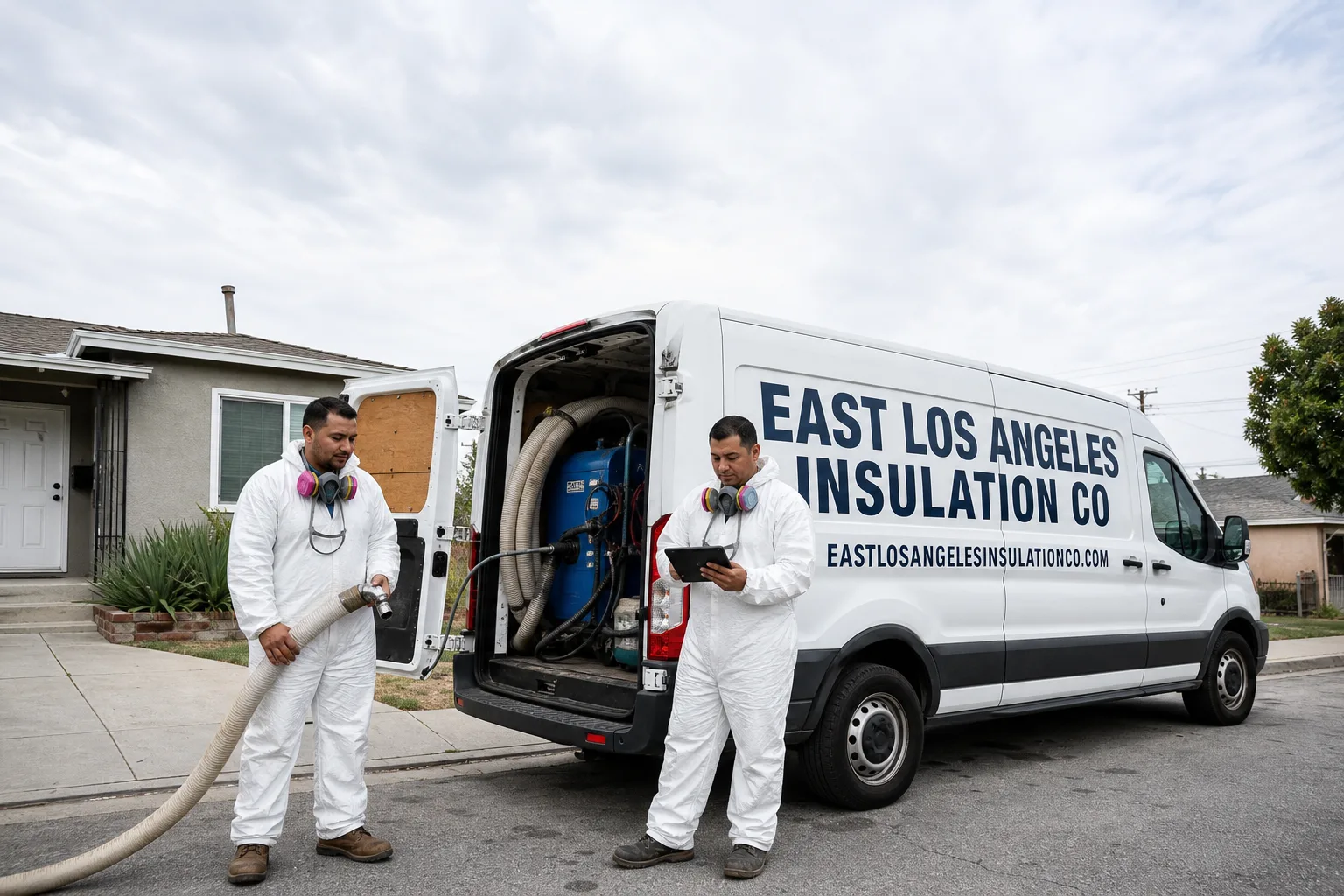
Fast, Reliable Spray Foam Insulation Across Covina
Spray foam insulation in Covina typically runs $2.40 – $4.90 per board foot installed, with most mid-century tract homes in 91722 and 91724 falling between $3,800 and $9,600 for a full attic envelope job. We get to Covina neighborhoods typically within 24 – 48 hours for estimates and can schedule most attic work the same week. If you’re chasing a summer cooling bill that won’t budge, call Ruben Acosta’s team at (866) 566-0304 and we’ll tell you straight whether spray foam is the right fix or if air-sealing has to come first.
We know Covina’s homes. The 1950s and 60s stucco tracts off Cypress Street, the pre-war bungalows near downtown, the converted garages on Citrus Avenue, and the room additions that make attics weird. That local knowledge matters because spray foam only performs when it’s applied to the right surfaces in the right sequence. Get the sequence wrong and you’ve spent thousands on foam that can’t do its job.
Why East Los Angeles Insulation Co Is Covina’s Preferred Spray Foam Insulation Company
Covina homeowners call us because we actually diagnose before we spray. Most insulation crews show up, shoot foam, and leave. We walk your attic first. We look at what’s already up there: collapsed original batt, unsealed recessed-can penetrations, knee-wall cavities that vent straight to the outside, and the weird framing around converted garages. Then we tell you what has to happen before the foam goes in – and whether foam is even the right choice for your specific house.
Our Spray Foam Insulation team carries Icynene and Demilec products, two of the most performance-trusted brands in the category. That matters in Covina where summer afternoons push past 100°F and the cooling load is the whole game. We also stock CertainTeed for jobs where a hybrid approach makes more sense. The point isn’t brand loyalty. It’s matching the product to the house.
Ruben Acosta has built this crew around one idea: insulation should be diagnosed, not just installed. When we send a tech to Covina, they’re not a general handyman who also does insulation. They’re a specialist who knows exactly what a 1962 stucco tract home off Workman Avenue looks like from the attic side – because they’ve seen dozens of them.
Covina represents a big chunk of our work in the eastern San Gabriel Valley, and the reviews from those jobs have made it clear: homeowners here want honesty about what’s wrong before anyone quotes foam. That’s exactly how we operate. Call (866) 566-0304 and you’ll get a straight answer about your attic, not a sales script.
Garage Spray Foam Insulation in Covina
Garage Spray Foam Insulation in Covina often means something specific: a converted garage or an attached garage with a ceiling that’s never been insulated and a knee-wall or rim-joist area that leaks air freely. Many Covina homes built in the 50s through 70s had garages added or converted without any attic access, which means the garage ceiling is often bare drywall or open framing with zero thermal barrier. We see this constantly in 91722 and 91724. The fix is usually a closed-cell pass on the ceiling underside or a rim-joist foam application where the garage meets the house. Typical garage ceiling spray foam work in Covina runs $1,200 – $3,400 depending on square footage and whether we’re also air-sealing the rim joist.
Converted Garage Attic Cavities
Converted garages create some of the hardest-to-seal attic spaces in Covina. The original garage roof wasn’t framed for insulation, the ceiling height is often reduced, and there’s frequently a knee-wall or half-attic transition that lets conditioned air pour out. Closed-cell foam on the ceiling plane and the knee-wall backside is usually the right call here. We’ve done enough of these in Covina to know the framing patterns before we even open the hatch.
Rim Joist Sealing on Attached Garages
Attached garages in Covina’s tract homes often share a rim joist with the house, and that rim joist is almost never sealed. Cold air, dust, and moisture move through it year-round. A rim-joist spray foam pass is inexpensive – typically $600 – $1,800 in Covina – and it makes the house feel noticeably tighter within a day. We recommend it on nearly every attached-garage job we quote in 91722 and 91724.
Closed Cell Spray Foam Insulation in Covina
Closed Cell Spray Foam Insulation in Covina is the right choice for homes where the attic is shallow, the roof deck is the air barrier, or the homeowner wants maximum R-value per inch without soffit-reconfiguring. Closed cell delivers roughly R-6.5 to R-7 per inch, adds structural rigidity, and acts as an air and vapor barrier in one pass. In Covina’s 100°F summer heat, that air-barrier performance is what actually moves the needle on your bill. A typical closed-cell roof deck job in Covina runs $4,800 – $11,000 depending on roof surface area and depth applied.
Roof Deck Application on Mid-Century Homes
Covina’s 1950s and 60s stucco tract homes were built with vented attics, but many have been re-roofed so many times that the venting isn’t doing its job. When we spray the roof deck with closed cell, we’re converting that attic into a semi-conditioned space. It’s a big thermal win, but it only works if the recessed-can penetrations and knee-wall transitions are sealed first. Skip that sequence and you’ve spent five figures on foam that can’t hold the air.
When Closed Cell Beats Open Cell in Covina’s Climate
Open-cell foam is cheaper per board foot, but in Covina’s extended summer heat, closed cell often wins on real-world performance. The problem with open cell in poorly vented attics is that it’s vapor-permeable. When hot, dry Santa Ana air hits the underside of a roof deck and then cools overnight, moisture can condense inside open-cell foam. Closed cell doesn’t allow that. For shallow roof decks and homes with low attic clearance, we lean closed cell here. It costs more – typically 40 – 60% more than open cell – but it’s the correct fix for many Covina homes.
Trusted Brands We Service in Covina
We stock and install Icynene and Demilec spray foam products because they’ve earned their place through field performance, not marketing. Covina homeowners who ask about brand options usually want to know why we choose one over another – and the answer is application-specific. We also carry CertainTeed for hybrid jobs where fiberglass plus a foam air-seal layer makes more financial sense than full foam. For Covina customers, having access to multiple brands means we’re not trying to force one product onto every house. We spec what the attic actually needs. Turnaround on brand-specific requests in Covina is fast because we keep our most-specified products in local stock for eastern San Gabriel Valley jobs.
Common Spray Foam Insulation Problems We See in Covina Homes
- Foam sprayed over unsealed recessed cans. The 1950s-60s tract homes in 91722 and 91724 are full of recessed-can ceiling lights, and most were installed with no air sealing at all. If foam goes down without sealing those penetrations first, cooled air still pours through the ceiling plane – the foam becomes an expensive lid on a leaky pot.
- Open-cell foam delaminating from vented knee-wall cavities. Mid-century Covina homes often have knee-wall attic spaces that are vented to the outside. Open-cell foam applied directly to those surfaces traps moisture at the vent interface, and over a few seasons the foam separates from the substrate. We find this regularly and it’s usually a re-do of someone else’s work.
- Collapsed original batt left under new foam. Homes built in the 1950s-70s often still have the original R-5 fiberglass batt in the attic, compressed and useless after 50 years. Some installers spray right over it. The air channels around that collapsed batt stay active, and the homeowner wonders why the new foam didn’t do anything. We pull it out and start clean.
- Converted-garage ceiling foam with no rim-joist treatment. A converted garage in Covina can have a beautifully foamed ceiling and still leak air through the rim joist where it meets the house. The foam did one plane but not the thermal boundary. We treat the rim joist as part of every attached-garage quote.
Pricing for Spray Foam Insulation in Covina, CA
Here’s what we’re seeing for Covina work right now. Open-cell spray foam runs $2.40 – $3.60 per board foot. Closed-cell runs $3.80 – $4.90 per board foot. A typical 1,200 – 1,600 square foot attic in a Covina tract home needs $3,800 – $7,200 for open cell or $5,600 – $9,600 for closed cell. Garage ceiling jobs run $1,200 – $3,400. Rim joist work is $600 – $1,800. What moves the number: attic square footage, foam depth, whether we’re pulling old batt first, and whether air-sealing penetrations is included (it should be). Every estimate we give in Covina is free and comes with a written spec of exactly what we’ll do and in what order. Call (866) 566-0304.
We Also Serve Cities Near Covina
Our crew regularly works across the eastern San Gabriel Valley. Beyond Covina, we handle spray foam and air-sealing jobs in Irwindale, Azusa, Citrus, and West Covina – same products, same diagnostic-first approach, same 24 – 48 hour estimate response. If you’re in a neighboring city and wondering whether your attic has the same mid-century issues we see in Covina, call and ask. Chances are good the answer is yes.
Serving Covina, CA - Our Local Coverage Area
We serve Covina and nearby communities. Use the map below to see the area we cover. If you’re nearby, we can almost certainly help.
FAQs About Spray Foam Insulation in Covina
Because the foam was likely applied over unsealed recessed-can penetrations and knee-wall cavities, so cooled air is still escaping through the ceiling plane. A 1960s tract home in Covina’s 91722 zip code almost always needs air-sealing before foam. If the previous contractor skipped that sequence, the foam can’t do its job. We can inspect and tell you exactly what was missed – call (866) 566-0304 and we’ll walk your attic.
Yes, and converted garages are some of the trickiest and most rewarding jobs we do in Covina. The original garage framing usually has no attic access, low clearance, and awkward knee-wall transitions. We foam the ceiling plane and the rim joist where the addition meets the house. Converted garages in Covina typically run $1,200 – $3,400 depending on size and access. Call for a free look.
Usually yes, especially for roof deck and knee-wall applications. Covina’s summer heat regularly pushes past 100°F, and closed cell’s higher R-value per inch plus its air and vapor barrier performance makes a measurable difference on cooling bills. It costs 40 – 60% more than open cell, but many Covina homeowners choose it for shallow attics and converted spaces where open cell would underperform. We’ll quote both and tell you what we’d do in our own house.
Yes, it changes the sequence. Pre-war homes in 91723 often have active or abandoned knob-and-tube wiring, and spray foam can’t be applied over live knob-and-tube circuits. The wiring has to be addressed before any foam touches the ceiling plane. We also check for old balloon framing, which changes how air moves through the walls. Call (866) 566-0304 and we’ll tell you what your specific house needs first.
Because Covina’s mid-century tract homes in 91722 and 91724 were built with dozens of unsealed ceiling penetrations – recessed cans, plumbing chases, and wiring drops – plus knee-wall cavities that vent directly to the outside. Foam over those leaks is wasted foam. Air-sealing first is the difference between a job that lowers your summer bill and one that barely moves it. When you call (866) 566-0304 for an estimate, we’ll tell you if your house needs the two-part sequence.
Written by Ruben Acosta, Owner at East Los Angeles Insulation Co, serving Covina and the eastern San Gabriel Valley.