
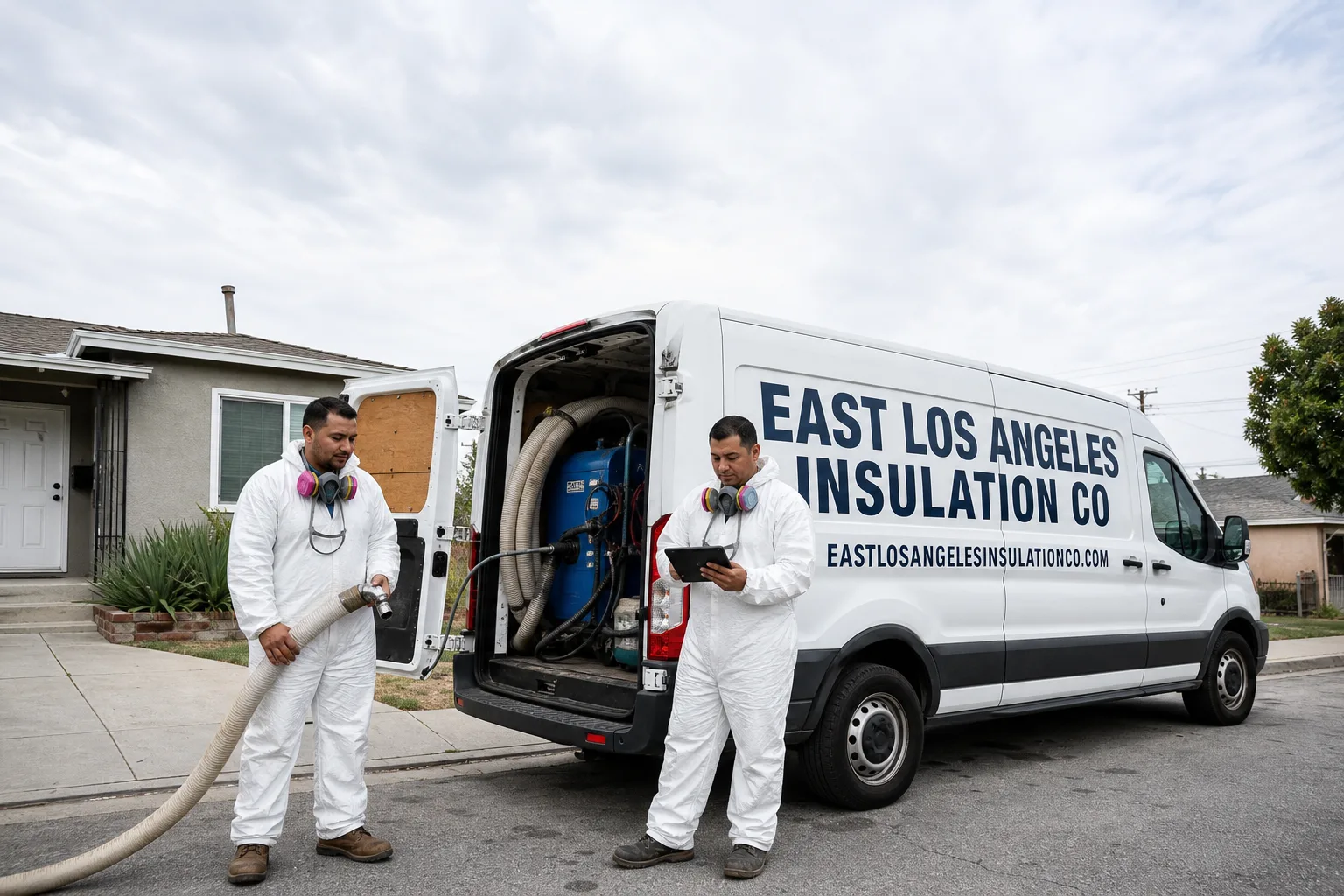
Fast, Reliable Spray Foam Insulation Across Jurupa Valley
Spray foam insulation in Jurupa Valley is a heat-rejection retrofit first and a comfort upgrade second. Our crews work the 91752 corridor weekly, and we know exactly what a 1970s ranch attic off Pedley Road does to fiberglass batts by mid-July. If your AC runs constantly and rooms still feel hot by 3 p.m., the problem is almost always in the attic. Call (866) 566-0304 and we’ll be out within 48 hours to map the heat load and show you what’s actually happening above your ceiling.
Why East Los Angeles Insulation Co Is Jurupa Valley’s Preferred Spray Foam Insulation Company
We’re not a general contractor who picked up a spray foam rig last year. Insulation is all we do, and we stock eight brands because one product doesn’t fit every house in Jurupa Valley. Homeowners here call us because we’ll tell them when open-cell makes sense, when closed-cell is the only honest answer, and when spray foam isn’t the right move at all. That’s the conversation most single-brand installers can’t have.
Ruben Acosta leads our spray foam work, and he’s spent enough time in Jurupa Valley attics to know the difference between a Glen Avon ranch and a 2008 tract home off Limonite before he climbs the ladder. Those two houses need completely different foam thicknesses, different prep, and different expectations. We price the job based on what your attic actually requires, not a one-size-fits-all square footage formula. Call (866) 566-0304 for a straight answer on what your home needs.
Spray Foam Attic Insulation in Jurupa Valley
Spray foam attic insulation in Jurupa Valley is the single highest-impact upgrade for homes with dark asphalt-shingle roofs and low-pitch attic framing, which describes most of the original ranch stock here. We spray closed-cell foam directly to the underside of the roof deck, sealing the attic from the 150°F air that builds under the shingles. This isn’t the same as blown-in fiberglass that sits on the floor; it changes the thermal boundary of the house entirely.
Roof Deck Encapsulation
When we encapsulate a roof deck, we’re sealing every rafter bay and ridge vent pathway so radiant heat from the shingles stops transferring into the attic air. In Jurupa Valley’s older tracts, we typically see original R-11 batts sagging off rafters with bare decking behind them. The fix is 2 to 3 inches of Icynene closed-cell foam applied directly to the deck, which air-seals and insulates in one pass. Expect to pay $4,200 – $6,800 for a typical 1,200 – 1,600 square foot ranch attic in the 91752 corridor.
Radiant Barrier Combination
For attics that have never had a radiant barrier, we pair the foam with a reflective layer under the roof deck. Jurupa Valley sun is brutal, and a radiant barrier knocks down the shingle-side heat load before it ever reaches the foam. This combo regularly drops attic temps by 35 – 40°F, which shows up directly on your electric bill. A radiant barrier add-on runs $900 – $1,500 depending on attic geometry.
Spray Foam Wall Insulation in Jurupa Valley
Spray foam wall insulation in Jurupa Valley addresses what happens when stucco walls with no sheathing insulation bake all day and radiate heat into living rooms after sunset. Many of the 1970s and 1980s ranches here have empty wall cavities or a thin layer of settled fiberglass. We see this constantly on rim joists and band boards where the framing meets the foundation, especially in homes with crawl spaces.
Rim Joist and Band Board Sealing
The rim joist is where hot outside air slips into floor framing, and in Jurupa Valley’s older homes it’s almost always uninsulated. We inject closed-cell foam into each joist bay to seal the thermal break at the foundation line. This also cuts the dust and dry air that migrates up through floors, which matters in a climate as dusty as Riverside County’s. Rim joist work on a standard single-story ranch runs $1,800 – $3,200 for a full perimeter.
Garage Ceiling and Bonus Room Additions
Large-lot Jurupa Valley homes often have detached garages, converted shops, or additions that were never insulated properly, if at all. We spray closed-cell or open-cell foam on garage ceilings and bonus-room walls to bring those spaces into the conditioned envelope of the home. Because these structures were built inconsistently, we map foam thickness room by room rather than spraying a uniform blanket. Garage ceiling foam typically lands between $1,400 – $2,600 depending on square footage and joist depth.
Trusted Brands We Service in Jurupa Valley
We install Icynene and Demilec spray foam because both have real field records in hot, dry climates like this one. Icynene’s closed-cell formulation holds up against the sustained 150°F deck temps we measure in Jurupa Valley attics every summer, and Demilec’s open-cell product gives us flexibility on wall cavities where cost matters more than maximum R-value. We also keep Owens Corning and GreenFiber in stock for jobs where blown-in or batts make more sense. Fast turnaround on parts and material means no two-week waits for a foam kit to arrive; we carry what your job needs and we carry it now.
Common Spray Foam Insulation Problems We See in Jurupa Valley Homes
- Collapsed original fiberglass batts in 1970s low-pitch attics. The sustained 150°F+ heat across a dark shingle roof causes old batts to slump off the rafters, leaving bare decking that radiates heat straight into living space. We find this on nearly every pre-1980 ranch we inspect in the Pedley Road and Jurupa Road corridors.
- Detached shops and additions with zero insulation. Large-lot Jurupa Valley properties often have detached garages or converted workshops that were built without any thermal envelope. Spray foam on these structures needs custom thickness mapping because framing depth varies bay to bay.
- Open-cell foam applied too thin on roof decks under dark shingles. In Jurupa Valley’s sun load, open-cell foam under a dark asphalt roof can let radiant heat push through if it isn’t thick enough, stratifying cool air and making the AC work harder. We see this on retrofit jobs done by crews unfamiliar with Inland Empire heat.
- Gaps at rim joists and band boards that leak hot air into floors. Crawl-space homes in 91752 commonly have unsealed rim joists, which pull 100°F+ outside air into the floor system. This shows up as hot floors in summer and a constant cycle of dust infiltration.
Pricing for Spray Foam Insulation in Jurupa Valley, CA
Spray foam pricing in Jurupa Valley runs on a different scale than coastal markets because the heat load demands more material. A full roof deck encapsulation on a 1,200-square-foot ranch attic lands between $4,200 and $6,800. Rim joist work on a single-story home runs $1,800 – $3,200. Wall injection or open-cell cavity fill in an average 1970s stucco home runs $2,500 – $4,500. Garage ceilings and detached shop retrofits sit in the $1,400 – $2,600 range. Square footage, attic height, existing insulation removal, and foam thickness all move the number. Call (866) 566-0304 and we’ll walk your attic with you or do a video assessment, then give you a fixed quote before any work starts.
We Also Serve Cities Near Jurupa Valley
Our crews cover Jurupa Valley and the surrounding Inland Empire communities including Glen Avon, Pedley, Sunnyslope, and Eastvale. If you’re right outside the 91752 boundary, we’ll still come out. See our full spray foam insulation service area for details or read more about our Spray Foam Insulation approach across the region.
Serving Jurupa Valley, CA - Our Local Coverage Area
We serve Jurupa Valley and nearby communities. Use the map below to see the area we cover. If you’re nearby, we can almost certainly help.
FAQs About Spray Foam Insulation in Jurupa Valley
In Jurupa Valley, sustained roof-deck temperatures above 150°F mean closed-cell foam is usually the right call for attic roof decks, because open-cell applied too thin can let radiant heat push through and stratify cool air. Closed-cell Icynene foam at 2 to 3 inches seals the deck and stops radiant transfer at the source. If your attic has dark asphalt shingles and no radiant barrier, we’ll recommend closed-cell or a foam-plus-radiant-barrier combination. Call (866) 566-0304 and we’ll tell you which product fits your roof, not just what we have on the truck.
No. In Jurupa Valley’s older ranch homes, those original batts are usually collapsed, dusty, and doing almost nothing, so we remove them before spraying foam directly to the roof deck. Leaving them in place creates gaps behind the foam that trap heat and defeat the air seal. Removal adds a small amount to the job cost but it’s the only way to get the R-value and air barrier you’re paying for. We’ll show you photos from your attic so you can see exactly what’s up there before we recommend a scope.
Yes, and this is one of the most underrated benefits for Jurupa Valley homes. Rim joist spray foam and wall cavity injection seal the air pathways that pull dusty, dry Riverside County air into living space through the floor and exterior walls. Once those gaps are sealed, indoor humidity stabilizes and the constant dust film on furniture drops noticeably. It’s a side effect of doing thermal work correctly, but homeowners here mention it within weeks of the job finishing.
Spray foam seals the attic at the roofline, turning the attic into semi-conditioned space, while blown-in fiberglass sits on the attic floor and leave the roof deck exposed to 150°F+ summer heat. In Jurupa Valley, that exposed deck is the biggest driver of cooling costs, which is why we recommend spray foam roof deck encapsulation for most older ranches here. Blown-in works well when paired with a radiant barrier, but it doesn’t stop radiant heat at the source the way closed-cell foam does. We’ll walk you through both options and let you decide based on your home’s specific framing.
Yes, we regularly spray foam detached garages, converted shops, and standalone workshop spaces on the large-lot properties that make up much of Jurupa Valley’s housing stock. These structures were often built without any insulation or with inconsistent framing depths, so we map foam thickness bay by bay instead of spraying a uniform blanket. A detached garage ceiling or shop retrofit typically runs $1,400 – $2,600 depending on square footage and access. Call (866) 566-0304 for a free estimate on your outbuildings.
Written by Ruben Acosta, Owner at East Los Angeles Insulation Co, serving Jurupa Valley and the Inland Empire.