
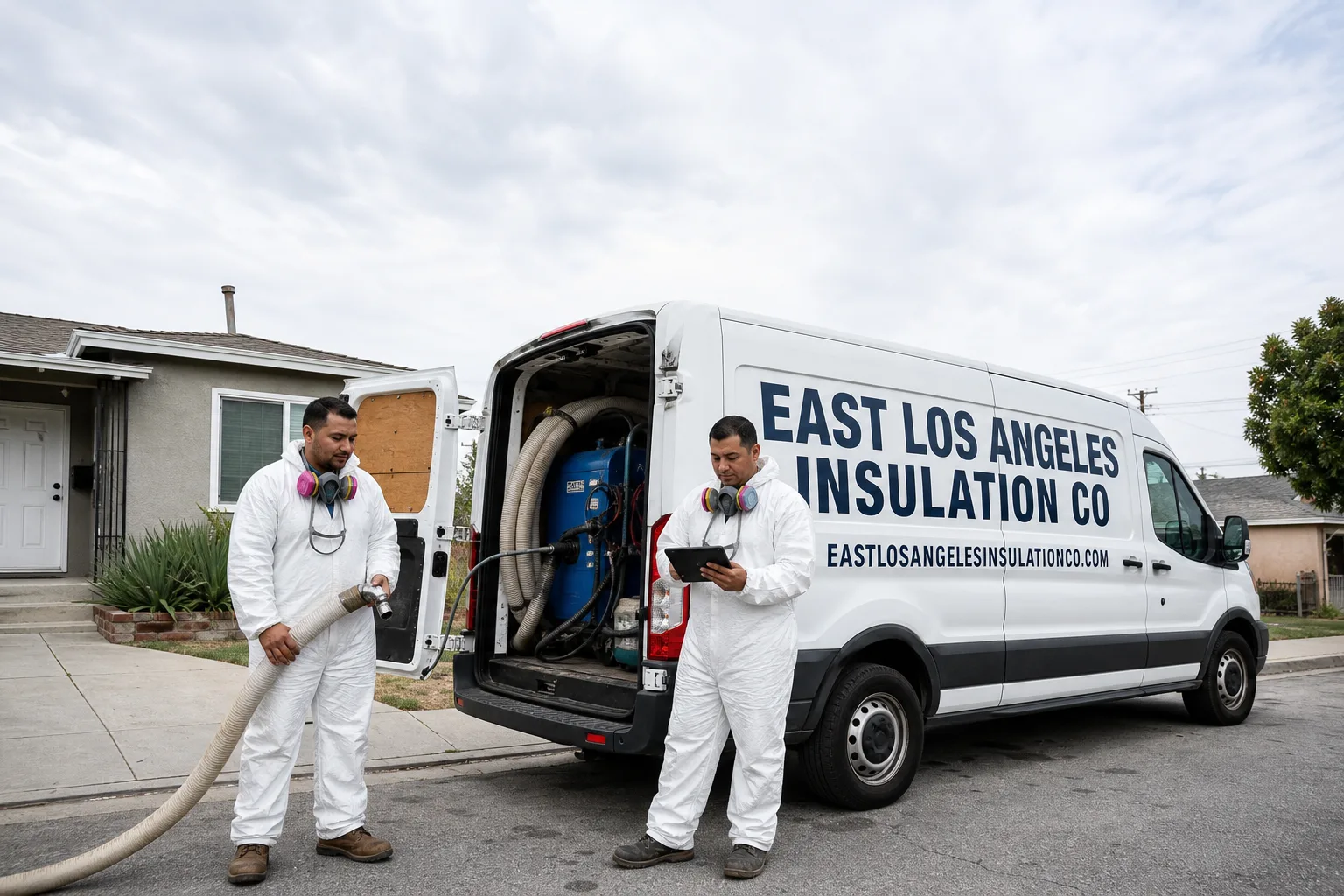
Fast, Reliable Spray Foam Insulation Across Long Beach
Spray foam insulation in Long Beach costs between $2.20 and $7.50 per square foot installed, with most whole-room or attic projects landing in the $2,800 to $9,400 range depending on whether you’re using open-cell or closed-cell foam and where in the city your house sits. We get calls from homeowners in Naples one afternoon and North Long Beach the next morning, and we quote both the same way: by looking at what the house actually needs, not what’s easiest to spray. If you’re fighting condensation near the water or attic heat a mile inland, call (866) 566-0304 and we’ll walk you through it.
Why East Los Angeles Insulation Co Is Long Beach’s Preferred Spray Foam Insulation Company
We’re a dedicated insulation contractor, not a generalist carrying one spray foam rig and a prayer. Long Beach’s housing stock runs the gamut from 1920s Craftsman bungalows with pier-and-beam floors in Belmont Shore to mid-century stucco tract homes in Lakewood-adjacent neighborhoods, and the right foam spec for each is rarely the same. Ruben Acosta leads a crew that’s put closed-cell on damp subfloors two blocks from the sand and open-cell in attics twenty blocks inland, and we read the difference before we ever quote it.
Long Beach homeowners call us because we stock foam from Demilec and Icynene, two manufacturers whose closed-cell products hold up in salt-heavy air better than bargain polyurethane blends. We don’t send a sales rep to your house. The person who measures is the person who sprays. And our response time to Long Beach addresses from the Peninsula up through 90805 is same-week in most cases, often same-day when a homeowner pulls back insulation and finds what’s actually underneath.
That last part matters here more than most cities. Pull down a can light in a 1940s Long Beach bungalow and you may find Knauf fiberglass from a remodel in 1987, settled to half its original depth. Or nothing at all. We’ve worked around knob-and-tube in Wrigley and corroded foil-faced batts in Bluff Park, and we know which problems are foam-solvable and which need a different approach first.
Spray Foam Insulation Contractors in Long Beach
Spray Foam Insulation Contractors in Long Beach handle the most variable insulation job in this city because the foam’s purpose flips between ZIP codes. Near the water, closed-cell foam goes on subfloors and rim joists to block marine-layer moisture and salt air from entering a crawl space. Inland, the same material goes on attic floors and sloped ceilings to add R-value and stop radiated heat from cooking the upstairs. At East Los Angeles Insulation Co, we do both, and we spec the foam thickness, type, and placement based on where your house sits, how old the framing is, and what’s already up there.
Closed-Cell Spray Foam for Coastal Crawl Spaces
A 90803 bungalow with a damp pier-and-beam crawl space needs something that stops moisture, not just something that insulates. Closed-cell foam at 2 to 3 inches acts as a vapor and air barrier, which is why we use Icynene and Demilec closed-cell on subfloors and rim joists within a few blocks of the water. The foam has to be sprayed onto a dry surface. If the joists are already wet, the job starts with ventilation and drying, not foam.
Open-Cell Spray Foam for Attic Air Sealing
Open-cell foam in a Long Beach attic is more about air sealing than raw R-value. Older homes leak conditioned air through can light penetrations, wall-top plates, and bathroom fan housings, and open-cell expands into those gaps better than batts ever will. It’s the right call when the attic framing is dry and the goal is stopping hot air exchange, not managing water. We spray open-cell at 5.5 to 6 inches for roughly R-20 to R-22.
Spray Foam Attic Insulation in Long Beach
Spray Foam Attic Insulation in Long Beach usually means one of two jobs: capping an existing layer of settled fiberglass with open-cell foam, or sealing the roofline so the attic becomes a conditioned part of the house. Both are common here because the city’s pre-war housing stock predates modern attic insulation standards by a generation, and the coastal side’s marine layer keeps attics cool enough that homeowners ignore them until a bedroom won’t hold temperature. The people who notice are the ones with kids’ rooms on the west side of the house, the side that bakes from noon to seven in August.
Attic projects in Long Beach run $3,100 to $8,700 on average, depending on attic floor area, access clearance, existing insulation removal, and whether the gable end has vents that need to stay open. We inspect first, quote second. You don’t get a per-square-foot number over the phone from us because attic geometry drives material waste harder in Long Beach than almost any other variable: low-pitch 1920s roofs, zero-walkable access, wet headers, and plywood decks too close to the ceiling joists to move around.
Conditioning the Attic in a Coastal Long Beach Home
On the Peninsula and in Belmont Shore, we sometimes recommend leaving the attic vented and applying closed-cell to the attic floor instead. The marine layer puts moisture in the air almost every summer morning, and a vented attic gives that moisture a way out. Conditioning the roofline in a fog-belt house without addressing existing soffit and gable venting can trap wet air against the decking, which leads to sheathing rot within a few years.
Attic Floor Capping in North Long Beach
In 90805 and parts of Bixby Knolls, attics get hot enough that the existing fiberglass has settled to an R-value that isn’t doing much. We cap settled layers with open-cell foam, which expands over and into the compressed batts and seals the edges where air moves fastest. The result is a continuous thermal layer over a leaky older one, which is the fastest single improvement most inland Long Beach houses can get without a full attic gut.
Trusted Brands We Service in Long Beach
We stock Demilec and Icynene spray foam because both have long field records in coastal and high-humidity environments, and because their closed-cell products stay dimensionally stable when installed over the kind of pier-and-beam framing we see under Long Beach bungalows. Homeowners who want a recycled-content or lower-embodied-energy option get GreenFiber blown-in instead, which we pair with foam air sealing around rim joists and top plates. We don’t install one foam for every house. We carry what we carry because it performs in Long Beach conditions, not because a distributor gives us a rebate. Local parts and material availability means faster turnaround when a crew finds something mid-job that changes the spec.
Common Spray Foam Insulation Problems We See in Long Beach Homes
- Ground moisture blisters under beach-area subfloors. Closed-cell sprayed over damp pier-and-beam joists near the water traps ground moisture against the framing and blisters from below. We’ve seen whole sections peel off a 1930s joist bay in Naples because nobody dried the crawl space first.
- Salt-corroded fasteners on old foil-faced batts. Within a few blocks of the Pacific, the staples and foil facings on legacy batt insulation fail from salt air before the material has lost any R-value. The batts sag, the foil corrodes white, and the insulation stops doing its job even though it looks intact from a distance.
- Foam sprayed over settled batts in inland attics. In North Long Beach and along the 710 corridor, attic heat bakes the existing fiberglass down to half or less of its rated depth. Spraying foam over settled batts without addressing them creates pockets where hot air still moves through the old material, and homeowners wonder why the upstairs is still hot in August.
- Knob-and-tube wiring buried by DIY foam jobs. We open up 1920s and 1930s Long Beach ceilings regularly and find live knob-and-tube still in service. Spraying foam directly over active knob-and-tube is unsafe and often a code violation. The wiring has to be evaluated and usually replaced or decommissioned before any foam goes over it.
Pricing for Spray Foam Insulation in Long Beach, CA
Open-cell spray foam in Long Beach runs $2.20 to $3.75 per square foot installed at typical attic depths. Closed-cell runs $4.50 to $7.50 per square foot, with the higher end on crawl spaces, rim joists, and anything requiring lift access or extensive prep. A 1,200-square-foot attic cap in Bixby Knolls is usually a $4,300 to $7,200 job. A pier-and-beam subfloor seal in Belmont Shore with closed-cell foam and rim joist treatment typically lands between $3,800 and $6,500. If we find knob-and-tube, saturated decking, or rotted sills, those get handled before foam touches anything, and we quote the add-on before the work starts. Estimates are free, and we’ll give you a written number that doesn’t move unless the scope changes. Call (866) 566-0304.
We Also Serve Cities Near Long Beach
Our crews work throughout the Long Beach area every week. We’re in Signal Hill, Lakewood, Carson, and West Carson regularly, and our service area includes all four Long Beach ZIP codes: 90835, 90840, 90842, and 90844. Read more about our Spray Foam Insulation services or see the full Spray Foam Insulation in Long Beach coverage area.
Serving Long Beach, CA - Our Local Coverage Area
We serve Long Beach and nearby communities. Use the map below to see the area we cover. If you’re nearby, we can almost certainly help.
FAQs About Spray Foam Insulation in Long Beach
Because the Peninsula has a crawl-space moisture problem and North Long Beach has an attic heat problem. Near the water, foam’s job is a vapor and salt-air barrier over damp pier-and-beam subfloors. Inland, the same material is an attic R-value cap over baked, settled insulation. We spec the foam type and thickness based on which problem your block actually has, not a one-size city average. Call (866) 566-0304 and we’ll tell you which one your house is.
No, not directly. Old batts near the water are usually corroded, sagging, or holding salt and moisture, and the joists underneath may be damp. We remove the failed batts, dry and inspect the framing, then spray closed-cell foam onto clean wood. If the joists are rotted or the crawl space is wet from the ground, that gets fixed first. Call (866) 566-0304 for an inspection.
We won’t spray over live knob-and-tube. The wiring runs hot in open air and burying it in foam removes its only heat-dissipation path, which is a fire hazard and against code in most Long Beach retrofit situations. We flag it during the estimate and work with an electrician to decommission or replace the affected circuits before any foam goes in. Call (866) 566-0304 if you suspect your bungalow still has it.
In most Belmont Shore and Peninsula homes, yes. The condensation comes from warm indoor air hitting a cold floor assembly fed by marine-layer moisture in the crawl space. Closed-cell foam on the subfloor and rim joists creates a barrier that keeps the warm, moist interior air away from the cold framing and stops the damp crawl space air from wicking upward. We’ve seen the condensation clear up within a week of the first cool morning after install. Call (866) 566-0304 for a crawl space assessment.
Maybe. If your attic has six inches of settled fiberglass that was installed decades ago, capping it with open-cell spray foam will outperform blowing in more fiberglass because the foam seals the air-leak channels around light penetrations, top plates, and bathroom fans. If the existing insulation is dry and mostly intact, adding blown-in GreenFiber may be enough. We’ll tell you which one your attic needs after seeing it. Call (866) 566-0304 and ask for an attic evaluation.
Written by Ruben Acosta, Owner at East Los Angeles Insulation Co, serving Long Beach and the surrounding coastal communities.