
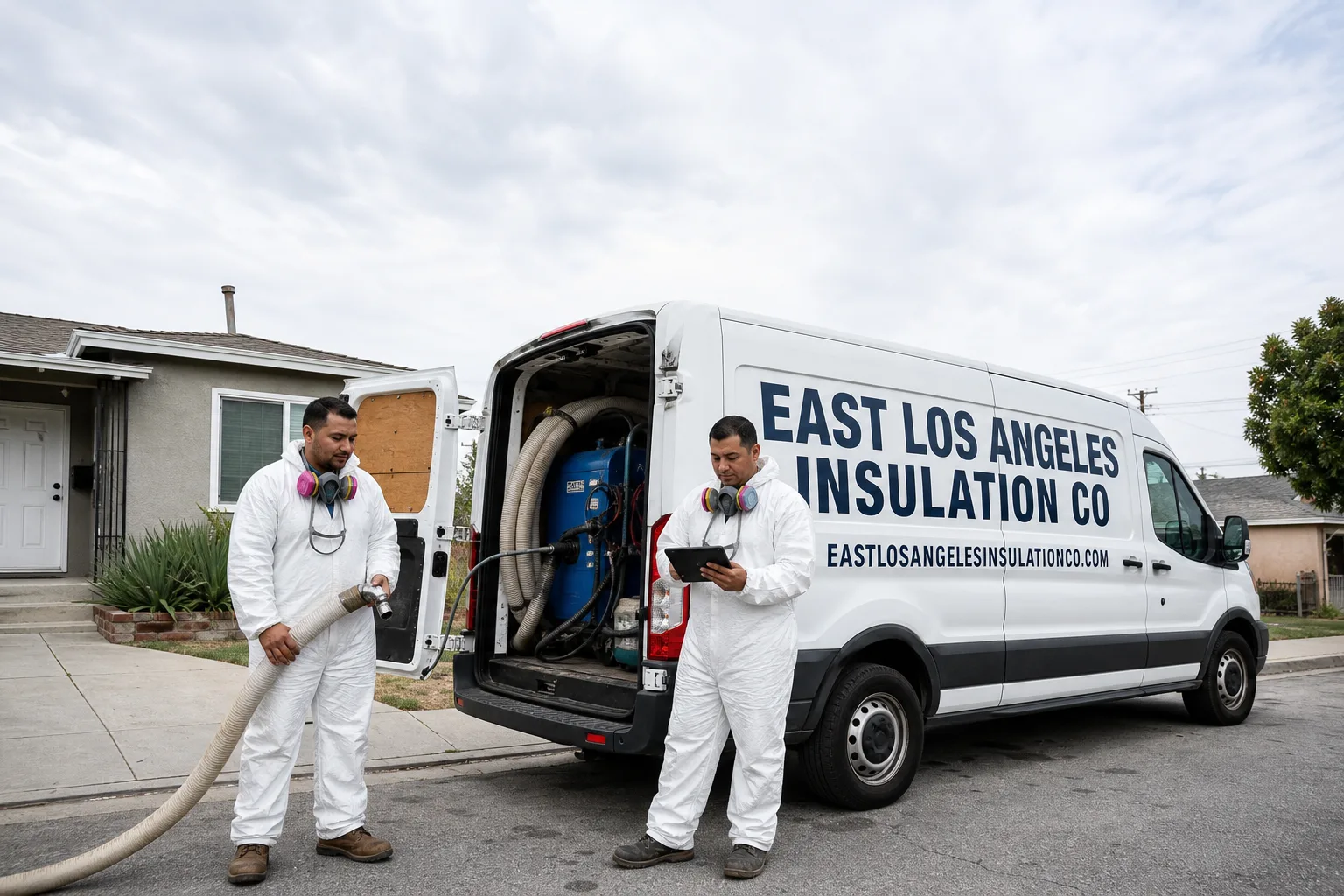
Fast, Reliable Spray Foam Insulation Across Quail Valley
Spray foam insulation in Quail Valley has to fight two things most California homes never deal with: triple-digit canyon heat soaking through the roof deck, and fine dust off the slopes that quietly clogs soffit vents until your attic stops breathing. We’re East Los Angeles Insulation Co, and our Spray Foam Insulation crews work in Quail Valley every week. Most jobs in the 92587 zip code get scheduled within 3 to 5 business days, and we stock enough Icynene and Demilec foam on the truck to handle full roof-deck applications without a second trip. Call (866) 566-0304 for a free estimate, and we’ll tell you straight whether closed cell, open cell, or a hybrid approach fits your house.
Why East Los Angeles Insulation Co Is Quail Valley’s Preferred Spray Foam Insulation Company
We’re a dedicated insulation contractor, not a generalist juggling HVAC calls and roofing bids. That focus is why Quail Valley homeowners call us when attic temperatures spike and power bills follow. Our crews know the canyon communities off Goetz Road and the golf-course pockets where manufactured homes sit on permanent foundations with underbelly insulation that rodents have torn apart. We’ve sprayed roofs in the stucco-on-frame tracts along Canyon Lake Drive and in older custom builds up the slopes, so we know the framing patterns, the duct layouts, and the failure points specific to 1980s-2000s Riverside County construction.
Quail Valley customers consistently mention two things in their reviews: we show up when we say we will, and we don’t push product the house doesn’t need. Ruben Acosta built this company on that principle: carry eight brands, master three installation methods, and never pretend one material solves every problem. That’s why we stock Owens Corning, Johns Manville, Demilec, and GreenFiber on our service vehicles, so a Quail Valley job doesn’t stall waiting on a warehouse order. Free estimates, licensed and insured, and a team that can explain the difference between open cell and closed cell foam without a sales script.
Closed Cell Spray Foam Insulation in Quail Valley
Closed Cell Spray Foam Insulation is the workhorse for Quail Valley roof decks and rim joists, because it adds structural rigidity, stops air movement, and blocks moisture at roughly R-7 per inch. In the canyon heat, that density means your attic doesn’t cook the way it did with sagging fiberglass. A typical closed cell roof-deck application in Quail Valley runs $3,800 to $7,500 depending on square footage, roof pitch, and how much prep work the dust-clogged venting requires.
Roof Deck and Rim Joist Application
Closed cell sprayed on the underside of the roof deck creates an unvented assembly that locks out Santa Ana-driven dust and triple-digit solar gain. We apply it in 2 to 3 inches to hit code-compliant R-value while leaving room for can-light boxes and junction boxes to remain accessible. For rim joists, closed cell’s rigidity and air-sealing make it the only product we recommend in Quail Valley’s elevated homes where wind pushes unconditioned air through the band board.
When Closed Cell Earns Its Cost
If your 1980s tract home still has builder-grade R-11 batts and you’re tired of the upstairs never cooling down, closed cell roof-deck foam is the most direct fix. The upfront cost is higher than open cell, but the performance difference in a Quail Valley August is measurable: conditioned air stays in, dust stays out, and the roof assembly doesn’t sweat during cold canyon nights.
Open Cell Spray Foam in Quail Valley
Open Cell Spray Foam is the smart play for Quail Valley attic floors and interior wall cavities where sound control and air sealing matter more than structural rigidity. It expands to roughly 100 times its liquid volume, filling gaps around top plates, can lights, and duct chases that fiberglass never touches. A typical open cell attic-floor application in Quail Valley runs $1,900 to $4,200 for a 1,200 to 2,000 square foot attic, depending on existing insulation removal and air-sealing scope.
Air Sealing and Duct Boots First
In Quail Valley’s 1980s-2000s tract homes, open cell delivers its best result when paired with aggressive air sealing. We foam the top plates, can-light penetrations, and duct boots before spraying, because a foam job that skips sealing the leak path is just an expensive blanket. Duct boots in older canyon homes are often cracked and leaking conditioned air into the attic; open cell seals those boots permanently.
One caveat for Quail Valley specifically: open cell sprayed thick on a hot roof deck without an ignition barrier or radiant barrier plan can underperform in intense solar gain and fail code review. We’ll tell you honestly if closed cell or a hybrid method fits your assembly better.
Trusted Brands We Service in Quail Valley
We install Icynene and Demilec spray foam products, both with established field-performance records and manufacturer warranties. For Quail Valley homeowners who prefer a recycled-content option in blown-in applications, we carry GreenFiber. And for batt or mineral-wool retrofit work alongside foam, we keep Owens Corning and Johns Manville on hand. The point is simple: we stock multiple brands because the right product for a manufactured home’s belly cavity is not the same as the right product for a custom build’s roof deck. Call (866) 566-0304 and we’ll match the product to your house, not the other way around.
Common Spray Foam Insulation Problems We See in Quail Valley Homes
- Dust-clogged soffit vents turning vented attics into hot boxes. Wind-driven dust off the canyon slopes packs into soffit vents until airflow through the attic drops to nearly nothing. We see this constantly in the tract homes along Goetz Road, where the “vented” attic is running 30 to 40 degrees hotter than it should, and foam applied without fixing the ventilation just traps that heat.
- Builder-grade R-11 to R-19 batts cooked brittle and sagging off the deck. Decades of inland canyon heat bake fiberglass until it’s paper-thin and falling away from the roof deck, leaving gaping thermal bypasses. Foam has to bridge those gaps, not just cover them; we air-seal first, then spray.
- Manufactured home underbelly insulation torn by rodents, with sagging ductwrap. In the Quail Valley golf-course and canyon manufactured-home communities, the failure sequence runs from the belly up: rodents tear the underbelly vapor barrier, insulation falls onto the ground, and ductwrap sags away from the ductwork. Attic foam alone misses the dominant leak path entirely.
- Old ductwork and penetrations leaking conditioned air faster than new foam can offset. In 1980s-2000s tract attics, the ducts were often poorly sealed at the boots and plenum. Spraying foam without sealing those penetrations throws good money after a leaky assembly; we address both in the same visit.
Pricing for Spray Foam Insulation in Quail Valley, CA
Quail Valley pricing runs slightly higher than flatland Riverside County because canyon access, attic heat, and dust remediation add labor. Closed cell roof-deck jobs typically land between $3,800 and $7,500. Open cell attic floors run $1,900 to $4,200. Rim joist sealing in a crawlspace home averages $1,100 to $2,600. Garage ceiling spray foam in an attached garage runs $900 to $1,800. The variables are square footage, roof pitch, existing insulation removal, and how much dust-driven ventilation repair the attic needs first. Estimates are free, and we give you a line-item quote before any work starts. Call (866) 566-0304 for exact numbers on your house.
We Also Serve Cities Near Quail Valley
Our crews cover all of Quail Valley and the surrounding communities, including Sun City, Canyon Lake, Meadowbrook, and Romoland. If you’re a few minutes down the road and need the same specialist-level spray foam work, we schedule the same week in most cases.
Serving Quail Valley, CA - Our Local Coverage Area
We serve Quail Valley and nearby communities. Use the map below to see the area we cover. If you’re nearby, we can almost certainly help.
FAQs About Spray Foam Insulation in Quail Valley
Spray foam matters in Quail Valley because your attic’s real problem is air movement and dust intrusion, not just R-value on a chart. A fiberglass batt labeled R-38 stops doing its job the moment canyon wind pushes conditioned air through gaps around the top plates and can lights. Spray foam seals those gaps and creates a continuous thermal and air barrier, which is the only way to keep triple-digit attic heat from bleeding into your living space. R-value on a package means little if the assembly leaks air; in Quail Valley, the dust-clogged soffits and sagging batts make sealing the first job, not the last. Call (866) 566-0304 and we’ll show you exactly where your attic is leaking, free.
Foam the underbelly first. In Quail Valley’s manufactured-home communities off the golf course and canyon roads, the dominant failure path runs from the belly up: rodent-torn underbelly insulation and sagging ductwrap leak conditioned air into the crawlspace before the attic batts ever fail. Attic foam makes a real difference, but if the underbelly is open, you’re sealing the top of a leaky barrel. We inspect both areas during the free estimate and tell you where the actual heat loss is happening.
Yes, but we restore airflow first. Packed soffit vents have turned your vented attic into a hot box, and spraying foam without addressing that ventilation traps heat instead of stopping it. In most Quail Valley homes, we clear the soffit vents, then spray the roof deck as an unvented assembly, which locks out future dust intrusion permanently. If going unvented isn’t right for your roofline, we’ll say so before any foam goes on. Call (866) 566-0304 for an attic assessment.
Closed cell is the better fit for Quail Valley roof decks because it handles the canyon’s intense solar gain and Santa Ana dust without an ignition-barrier complication. Open cell works well on attic floors and interior walls, but sprayed thick on a hot roof deck it underperforms and can fail code review without a radiant-barrier plan. For most tract attics in the 92587 zip, we recommend closed cell on the roof deck and open cell or air sealing at the attic floor, depending on whether the attic is conditioned space. We’ll walk you through both options on site.
Yes, because we remove the failed batts before spraying. Brittle, sagging fiberglass can’t be “covered into” working again; it has to come out for the foam to bond to the deck and seal the assembly. In Quail Valley’s 1980s-2000s tract homes, we typically remove the R-11 to R-19 batts, air-seal the top plates and can lights, then spray the roof deck or attic floor per your chosen approach. The result is a continuous barrier that doesn’t sag, doesn’t collect canyon dust, and doesn’t degrade in triple-digit heat. Call (866) 566-0304 for a free removal-and-foam estimate.
Written by Ruben Acosta, Owner at East Los Angeles Insulation Co, serving Quail Valley and surrounding Riverside County communities.