
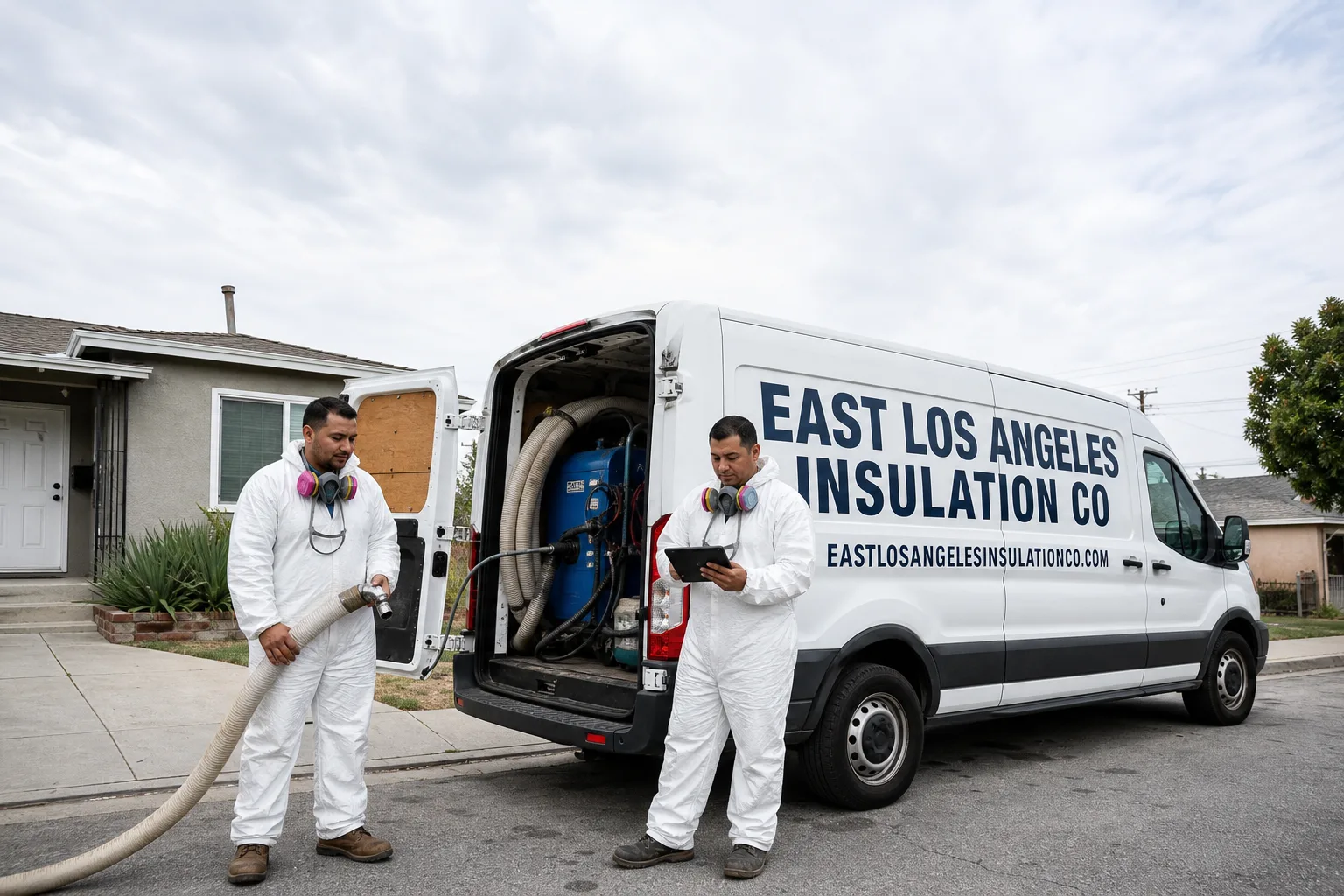
Fast, Reliable Spray Foam Insulation Across Shadow Hills
Spray foam insulation in Shadow Hills typically costs $1,800 to $4,600 for a standard attic application, and the largest variable is whether your lot includes a barn, tack room, or detached garage that also needs treatment. We respond to Shadow Hills service calls within one to two days on most requests. If you’re calling from a horse property off Wheatland Avenue or McBroom Street, we already know the kinds of rooflines, wiring, and outbuildings we’ll be working around. Ruben Acosta and our crew have been insulating the custom homes and equestrian structures of this canyon long enough that we don’t show up surprised. Call (866) 566-0304 and tell us what you’re dealing with.
Why East Los Angeles Insulation Co Is Shadow Hills’s Preferred Spray Foam Insulation Company
Shadow Hills isn’t tract housing. The homes here were built across decades, many by the original owner, with framing decisions that made sense to one builder in 1968 and to nobody since. Our competitors who quote spray foam by square footage alone miss what actually drives the job: non-standard bay spacing, vaulted ceilings that trap heat against the roof deck, and accessory structures that never had a single R-value in them. We walk the property first. We look at the attic access, the existing insulation if any, the wiring, the roofline geometry. Then we quote.
Homeowners around the 91040 ZIP code call us because we show up with eight brands and three installation methods, not one product we’re trying to unload. That matters in a neighborhood where one house needs open-cell for sound dampening against canyon wind and the next needs closed-cell for the tack room. Ruben Acosta built the team around matching the material to the structure, not the other way around, and we also handle Reflectix repair in Shadow Hills when that’s the right fit. If a spray foam approach isn’t right for your specific attic, we tell you. That’s how we keep referrals coming from Sunland, Tujunga, and the rest of the northeast Valley.
Open Cell Spray Foam in Shadow Hills
Open cell spray foam is the workhorse for Shadow Hills attics, especially on the mid-century custom homes that dominate the canyon. It expands into the cavity, seals gaps that fiberglass batts were never able to close, and adds enough R-value per inch to handle our specific problem: a summer attic that can exceed 140°F while the living space below struggles to stay at 78. The foam also does something batts can’t in this climate: it stops the stack effect that pulls superheated attic air down through recessed lights and ceiling penetrations on winter nights when the temperature can drop thirty degrees from the afternoon high.
When Shadow Hills homeowners choose open cell
A sprawling ranch-style home off the canyon roads near 91040 is exactly the candidate. We sprayed open-cell Icynene across a mid-century attic whose non-standard roofline had defeated an earlier batt package, then foamed the adjacent tack room and detached garage that had never been insulated at all. Before we covered anything, we flagged the older early NM wiring buried in the old insulation to the homeowner for an electrician, then sealed the ceiling plane so the 140°F summer attic heat stayed out of the living space and the cold canyon nights stayed in.
Cost range for open cell in Shadow Hills
Open cell spray foam in Shadow Hills runs $1.80 to $3.20 per board foot installed, which translates to roughly $2,900 to $4,600 for a 1,200-square-foot attic at typical depths. The custom rooflines common here add labor, not material cost, because our crews are cutting and fitting around beams that were never meant to be uniform. Call (866) 566-0304 for a free estimate based on your actual roof geometry.
Spray Foam Insulation Contractors in Shadow Hills
Spray foam insulation contractors working in Shadow Hills need to understand two things a generalist crew won’t: how to foam around buried legacy wiring safely, and how to treat the outbuildings most contractors ignore. The canyon’s stock of 1950s through 1980s homes includes plenty of attics with knob-and-tube or early NM conductors hidden under old insulation. Spraying foam directly over those wires can trap heat against them. A competent contractor stops, flags it, and coordinates with an electrician before the foam goes in. We do that as standard practice, not as a premium service.
Why foam spec matters on custom rooflines
Tract-home foam packages don’t survive contact with the vaulted ceilings and irregular framing bays we see throughout Shadow Hills. When the pitch changes every eight feet, you need a crew that adjusts depth and pass count on the fly. Our installers have worked enough of these attics that they can read a roof from the access hatch. That’s the difference between a continuous air seal and a pretty-looking job that leaves cold spots at the ridge.
What you’ll pay for a full foam scope in Shadow Hills
For a typical large-lot home with a 1,000 to 2,000-square-foot attic, closed-cell spray foam runs $3.50 to $5.50 per board foot, or $4,500 to $7,200 for a full attic treatment. If your job includes the barn and tack room, budget an additional $1,800 to $3,400 depending on size and condition. We quote line items separately so you see exactly what goes where. Estimates are free.
Trusted Brands We Service in Shadow Hills
We stock and install Icynene, Demilec, and CertainTeed products in our Shadow Hills-bound trucks, which means we’re not waiting on a distributor when your project is scheduled. Icynene open-cell is our most common spec for canyon attics because it performs consistently on irregular framing without sacrificing the R-value these homes need. Demilec closed-cell gets the call when we’re sealing a barn or tack room against moisture and thermal swings. For homeowners who want recycled-content options, our Spray Foam Insulation team can also discuss GreenFiber blown-in as an alternative in standard-framing attics. We carry the brand that fits the job, not the brand that fits our inventory sheet.
Common Spray Foam Insulation Problems We See in Shadow Hills Homes
- Foam covering buried knob-and-tube wiring: Several homes built before 1965 in the Shadow Hills canyon still have active legacy circuits under the insulation. Spraying foam over them without an electrician’s sign-off can create a serious fire hazard. We stop the job, flag the wiring, and wait for remediation before foam touches the area.
- Tract-home quotes applied to custom rooflines: We regularly follow contractors who priced a flat attic at $2,800, then discovered the pitched vaults and irregular framing bays that make the actual labor twice as involved. The homeowner ends up paying for the correction. We walk the roof first, measure the real geometry, and quote what the house actually needs.
- Uninsulated barns, tack rooms, and garages left untouched: On equestrian lots, the outbuildings are usually the biggest energy sink on the property and the place where summer heat radiates straight into the stall area. A spray foam job that skips them solves half the problem and saves none of the cooling cost.
- Missing radiant-barrier strategy above the foam: With attic temperatures that sustain well over 140°F from June through September, foam works harder here than it needs to when the roof deck isn’t also reflecting heat. We combine a radiant barrier with the foam ceiling plane on most Shadow Hills attics, which drops the load on the conditioned space and extends the life of the foam.
Pricing for Spray Foam Insulation in Shadow Hills, CA
A complete open-cell attic treatment in Shadow Hills runs $2,900 to $4,600 for most custom homes. Closed-cell runs $4,500 to $7,200 for a full attic, with barns and tack rooms adding $1,800 to $3,400. Older attics with legacy wiring that require electrician coordination before foam will add to the timeline, though not typically to the material cost. The two things that move your price most are the actual board footage of your roof geometry and whether the job includes outbuildings. Call (866) 566-0304 for a free, no-pressure estimate that includes a walkthrough of your specific attic and structures.
We Also Serve Cities Near Shadow Hills
We run crews regularly through Spray Foam Insulation in Shadow Hills and the surrounding northeast Valley communities. That includes Sunland, Tujunga, La Crescenta-Montrose, and Burbank, where we see similar mid-century housing stock and many of the same attic conditions. If you’re in one of those areas and dealing with an uninsulated or under-insulated custom home, call (866) 566-0304.
Serving Shadow Hills, CA - Our Local Coverage Area
We serve Shadow Hills and nearby communities. Use the map below to see the area we cover. If you’re nearby, we can almost certainly help.
FAQs About Spray Foam Insulation in Shadow Hills
Yes. Barns, tack rooms, and detached garages are a standard part of the scope on equestrian lots in Shadow Hills, and we quote them as separate line items so you can prioritize. A typical tack room in the 200 to 400-square-foot range runs $1,200 to $2,200 for closed-cell foam depending on the ceiling height and whether the structure is open-framed or finished. Detached garages usually run $1,800 to $3,000. Call (866) 566-0304 to schedule a walkthrough of all your structures.
We can foam the attic, but only after a licensed electrician evaluates and, if needed, remediates the wiring. Homes built in the 1950s through the 1980s in this canyon commonly have knob-and-tube or early NM cable under the existing insulation, and spraying foam directly over live legacy conductors creates a heat trap that can start a fire. We flag the wiring before any foam leaves the truck, wait for the electrician’s sign-off, then proceed with a clean air seal. The foam work itself is unaffected once the wiring is safe.
Spray foam is usually the better call for custom rooflines because it expands to fill irregular framing bays that fiberglass batts leave gap-ridden. The mid-century homes in Shadow Hills have vaulted ceilings, uneven beam spacing, and ridge transitions that batts can’t fully cover, which is why we see so many attics with partial batt jobs that never performed. Foam gets continuous coverage across the entire ceiling plane. If your attic is one of the rare standard-framed ones, GreenFiber blown-in may be a lower-cost alternative, and we’ll tell you when that’s honest.
Open-cell foam handles both directions when it’s paired with a radiant barrier on the roof deck. The foam seals the ceiling plane to stop superheated attic air from reaching the living space in summer and keeps interior heat from escaping during cold canyon nights. The radiant barrier reflects a large share of the 140°F-plus heat before the foam has to resist it. For outbuildings or areas with moisture exposure, we often spec closed-cell instead. Call (866) 566-0304 and describe your attic or outbuilding, and we’ll tell you which product fits.
A standard attic between 1,000 and 2,000 square feet takes one to two days of spraying, with a third day for trimming and inspection if the roofline is heavily vaulted. When the job includes a barn, tack room, or detached garage, add a day per structure depending on size. Legacy wiring that requires an electrician before foam goes in can add one to three days for scheduling. Most Shadow Hills projects are finished within a single week from start to final walkthrough.
Contact Us for Spray Foam Insulation in Shadow Hills, CA
Ready to get your Shadow Hills home, barn, or tack room properly insulated? Call (866) 566-0304 for a free estimate. Ruben Acosta and the crew at East Los Angeles Insulation Co know this canyon’s custom rooflines and equestrian outbuildings better than any generalist contractor ever will. We’ll walk your property, measure the real geometry, check the wiring, and give you a quote that covers everything, including the structures the other guys forgot to mention.
Written by Ruben Acosta, Owner at East Los Angeles Insulation Co, serving Shadow Hills and the northeast San Fernando Valley with spray foam, attic, and blown-in insulation expertise.