
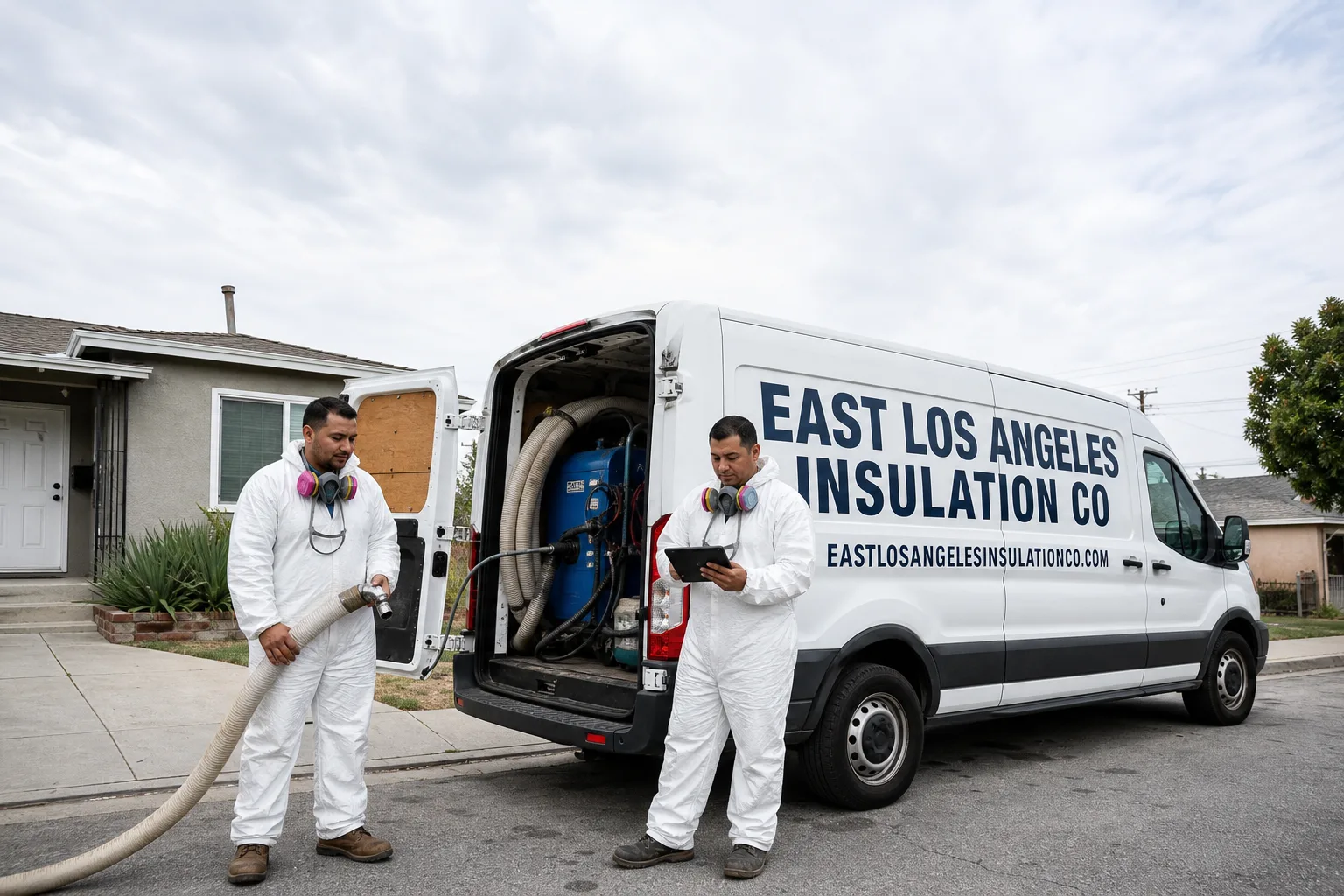
Fast, Reliable Spray Foam Insulation Across Sky Valley
Spray foam insulation in Sky Valley typically costs $2.50 – $6.80 per board foot installed, with a standard 1,200-square-foot attic running $3,100 – $5,400 and full wall cavity retrofits on older homes landing between $6,800 and $14,000 depending on closed-cell versus open-cell selection. Our crews respond to Sky Valley calls within 24 – 48 hours for quotes, because we know the high desert doesn’t wait when a windstorm blows through. If you’re fighting heat gain in August or sand infiltration after a Santa Ana event, call Ruben Acosta’s team at (866) 566-0304 and we’ll get a foam plan together that actually holds up in the 92241 climate.
Why East Los Angeles Insulation Co Is Sky Valley’s Preferred Spray Foam Insulation Company
Most insulation companies serving Sky Valley drive in from Palm Springs or the Inland Empire with whatever truck stock they loaded that morning. We come prepared for the specific failure patterns we know this high-desert plateau produces. Ruben Acosta has walked attics in Sky Valley where wind-driven sand had packed against exterior sheathing and blown-in fiberglass sat in drifts like dune ridges. That’s not a problem you solve by guessing from a brochure.
What sets us here apart is simple: we carry two closed-cell foams rated for intense UV and temperature swing conditions. Icynene and Demilec. We also keep open-cell on the truck for interior cavity work where sound dampening matters more than an air barrier. You don’t have to accept one product. You get an honest conversation about which foam behaves correctly in Sky Valley’s specific environment, not in Vancouver’s.
Sky Valley homeowners call us because we show up on time, quote from actual measurements, and don’t upsell batts when foam is the correct call. Our Spray Foam Insulation team treats this area as a distinct service territory, not an add-on to a Los Angeles route. That means we schedule for desert conditions: early morning starts in summer, wind-aware material handling, and flash times adjusted for single-digit humidity.
Spray Foam Attic Insulation in Sky Valley
Spray foam attic insulation in Sky Valley is the highest-impact upgrade you can make to a 1970s-90s home with original R-11 to R-19 fiberglass or batt insulation. We see these attics every week in the 92241 area: thin batts sagging between trusses, gable vents sucking in sand, and afternoon heat radiating through the ceiling by 3 p.m. The fix starts with air-sealing every penetration, then applying closed-cell foam directly to the underside of the roof deck to create a conditioned, wind-resistant attic space.
Attic foam work in Sky Valley runs $2.80 – $5.60 per board foot for closed-cell, with most single-family homes landing between $4,200 and $8,900 depending on roof geometry and whether we’re sealing the deck or just the top plates. Manufactured homes with lower roof pitches typically come in on the lower end. The payback is immediate in July when your attic stops acting like a heat battery.
Roof Deck Air-Sealing
We bond foam directly to the roof deck sheathing, sealing every gap where wind-driven sand pushes through. This converts your attic from a vented, leaky space into a conditioned buffer that stops afternoon heat gain before it reaches your living area. We’ve done this on enough Sky Valley homes to know it also cuts the dust load inside the house, because the same gaps that leak heat leak sand.
Top Plate and Gable Vent Sealing
The most common call we run after a Sky Valley windstorm is a gable vent inspection. Sand packs against the sheathing, fiberglass drifts, and the envelope is effectively open. Closed-cell foam around top plates and gable penetrations seals the leaks permanently, not seasonally. This is the step most single-product installers skip because they never see the wind damage up close.
Spray Foam Wall Insulation in Sky Valley
Spray foam wall insulation in Sky Valley is the answer for older wood-framed and manufactured homes where wall cavities were built with nothing, or with batts that have settled and pulled away from framing over three decades of temperature cycling. Here the job is different from coastal California: we’re not fighting moisture, we’re fighting air movement and thermal swings. Closed-cell foam injected into wall cavities locks the framing, blocks wind intrusion, and creates a continuous air barrier along the building envelope.
Wall cavity foam for Sky Valley homes runs $3.10 – $6.80 per board foot depending on cavity depth and whether we’re doing a full stud-bay fill or a flash-and-batt hybrid. A 1,500-square-foot home with 2×4 walls typically lands between $7,500 and $12,900. We quote from cavity volume, not square footage, because you deserve to know exactly what’s being installed.
Closed-Cell Retrofit for Existing Walls
We inject closed-cell foam through small access points into existing wall cavities where batts have slumped or blown-in fiberglass has compacted. The foam expands to fill the cavity, adheres to the sheathing, and creates a structural and air barrier in one pass. On the 1970s home we worked off the desert lots, exterior wall batts were literally hanging loose after a windstorm. Closed-cell bond solved that permanently.
Open-Cell Applications for Interior Partitions
For interior walls where you want sound control between rooms, open-cell spray foam is the more economical choice. It’s also appropriate for some interior ceiling cavities. But we rarely specify open-cell for Sky Valley exterior walls, because the high-desert UV exposure and 100°F-plus surface temperatures make it a poor match for long-term exterior performance. Ruben will tell you the same thing in person.
Trusted Brands We Service in Sky Valley
We install and service spray foam from Icynene and Demilec for closed-cell applications, and carry GreenFiber blown-in products for hybrid attic work where a foam-plus-blown combination makes more sense. Icynene closed-cell is our primary wall cavity spec for Sky Valley because it bonds aggressively to dry desert wood and tolerates the thermal cycling better than open-cell alternatives. Demilec gives us a second closed-cell option when ceiling temperatures or UV exposure demand a specific formulation. We don’t stock brands because a distributor gave us a deal. We stock them because they perform in this climate, and our Sky Valley customers shouldn’t have to wait a week for a product order when a project is ready to go.
Common Spray Foam Insulation Problems We See in Sky Valley Homes
- Wind-driven sand packing against sheathing. Gable vents and wall penetrations let sand push into wall and attic cavities, bypassing poorly bonded foam. The foam is there, but the envelope isn’t sealed. We identify and seal every penetration before injecting foam.
- UV degradation of exposed foam. Where foam is left uncovered in attics or knee walls, intense high-desert UV breaks down the surface layer and causes off-gassing. We cover or re-coat exposed foam as part of every attic job. Sky Valley’s UV index punishes anything left bare.
- Bond failure from temperature swings. Extreme day-to-night swings stress the foam-to-substrate bond. Open-cell foam especially can crack and pull away from framing over a few desert seasons. Closed-cell Icynene or Demilec holds the bond far longer in this climate.
- Drifted and compacted blown-in fiberglass. After a summer windstorm, we routinely find fiberglass piled like dunes in one corner of an attic and bare decking elsewhere. The R-value is gone in half the space. Foam air-sealing and a proper attic deck application stops the drift entirely.
Pricing for Spray Foam Insulation in Sky Valley, CA
Sky Valley spray foam pricing falls into three clear bands. Attic roof-deck applications: $2.80 – $5.60 per board foot. Wall cavity retrofits: $3.10 – $6.80 per board foot. Rim joist and gable sealing: $1.90 – $3.40 per linear foot. A full attic on an older single-family home in the 92241 area typically runs $4,200 – $8,900, while whole-wall retrofits on a 1,500-square-foot home land between $7,500 and $12,900. What moves the number? Cavity depth, roof pitch, access difficulty through existing drywall, and whether we’re doing air-sealing as part of the foam job, which we almost always are in Sky Valley. Manufactured homes run lower because cavities are shallower and access is simpler. Call (866) 566-0304 and Ruben’s team will give you a free, measured quote with a written price before any material is ordered. No per-inch surprises after we open a wall.
We Also Serve Cities Near Sky Valley
Our crews work throughout the Coachella Valley high desert. You’ll find us in Thousand Palms on older tract homes with original batt insulation, in Desert Hot Springs where wind exposure issues parallel Sky Valley’s, in Cathedral City and Rancho Mirage on larger custom homes needing roof-deck foam. If you’re in any of these areas, our Sky Valley crew covers the route regularly. Call (866) 566-0304 to get on the schedule.
Serving Sky Valley, CA - Our Local Coverage Area
We serve Sky Valley and nearby communities. Use the map below to see the area we cover. If you’re nearby, we can almost certainly help.
FAQs About Spray Foam Insulation in Sky Valley
Yes, spray foam makes complete sense in Sky Valley’s dry climate, and in fact closed-cell foam is better matched to this environment than it is to coastal California. Here the job is air-sealing and heat-gain resistance, not moisture migration. Closed-cell foam locks out wind-driven sand, blocks radiant heat transfer, and doesn’t absorb what little moisture exists. The dry desert is where closed-cell spray foam earns its cost fastest.
Call (866) 566-0304 for a free attic inspection and we’ll show you exactly where your current insulation is failing in the dry air.
We recommend closed-cell for Sky Valley exterior walls because the high-desert temperature swings and UV exposure crack open-cell foam’s bond to framing over just a few seasons. Open-cell also admits air movement, which means wind-driven sand can still work through the foam matrix. Closed-cell Icynene or Demilec forms a solid, structural air barrier that holds its bond through 40-degree overnight drops and 100°F-plus afternoons.
If you’re deciding between the two, call (866) 566-0304 and ask for Ruben directly. He’ll walk you through the honest comparison for your specific walls.
Yes. Spray foam fixes drifted insulation permanently because it doesn’t sit loose on the attic floor like fiberglass does. Closed-cell foam bonds to the roof deck and gable framing, sealing the gaps that let wind push through. Once the deck is foamed and gable penetrations are sealed, there’s no air path left to shift insulation. We’ve performed this correction on dozens of Sky Valley homes, including a 1970s off the desert lots where the gable vents were the entire problem.
For a permanent fix instead of another re-blow, call (866) 566-0304.
Yes, spray foam applies well to Sky Valley’s older single-family and manufactured homes. The key is cavity depth and sheathing condition. 2×4 walls take closed-cell foam easily, and manufactured home roof decks are straightforward to air-seal from inside the attic. Many of these homes were built with R-11 to R-19 insulation that’s now compacted or drifted. We inspect before quoting so you’re not paying for foam in a cavity that can’t hold it.
Ruben has walked through enough Sky Valley manufactured homes to know exactly what to expect. Call (866) 566-0304 to schedule that walk-through.
UV exposure degrades exposed spray foam quickly in Sky Valley’s high-desert sun, which is why Reflectix repair in Sky Valley is often needed on reflective barriers that face similar UV damage. The foam surface chalks, breaks down, and can off-gas when left uncovered. That’s why we never leave foam bare in an attic or kneewall application. We cover it with a thermal or ignition barrier, or we specify a foam formulation designed to handle the UV load. Sky Valley’s UV index is unforgiving, so we plan for it from the start.
For a free evaluation of your attic’s current condition, call (866) 566-0304 and ask for the Sky Valley crew.
Written by Ruben Acosta, Owner at East Los Angeles Insulation Co, serving Sky Valley and the Coachella Valley high desert.