
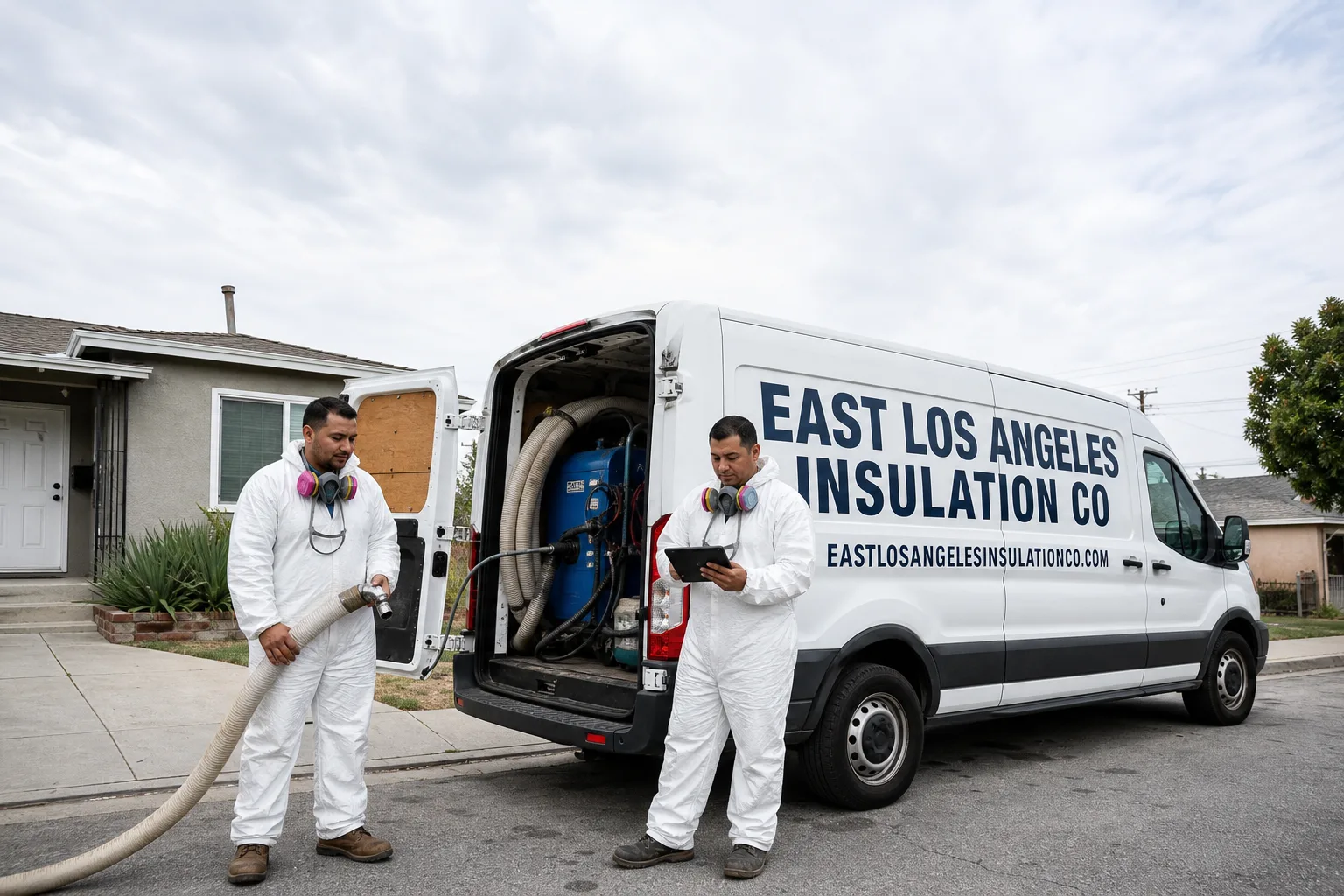
Fast, Reliable Spray Foam Insulation Across South San Jose Hills
If your South San Jose Hills home was built in the 1960s or 70s, there’s a good chance your attic has little or no insulation, and what’s there has settled into something closer to a blanket for heat than a barrier against it. Our spray foam work in the 91792 zip solves that by sealing the actual gaps in your framing, not just covering them. Most jobs in South San Jose Hills run from $2,800 to $6,900 depending on attic size and whether we’re doing open-cell or closed-cell. Call (866) 566-0304 and we’ll give you a straight answer on what your house needs.
Why East Los Angeles Insulation Co Is South San Jose Hills’s Preferred Spray Foam Insulation Company
Ruben Acosta leads our crew, and he’s spent enough time in South San Jose Hills attics to know exactly what this neighborhood throws at you: low-pitch roofs, cathedral ceilings with inches of clearance, and decades of stucco-to-wood gaps that were never sealed when these homes went up. That kind of local knowledge matters when you’re deciding between dense-pack, open-cell flash coating, or a full closed-cell retrofit. We don’t guess. We measure, inspect, and tell you what’s actually there.
Homeowners in Valinda and Rowland Heights also call us for the same reason: we show up when we say we will, and we bring eight brands with us, not one. Icynene, Demilec, GreenFiber, CertainTeed. That means the recommendation you get is based on your roof pitch and your vent placement, not on what we happen to have in the truck. Our response time to South San Jose Hills is typically same-day for estimates and under five business days for most installs, depending on scope.
Open Cell Spray Foam in South San Jose Hills
Open Cell Spray Foam is the product we reach for most often when a South San Jose Hills home has a cramped attic and a low-pitch composition roof that never left room for batts. It expands into the rafter bays and seals the gaps that original 1960s framing left behind, especially around stucco-to-wood seams and electrical penetrations. It’s a smart choice here because it still lets the roof assembly breathe while cutting the radiant heat that turns west-facing second-story rooms into ovens by mid-afternoon. Pricing for open-cell in a typical South San Jose Hills ranch runs $2,800 to $4,500 for attic flashing and rafter bay work.
How We Handle Low-Pitch Cathedral Ceilings
Those ceiling shapes from the late-1950s and 60s leave almost no room between the drywall and the roof deck. We often flash-coat the rafter bays with an open-cell like Icynene and then dense-pack the flat fields with GreenFiber, which keeps the vent path intact. That’s not a code-driven upgrade, it’s a retrofit designed around the geometry these homes actually have.
When Open-Cell Outperforms Closed-Cell
Open-cell tends to work better in South San Jose Hills attics with narrow soffit and gable vents because it lets some vapor pass rather than trapping it against the roof deck. Inland San Gabriel Valley summers are dry, so the moisture risk is lower, and the air-sealing is what matters most. We’ll run through the tradeoffs with you before we spray anything.
Spray Foam Insulation Contractors in South San Jose Hills
Spray Foam Insulation Contractors who don’t understand these older unincorporated tract homes will often put foam where it doesn’t belong and block the vent path. We see it on follow-up calls all the time. A 1960s ranch with original single-pane windows and no attic insulation was never detailed for an airtight roof assembly, so the prep work matters more than the spray itself. We spend as much time air-sealing the framing, gable ends, and around the chimney chase as we do on the actual foam. Typical closed-cell retrofits in South San Jose Hills run $3,800 to $6,900 depending on square footage and roof condition.
We’re a Dedicated Insulation Crew, Not a Generalist
You won’t see us trying to sell you a water heater or a new roof. We do attic insulation, spray foam, and blown-in, and that’s it. That focus is why we stock products like Demilec’s closed-cell for areas that need higher R-value per inch, and why we can tell you in plain English whether spray foam is even the right call for your home, or whether dense-pack GreenFiber gets you 90 percent of the result for less money.
Prep Work We Don’t Skip
Before any foam goes in, we check the roof deck, the vent configuration, and the framing seams. On these low-pitch roofs, if you don’t seal the stucco-to-wood joints and then you foam, you can trap heat and moisture in the living space instead of venting it. We’d rather spend an extra hour prepping than leave you with a hot, sealed box that cooks through August.
Trusted Brands We Service in South San Jose Hills
We install Icynene and Demilec spray foam in South San Jose Hills because these two brands have field records that hold up on older, low-pitch roof assemblies. We also stock CertainTeed and GreenFiber for dense-pack and blown-in work, which means we can mix methods on the same job without running back to the warehouse. Most single-brand installers can’t do that. If we’re called out to a home near the Rowland Heights edge of 91792, we show up with the product already matched to the job, and we keep enough local stock in inventory to avoid mid-project delays.
Common Spray Foam Insulation Problems We See in South San Jose Hills Homes
- Zero existing insulation in the attic. Many of these late-1950s and 60s tract homes went up before Title 24 energy codes, and nobody ever went back to add anything. We regularly open a gable vent here and find bare ceiling joists staring back at us.
- Cathedral ceilings with only inches of rafter depth. That’s why batts don’t work in so many 91792 homes. We dense-pack the flat fields and flash-coat the rafter bays, but only after confirming the vent path stays open.
- Soffit and gable vents that are undersized or blocked. These older homes relied on narrow vents that were never meant to handle an airtight roof assembly. Foam has to be planned around them, not sprayed over them.
- Stucco-to-wood seams left open from the original build. The 1960s framing around these wood-frame stucco homes left gaps that let Inland Valley afternoon heat flow straight into the second story. Foam can seal them, but only if the installer knows to look.
Pricing for Spray Foam Insulation in South San Jose Hills, CA
We Also Serve Cities Near South San Jose Hills
Our crews work Valinda, Walnut, West Covina, and Rowland Heights every week, so if you’re just across the unincorporated line, we can still get to you fast. For a deeper look at how this service works in your specific area, visit our Spray Foam Insulation hub page. And if you’re reading this from a neighboring zip, you can also see more about the local angle on South San Jose Hills.
Serving South San Jose Hills, CA - Our Local Coverage Area
We serve South San Jose Hills and nearby communities. Use the map below to see the area we cover. If you’re nearby, we can almost certainly help.
FAQs About Spray Foam Insulation in South San Jose Hills
Can you spray foam a South San Jose Hills ranch with a low-pitch roof and a cramped cathedral ceiling?
Yes, and it’s one of the most common jobs we do in 91792. The approach is different from a standard attic: we flash-coat the rafter bays with open-cell foam and dense-pack the flat fields rather than trying to lay batts that won’t fit. Those low-pitch roof assemblies leave inches of depth, not feet, so the technique has to match the geometry. Call (866) 566-0304 and we’ll inspect yours before recommending anything.
Why do so many 91792 attics have no insulation at all?
Because these homes were built from the late 1950s through the 1970s, before California’s Title 24 energy code existed. Builders here in unincorporated South San Jose Hills had no reason to add material that wasn’t required, and most homeowners never went back to retrofit. We find bare joists and empty rafter bays on the majority of homes we open up in this neighborhood.
Will spray foam seal the stucco-to-wood seams on my older South San Jose Hills home?
Yes, if the installer knows to look for them. Those original wood-frame stucco homes have gaps where the framing meets the exterior, and open-cell spray foam is one of the best materials for sealing them from the inside. But you have to prep the area and know where the vent path runs, or you’ll seal in the heat instead of out. That prep is part of every spray foam job we quote in South San Jose Hills.
Do the narrow soffit and gable vents on these old homes complicate a spray foam job?
Yes, and they should. If a contractor sprays over those vents or ignores the airflow path, you get a sealed attic that traps heat and moisture against the roof deck. We map the venting before we spray and design the foam thickness around it, not over it. That’s the difference between a retrofit that works and one that makes your second floor hotter.
Should I repair or fully retrofit the insulation in an older South San Jose Hills home?
In almost every case, you should retrofit, not repair. The insulation that exists in most of these homes is thin, settled, or missing entirely. Adding a little more on top won’t fix the gaps at the framing, and it won’t address the stucco-to-wood seams. A full retrofit, whether spray foam, dense-pack, or a combination, pays back faster in this climate because the summer heat load is so high.
Call (866) 566-0304 for a free estimate on spray foam insulation in South San Jose Hills. We’ll inspect your attic, check your roof pitch and vent path, and give you a written quote. No pressure, no vague numbers, just what your house actually needs.
Written by Ruben Acosta, Owner at East Los Angeles Insulation Co, serving South San Jose Hills and the surrounding area.