
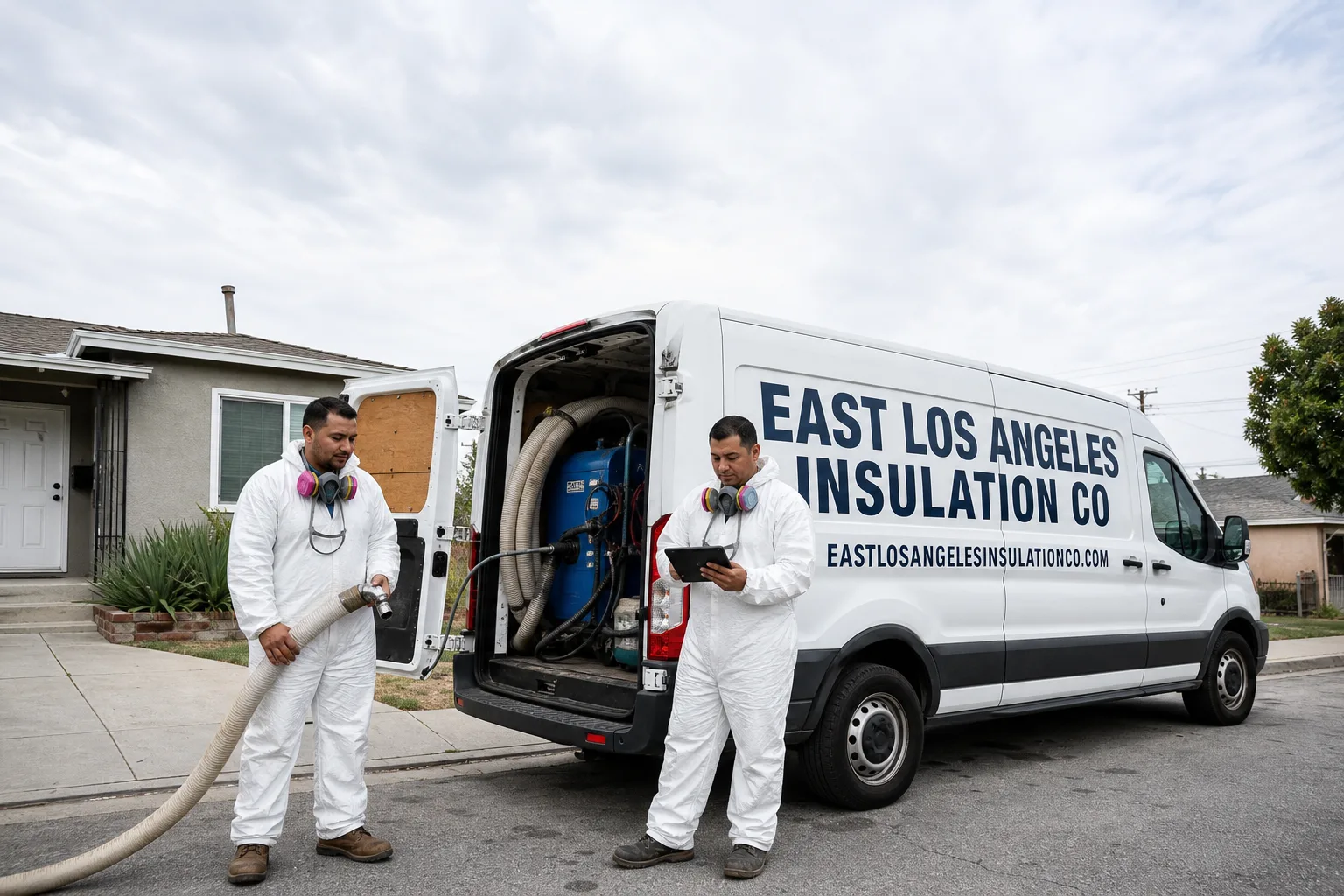
Fast, Reliable Spray Foam Insulation Across Studio City
Spray foam insulation in Studio City usually costs between $2,800 and $7,500 for a typical attic or rim joist project, and our crew reaches most Studio City neighborhoods the same week you call. We work the winding hillside streets off Laurel Canyon, the mid-century ranches south of Ventura Blvd, and everything in between. Ruben Acosta built East Los Angeles Insulation Co around one idea: the right insulation for your home, not just what we happen to stock. If your attic bakes in Valley heat or your energy bill climbs every August, call (866) 566-0304 and we’ll tell you straight whether spray foam is the right fix.
Why East Los Angeles Insulation Co Is Studio City’s Preferred Spray Foam Insulation Company
We’ve spent enough time in Studio City attics to know what separates a hillside home off Coldwater from a flat-lot ranch south of the Boulevard. The difference isn’t just geography. It’s how the sun hits the roof, how the roofline meets the grade, and what happens inside those cavities when the temperature climbs past 100°F.
Ruben leads a team that installs spray foam, blown-in, and attic insulation in-house. That matters in Studio City because so many homes here need a hybrid approach: closed-cell foam on the roof deck, blown-in in the flat attic sections, maybe batts in a knee wall. Most contractors sell you what’s on the truck. We match the product to the cavity.
Studio City homeowners call us because we show up with a plan, not a pitch. We’ll tell you when open-cell makes sense and when it doesn’t. We’ll tell you if your attic needs ventilation work before foam goes in. That honest diagnostic work is why our Spray Foam Insulation team keeps getting referrals from Laurel Canyon to the 91604 flats.
Closed Cell Spray Foam Insulation in Studio City
Closed Cell Spray Foam Insulation in Studio City is the workhorse for hillside homes where the roof deck sits near grade and standard batts simply won’t fit. A typical closed-cell roof deck application in Studio City runs $4,000 to $8,500 depending on square footage and access. The foam cures into a rigid air barrier and vapor retarder all at once, which is exactly what a semi-buried attic cavity needs when the uphill side of the roof nearly touches the hillside.
Where It Belongs
The homes off Coldwater Canyon and Laurel Canyon often have attic spaces that are half crawlspace. The uphill roof deck angles down until there’s maybe 18 inches between sheathing and grade. Batts can’t be compressed into that space without losing their R-value. Blown-in blows right out the soffit gaps. Closed-cell foam adheres directly to the sheathing and seals the cavity from hot Valley air infiltration.
What It Costs
For a 1,200 to 1,600 square foot attic in Studio City’s 91604 zip, plan on $5,000 to $7,200 for closed-cell on the roof deck. Rim joist work in a mid-century crawlspace typically lands between $900 and $2,200. The material costs more than open-cell, but you’re buying structural rigidity, a built-in vapor barrier, and R-6.5 to R-7 per inch in one pass.
Open Cell Spray Foam in Studio City
Open Cell Spray Foam in Studio City costs less per board foot and works well in wall cavities, rim joists, and vented attics where moisture has a path out. Expect $1,800 to $5,800 for a typical Studio City wall cavity or attic floor project. The foam expands aggressively and fills irregular shapes, which is a real advantage in the 1940s and 1950s post-and-beam homes south of Ventura where framing is anything but square.
Where It Belongs
Open-cell makes sense for interior wall cavities and rim joists in Studio City’s mid-century housing stock. The foam gets into the gaps around old framing, around plumbing penetrations, around everything. R-value lands around R-3.7 per inch, so you need more thickness to hit the same numbers as closed-cell. In a vented attic with proper airflow, that’s fine. In a sealed, near-grade hillside roof deck, it’s not.
Where It Does Not Belong
Do not put open-cell on the underside of roof sheathing in a Studio City attic without confirming proper ventilation. Inland Valley heat pushes moisture into the assembly, and open-cell holds that moisture against the wood. We’ve pulled delaminated open-cell out of attics where condensation rotted the sheathing. If the attic isn’t vented correctly, closed-cell is the safer call.
Trusted Brands We Service in Studio City
We install Demilec and Icynene spray foam systems, both with established field performance records and manufacturer product warranties. We also stock Owens Corning and Johns Manville batt products for Studio City homes that need spot replacement in knee walls or cantilevered floor sections. Carrying eight brands means we’re not married to one product’s limitations. When a Studio City homeowner asks what’s best for a 1958 hillside ranch, we point to the product that fits, whether that’s Demilec closed-cell, GreenFiber blown-in, or Rockwool batts. Parts and materials stay local, so turnaround in 91604 and 91614 doesn’t stall waiting on a warehouse order.
Common Spray Foam Insulation Problems We See in Studio City Homes
- Exothermic overheating on sun-blasted roof decks. On a hot August day, a low-slope Studio City roof can hit 140°F at the sheathing. Spraying closed-cell too thick in one pass on a hot deck traps heat inside the foam as it cures, which shrinks the foam and pulls it off the rafters. We stage passes and watch deck temperature before we ever pull a trigger.
- Uneven coverage in hillside knee-wall cavities. Attics off Laurel Canyon and Coldwater often have irregular knee walls where the roofline tucks into the hillside. A rushed crew misses the outside corners and leaves unsealed gaps. Hot Valley air finds those gaps fast, and the homeowner pays to condition air that leaks straight out.
- Open-cell used where it should not be. We see open-cell on the underside of roof sheathing in unvented attics all over Studio City. The inland heat drives moisture into that foam, and the sheathing begins to rot. By the time the homeowner notices the musty smell, the damage is done.
- Soffit gaps blowing out blown-in work. In older Studio City homes where the roof meets the hillside, soffit details are often open to the outside air. Blown-in insulation gets pushed right out those gaps on the uphill side. We seal the soffit line first, then insulate. You can’t skip that step on a hillside.
Pricing for Spray Foam Insulation in Studio City, CA
Closed-cell spray foam in Studio City typically runs $5,000 to $8,500 for a roof deck application. Open-cell wall or rim joist work lands between $1,800 and $5,800. A combined job, say closed-cell on the roof deck plus open-cell in rim joists, usually falls in the $6,500 to $10,000 range for a standard mid-century ranch. Square footage, access, and existing insulation removal all move the number. Hillside attics with tight, near-grade cavities add labor because the tech is working in a space where he can’t stand upright. Call (866) 566-0304 and we’ll give you an exact quote. Estimates are free, and we walk the attic with you before quoting anything.
We Also Serve Cities Near Studio City
Our crew covers Spray Foam Insulation in Studio City and the surrounding areas, including North Hollywood, Universal City, Sherman Oaks, and West Hollywood. If you’re in the Valley on a hill or in a flat-lot ranch nearby, we’ll bring the same crew and the same eight-brand lineup.
Serving Studio City, CA - Our Local Coverage Area
We serve Studio City and nearby communities. Use the map below to see the area we cover. If you’re nearby, we can almost certainly help.
FAQs About Spray Foam Insulation in Studio City
Closed-cell foam is the only air barrier that works in the semi-buried attic cavities where your uphill roof deck sits within inches of grade. Fiberglass batts can’t be installed in those tight spaces without compressing. The foam seals the cavity, stops air infiltration, and adds structural rigidity to the roofline. Call (866) 566-0304 and we’ll tell you whether your hillside attic is a candidate.
Yes, if the attic is vented properly. Open-cell works well in wall cavities, rim joists, and vented attic floors in the mid-century homes south of the Boulevard. If your attic is sealed or the sheathing shows signs of past moisture, closed-cell is the safer product. We’ll assess the venting before we quote.
Closed-cell foam applied directly to the roof sheathing stops radiant heat transfer before it enters the living space. On a 140°F August afternoon, the underside of a properly foamed roof deck stays within a few degrees of the conditioned space. That’s the fix for the rooms that bake every summer.
Spraying too thick in one pass on a hot day. The exothermic reaction cooks the foam, it shrinks, and it delaminates from the rafters. We stage the passes, watch deck temperature, and let the foam cure before spraying the next layer. Rushing this step is how attics end up with gaps that leak hot air all summer.
For most existing-home insulation retrofits, no permit is required. New construction or additions that include insulation are covered under the building permit. If your project triggers a permit, we’ll tell you before we start work. For a specific answer about your Studio City property, call (866) 566-0304.
Written by Ruben Acosta, Owner at East Los Angeles Insulation Co, serving Studio City and the San Fernando Valley with spray foam, blown-in, and attic insulation.