
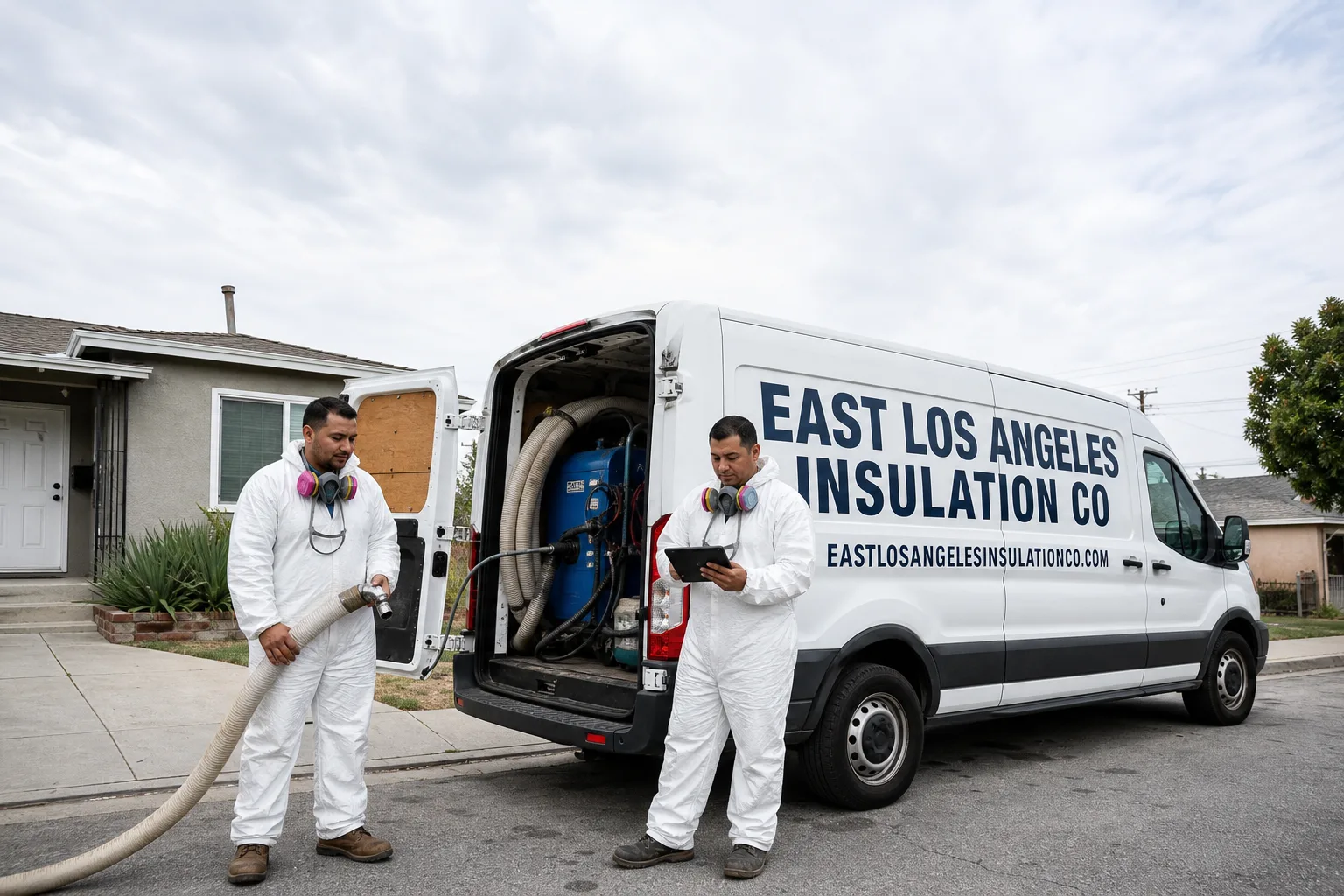
Fast, Reliable Spray Foam Insulation Across Upland
Spray foam insulation in Upland typically runs $2,800 – $7,500 for a full attic air-seal and insulation job, depending on whether the home needs open-cell or closed-cell foam, and most projects are completed in one or two days. Ruben Acosta and our crew know this city well: the heat that presses down on foothill homes in July, the older tract houses near downtown that leak air through original wall cavities, and the newer custom builds up in the 91784 slopes with vaulted ceilings that punish standard insulation. We aren’t a general contractor splitting time across trades. We’re a dedicated insulation team, and spray foam is what we do more than anything else. Call (866) 566-0304 for a free estimate and we’ll come out to your Upland home, inspect the actual framing and existing insulation, and tell you whether spray foam makes sense for how your house is built.
Why East Los Angeles Insulation Co Is Upland’s Preferred Spray Foam Insulation Company
We stock and install eight industry brands, but the spray foam side of the work leans heavily on Icynene and Demilec, two product lines with long field records in the performance insulation category. That matters in Upland because foothill custom homes and older slab-on-grade tract houses demand very different foam formulations, and a single-brand installer can’t always match the product to the framing. Ruben Acosta built this company around one principle: carry the right insulation for the home, not just whatever’s on the truck. We also do blown-in and batts, but spray foam remains the service most Upland homeowners call us for when they’re done patching drafts with caulk and want the house sealed at the source.
Our crews respond to Upland calls across all three ZIP codes: 91784 up in the foothills, 91786 around the downtown core, and 91785 in between. When a homeowner near Euclid Avenue or up toward Mountain Avenue calls about a sweltering upstairs bedroom, we can usually be out for a diagnostic visit within a couple days, and installation scheduling runs tight because the foam itself requires dry substrate and temperatures above about 50 degrees during application. We tell customers this upfront because Upland’s winter mornings in the 30s can push an exterior rim joist job by a day or two, and nobody wants to find that out after the crew arrives.
Spray Foam Attic Insulation in Upland
Spray foam attic insulation in Upland is the job we do most often for foothill custom homes with vaulted, exposed-beam ceilings, and it involves sealing and insulating the rafter bays directly rather than burying a flat attic floor. The first question we ask is whether the attic is vented or unvented, because that changes the product choice: open-cell foam for vented attics, closed-cell when the deck needs to double as an air and moisture barrier. Upland homes in the 91784 slopes frequently have cathedral ceilings with no attic access at all, which means the foam has to go into the rafter bays from below before the drywall or finish work is done. Closed-cell foam runs $1.50 – $3.00 per board foot installed in Upland, and an open-cell attic job generally lands between $2,800 and $5,500 for a whole ceiling plane.
Vaulted and Beam-Filled Rafter Bays
Foothill homes in Upland often expose their rafter bays with decorative beams, and those deep bays are where closed-cell foam earns its cost. The foam is sprayed into each bay, allowed to expand, then trimmed flush around the beam lines and any wiring chases. The work demands patience because trimming too aggressively cuts into the air seal, and leaving too much foam interferes with the finish carpenters.
Flat-Ceiling Attic Decks in Older Upland Tract Homes
Down in central Upland, especially the 1950s-1970s houses in 91786, the attic is a flat space with shallow ceiling joists and maybe R-11 fiberglass from the Eisenhower era. The spray foam goes directly against the top plates and into the joist bays to stop the stack effect: hot air rising through the house all summer, and cold air pouring down through the ceiling on 30s winter nights. A typical flat attic in Upland takes our crew one day to prep and spray, and the difference in bedroom comfort is immediate.
Spray Foam Wall Insulation in Upland
Spray foam wall insulation in Upland is the fix for homes with original, under-insulated walls, and in this city that means a lot of mid-century tracts on slab foundations where there’s no crawlspace to correct from below. Those 1950s-70s homes in central Upland often have empty or barely-filled wall cavities, and the only real solution is either blowing in dense-pack cellulose or injecting spray foam through small access holes from the interior or exterior. Open-cell foam is the common choice for wall retrofits because it expands gently and fills odd stud cavities without bowing drywall. Wall injection foam in Upland runs $1.00 – $2.50 per square foot of wall area depending on cavity depth and access, and a 1,200-square-foot home with original walls typically lands in the $3,500 – $7,000 range.
Slab-on-Grade Homes Without a Crawlspace
In Upland’s older downtown core around 91786, most houses sit on a slab, so heat gain through the walls has nowhere to go except into the living space. That’s why wall prep matters more here than almost anywhere else we service. We inspect the existing cavity, check for settlements and old wiring conflicts, then foam the cavity in lifts so the expansion doesn’t crack the interior plaster or sheetrock.
Exterior Wall Injection for Footing-to-Plate Sealing
For some Upland homes, especially stucco-walled ranches along Euclid or Foothill Boulevard, the better path is exterior injection behind the siding or stucco. We drill small ports, foam from the outside in, and patch the ports cleanly. The foam seals the band joist area where the wall meets the slab, which is the single biggest air leak in a typical slab-on-grade Upland house.
Trusted Brands We Service in Upland
When we spray foam for Upland homeowners, we’re working with Icynene and Demilec product lines, two brands we carry because their expansion consistency and long-term performance records measure up to the abuse Upland’s weather throws at them. For homeowners who want a lower-carbon option in attics or walls, we also offer GreenFiber blown-in or dense-pack cellulose as a complement to foam air-sealing. And for rim joist work or non-combustible wall cavity fills, we keep Rockwool mineral wool in the mix. The point is choice. Most Upland insulation calls get one product because that’s what the installer stocks. We carry the right tool for the house, and we’ll tell you why one brand fits your framing better than another when we come out.
Common Spray Foam Insulation Problems We See in Upland Homes
- Open-cell foam sprayed too thick in vaulted rafter bays. In the 91784 foothills, deep beam-filled bays tempt installers to overfill, but open-cell foam more than about 5 – 6 inches deep can pull away from the deck and lose its air seal. We see this on homes where a previous crew chased R-value numbers instead of installation quality.
- Foam applied over unsealed beam-to-deck gaps in exposed-beam ceilings. Upland’s custom foothill homes often have decorative beams that don’t sit tight against the roof deck, and expansion pressure pushes foam through the gaps where it cracks against custom interior finishes. The fix is a pre-fill seal pass before the main spray.
- Missed wall cavity prep in 1950s-70s central Upland tract homes. Slab-on-grade houses in 91786 have no crawlspace to catch air leaks, so a wall that isn’t prepped and fully filled shows up as a hot bedroom in August and a cold corner in December. Skipping the inspection on these walls means the foam can’t fix what the framing already allowed.
- Thermal bridges around exposed beams in foothill ceilings. Wood beams conduct heat differently than the foam around them, and in Upland’s 90s-100s summer heat, that bridge becomes a hot stripe across the ceiling. We address this by ensuring the foam locks tight to both sides of each beam, reducing the conduction path.
Pricing for Spray Foam Insulation in Upland, CA
Real numbers from our recent Upland jobs: a flat-ceiling attic air-seal with open-cell foam in a 1,500-square-foot central Upland home ran about $3,400. A vaulted, exposed-beam great room ceiling in the 91784 foothills, closed-cell foam with trimming and detail work around the beams, came in just under $5,800. Wall injection on a mid-century slab-on-grade ranch near San Antonio Heights was $4,200 for all exterior walls. Every Upland estimate is free, and Ruben Acosta will walk through the framing, existing insulation, and the exact product choice before you spend a dollar. Call (866) 566-0304 and we’ll bring the pricing worksheet to the site.
We Also Serve Cities Near Upland
From our base in East Los Angeles, we run crews into San Antonio Heights, Claremont, Montclair, and Rancho Cucamonga each week. If you’re in one of those nearby cities, Spray Foam Insulation in Upland is the page that maps to our overall Spray Foam Insulation service area. We treat the whole corridor as one service territory and schedule Upland-area calls as a single route.
Serving Upland, CA - Our Local Coverage Area
We serve Upland and nearby communities. Use the map below to see the area we cover. If you’re nearby, we can almost certainly help.
FAQs About Spray Foam Insulation in Upland
Yes, and it’s one of our most common Upland projects. We recently foamed the vaulted great-room ceiling of a custom home up in the foothill area off the 91784 slopes, where exposed decorative beams left deep, open rafter bays that batt insulation could never seal. Our techs sprayed closed-cell foam, Icynene and Demilec lines, into each bay to seal the beam-to-deck gaps and stop the afternoon heat driving in from the San Gabriel Mountain sun, then trimmed it flush around the smart-home wiring runs. The homeowners got a quieter, tighter ceiling that pairs cleanly with their custom finishes instead of the drafts and heat gain they’d had before. Closed-cell foam for a vaulted Upland ceiling with beam detail typically runs $4,500 – $8,000 depending on square footage and trim complexity. Call us for a site-specific quote.
Yes, but the work has to go into the walls, not under the floor. Downtown Upland’s 91786 houses sit on slab-on-grade foundations, so there’s no underfloor cavity to seal. That means wall injection or dense-pack work is the only path to fix the original, under-insulated stud cavities those 1950s-70s homes were built with. Spray foam injected through small ports is the most thorough option, and our crews prep each cavity so the foam fills completely without bowing drywall. Wall injection in older Upland homes runs $1.00 – $2.50 per square foot of wall area. Call (866) 566-0304 for a detailed estimate.
Yes, because spray foam addresses both directions of heat flow. Upland sits in the foothills of the San Gabriel Mountains, where the inland location means summer afternoons push into the high 90s and winter early mornings drop to the 30s, and homes here experience both extreme cooling loads and real heating demand. Air sealing with spray foam cuts the stack effect that drains conditioned air all summer and stops the cold ceiling drafts on winter nights. Our Upland customers typically see the biggest change in upstairs bedrooms, which are usually the first rooms to overheat and the last to warm up. A full attic air-seal and spray foam job in Upland runs $2,800 – $5,500 for open-cell work on a flat ceiling.
We spray Icynene and Demilec primarily, and we carry GreenFiber for homeowners who want a recycled-content, lower-VOC option in walls or as a complement to foam air-sealing. Icynene open-cell foam is the workhorse for wall injection and vented attic retrofits, while Demilec’s closed-cell line handles the moisture and structural demands of unvented vaulted ceilings in Upland’s foothill custom homes. Both brands have manufacturer product warranties and established field performance records. We’ll explain which one fits your framing when we inspect the house.
No, but the trimming and prep work matters. In Upland’s 91784 custom builds, we foam around smart-home wiring runs, can lights, and speaker chases, then trim the foam flush so it sits cleanly behind the finish work. The key is measuring the expansion before the full spray, because over-expansion against a decorative beam or custom trim is what creates cracking. Our crews pre-fill beam-to-deck gaps and spray in lifts where needed so the foam bonds tight instead of pushing through. The result is a sealed cavity that doesn’t touch the finishes.
Written by Ruben Acosta, Owner at East Los Angeles Insulation Co, serving Upland and surrounding foothill communities with dedicated spray foam, attic, and blown-in insulation work.