
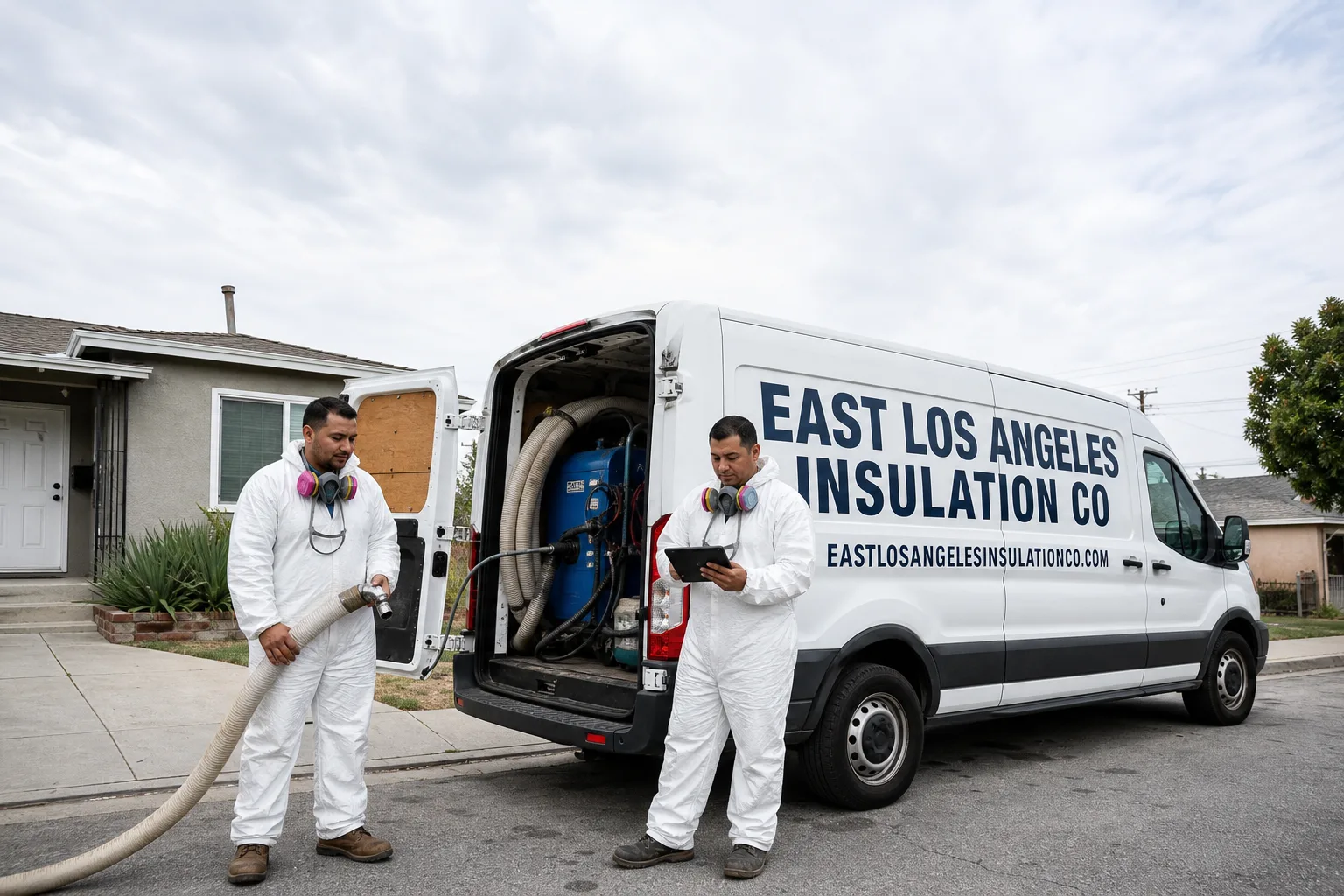
Fast, Reliable Spray Foam Insulation Across Azusa
Spray foam insulation in Azusa typically runs $3.50 to $7.00 per square foot installed, with most whole-attic jobs landing between $4,200 and $9,800 depending on foam type and roof deck access. We’re East Los Angeles Insulation Co, and we work in Azusa every week. Our crews know the 91702 foothill tracts, the mid-century bungalows off Foothill Boulevard, and the newer infill near Azusa Pacific University. When you call (866) 566-0304, you’ll talk to someone who has actually been to your street, not a call center routing a ticket.
Why East Los Angeles Insulation Co Is Azusa’s Preferred Spray Foam Insulation Company
Azusa homeowners don’t hire us because we’re the closest option. They hire us because we’re one of the only teams in the San Gabriel Valley that stocks and installs both Icynene and Demilec spray foam systems, and because we treat foam as one tool in a kit, not the only answer. Ruben Acosta, who leads our crew, has spent years working the foothill corridor from Glendora to Irwindale. He knows what happens to insulation when a Santa Ana wind event slams a 1950s attic at 2 a.m. and what it takes to keep a home stable through a 100-degree August afternoon.
We get called back to Azusa because homeowners tell us the same thing: the upstairs finally holds temperature. The bedroom that used to spike to 83 degrees by 4 p.m. now sits at 76. That’s the kind of result that spreads by word of mouth through the 91702 ZIP code faster than any ad. We carry manufacturer product warranties from Icynene and Demilec, and we install foam to the depth and coverage our manufacturers specify, not to whatever a general contractor thinks looks close enough.
Response time to Azusa is usually same-week for estimates and often within 48 hours for emergency re-insulation jobs after wind damage or a roof leak. We’re based in East Los Angeles, which puts most Azusa neighborhoods 25 to 35 minutes away. We schedule Azusa jobs in dedicated windows so our crews aren’t fighting rush-hour traffic on the 210.
Spray Foam Attic Insulation in Azusa
Spray foam attic insulation in Azusa is the single most effective upgrade we install, because no other part of your home takes a beating like your attic does here. The foothill edge near the Angeles National Forest pushes late-summer attic temperatures well past what flat-valley homes in Covina or West Covina experience. We’ve measured attic air temperatures over 140 degrees in August on homes along Sierra Madre Avenue. Open-cell foam applied to the roof deck turns that space into a conditioned zone, which matters when your ductwork runs through the attic, as it does in most 91702 homes built before 1980.
A typical one-story Azusa ranch with 1,100 to 1,500 square feet of attic floor runs $4,800 to $7,200 for open-cell Icynene spray foam on the roof deck. Closed-cell Demilec runs higher, usually $7,500 to $9,800, but adds structural rigidity and a vapor barrier. We help you decide which foam makes sense for your roof pitch, your budget, and whether you plan to store anything up there.
Roof Deck Foam for Foothill Heat
Azusa’s late-summer solar load means foam thickness on the roof deck is not negotiable. We spray a full nominal depth across the entire deck, including gable ends and ridge transitions, because thin spots shrink and pull away from rafters within a few summers under that heat. When we find existing foam that’s gapped or off-gassed, it’s almost always because someone under-applied to save a buck.
Air Sealing Before Foam
On mid-century homes off North Azusa Avenue, we routinely find unsealed top plates, can light housings, and plumbing chases that would quietly defeat a foam job. We air-seal those penetration points before spraying. Skipping it means the foam looks fine from the attic hatch while conditioned air leaks straight through the gaps.
Spray Foam Wall Insulation in Azusa
Spray foam wall insulation in Azusa solves two problems at once, and both are specific to this city. First, Santa Ana winds funnel through the San Gabriel canyons and press against the walls of homes from the foothill edge all the way down to the 210 corridor. That wind finds every gap in your sheathing, every unsealed electrical penetration, every seam that’s worked loose since 1962. Second, those same walls absorb solar heat all afternoon on the west-facing exposures common along Citrus Avenue and the older tracts near downtown. Closed-cell foam in the wall cavities seals those air channels and adds an R-value per inch that fiberglass batts cannot match.
Wall spray foam in Azusa typically runs $2.75 to $4.50 per square foot of wall area for existing homes, where we drill and fill from the exterior or interior. Full stud-bay coverage on a 1,200-square-foot home usually lands between $6,000 and $11,000. New construction or open-wall remodels run lower per square foot because access is easier.
Exterior Drill-and-Fill
Most Azusa homeowners don’t want their drywall torn out, which is where drill-and-fill comes in. We remove a small section of siding or stucco, drill through the sheathing, and inject closed-cell Demilec foam into each stud cavity. Then we patch and refill. It’s the least disruptive way to get foam into walls that have never had anything but air inside them.
Working Around Window Assemblies
Older 91702 homes with original single-pane and aluminum-frame windows leak so much heat that wall foam alone won’t fix the comfort problem. We’ll tell you that straight. Foam in the walls makes a real difference, but if your windows date from the Johnson administration, we recommend sequencing window replacement before or alongside wall foam so you’re not paying twice for the same thermal hole.
Trusted Brands We Service in Azusa
We install Icynene and Demilec spray foam in Azusa because both brands have earned their place in foothill-climate homes. Icynene open-cell is our workhorse for attic roof decks where you want air sealing plus thermal performance without over-insulating the structure. Demilec closed-cell is what we spec for wall cavities, rim joists, and anywhere moisture or structural rigidity matters. We also work with GreenFiber and CertainTeed products when a blown-in or batt solution makes more sense for a particular Azusa house. The point is choice: we’re not a single-brand shop pushing one product on every home. If foam is right for your attic but blown-in is smarter for your budget, we’ll say so. Call (866) 566-0304 and tell us what you’re dealing with; we’ll tell you what we’d do if it were our house.
Common Spray Foam Insulation Problems We See in Azusa Homes
- Foothill solar gain baking under-applied roof deck foam. When foam is sprayed too thin on the roof deck, the late-summer heat from the San Gabriel foothill exposure makes it off-gas and shrink away from the rafters. We see this on homes along the northern edge of 91702 where the afternoon sun hits the roof for ten hours straight. The fix is full-depth reapplication after removing the failed material.
- Santa Ana wind infiltration through unsealed top plates and penetrations. Even a good foam job can’t stop wind-driven air if the top plates aren’t sealed first. Canyon winds find every gap. In Azusa, we always inspect and seal top plates, can lights, and plumbing vents before any foam goes in.
- Settled original blown-in fiberglass under newer foam. Many 1950s Azusa homes had blown-in fiberglass installed decades ago. It settles, compacts, and sometimes traps moisture against the roof deck. If someone sprayed foam over it without removing the old material, the foam’s adhesion suffers and hidden air pockets form. We remove the degraded fiberglass before applying new foam.
- Single-pane windows overwhelming wall foam performance. Wall foam can’t fix a window that leaks heat like a screen door. On Azusa bungalows with original aluminum frames, we often find the foam is doing its job while the windows undo it. We’ll flag this before you spend, not after.
Pricing for Spray Foam Insulation in Azusa, CA
Here’s what we’re quoting in Azusa right now. Open-cell spray foam on an attic roof deck runs $3.50 to $4.75 per square foot of roof area. Closed-cell runs $5.50 to $7.00 per square foot. Wall spray foam via drill-and-fill runs $2.75 to $4.50 per square foot of wall area. A typical 1,200-square-foot Azusa tract home with an attic roof deck job lands between $4,800 and $7,200 for open-cell, or $7,500 to $9,800 for closed-cell. Wall insulation on that same home usually runs $6,000 to $11,000 depending on access and how many penetrations need sealing. What moves the price: roof pitch, attic access, whether old insulation needs removal, and whether the home has additions or complex framing. We give free estimates to every Azusa homeowner. Call (866) 566-0304 and we’ll walk your house, measure, and hand you a number you can take to the bank.
We Also Serve Cities Near Azusa
We work throughout the eastern San Gabriel Valley. If you’re in Citrus, Irwindale, Covina, or Glendora, you’re in our regular service area and we’ll get to you just as fast as we get to Azusa. Same products, same pricing philosophy, same crews. See more on our Spray Foam Insulation in Azusa page or learn about our full Spray Foam Insulation capabilities.
Serving Azusa, CA - Our Local Coverage Area
We serve Azusa and nearby communities. Use the map below to see the area we cover. If you’re nearby, we can almost certainly help.
FAQs About Spray Foam Insulation in Azusa
Yes, spray foam attic insulation works in Azusa’s foothill heat, and it does not degrade faster than on the valley floor when applied correctly. The key is full nominal depth and proper air sealing before the foam goes on. We’ve seen properly installed Icynene open-cell foam hold up for years on Azusa roof decks, even on homes along the northern 91702 foothill edge where late-summer attic temps climb past 140 degrees. What fails early is thin or rushed application. Call (866) 566-0304 to have us inspect your attic and tell you if the existing foam was done right.
Yes, closed-cell spray foam wall insulation is the most effective barrier we can install against Santa Ana wind infiltration in Azusa. The foam expands into every stud cavity gap, every electrical penetration, and every seam where air sneaks through. It works because it seals as it insulates. Fiberglass batts filter air; foam stops it. For Azusa homes in the wind corridor below the canyons, this is often the single biggest comfort upgrade we can make.
Yes, remove settled blown-in insulation before adding spray foam. On a mid-century tract home off North Azusa Avenue near the foothill edge, our crew found original 1950s blown-in fiberglass settled to less than half its depth and gapping at the ridge. We removed the degraded material, air-sealed the top plates and can lights, then applied Icynene spray foam to the roof deck and gable walls. The homeowner reported their upstairs bedrooms finally held a steady temperature through the August heat. Leaving the old stuff under new foam traps moisture and creates hidden air pockets. Removal adds cost, but skipping it wastes the foam’s performance. We’ll quote removal and re-insulation as one line item so you know the real number.
Yes, spray foam attic insulation helps in both directions. In summer, it blocks the solar heat that radiates down from your roof deck. In winter, it stops warm air from escaping through the attic, which is exactly when Santa Ana winds try to pull heat out of your home. Azusa sits at the base of the San Gabriel Mountains, so it runs hotter in summer and colder in winter than coastal LA. Foam on the roof deck is the rare upgrade that pays you back in July and again in January.
Wall spray foam still makes sense, but it won’t deliver its full benefit until you address the windows. Single-pane and aluminum-frame windows, common throughout the older 91702 housing stock, transmit heat so readily that they overwhelm the thermal performance of foam in the wall cavities. We’ll install wall foam now if that’s what your budget allows, and we’ll design the scope so it doesn’t need to be redone when the windows get replaced. The straightforward answer: foam first if you must, but plan on windows soon after. Call (866) 566-0304 and we’ll walk you through the sequencing.
If your Azusa home fights you every August and every winter wind event, foam is usually the answer, but the way it’s specified matters more than the product name on the barrel. Let’s talk about your house specifically. Reach East Los Angeles Insulation Co at (866) 566-0304 for a free estimate, and ask for Ruben Acosta. He’ll tell you what he’d do if it were his house.
Written by Ruben Acosta, Owner at East Los Angeles Insulation Co, serving Azusa and the eastern San Gabriel Valley.