
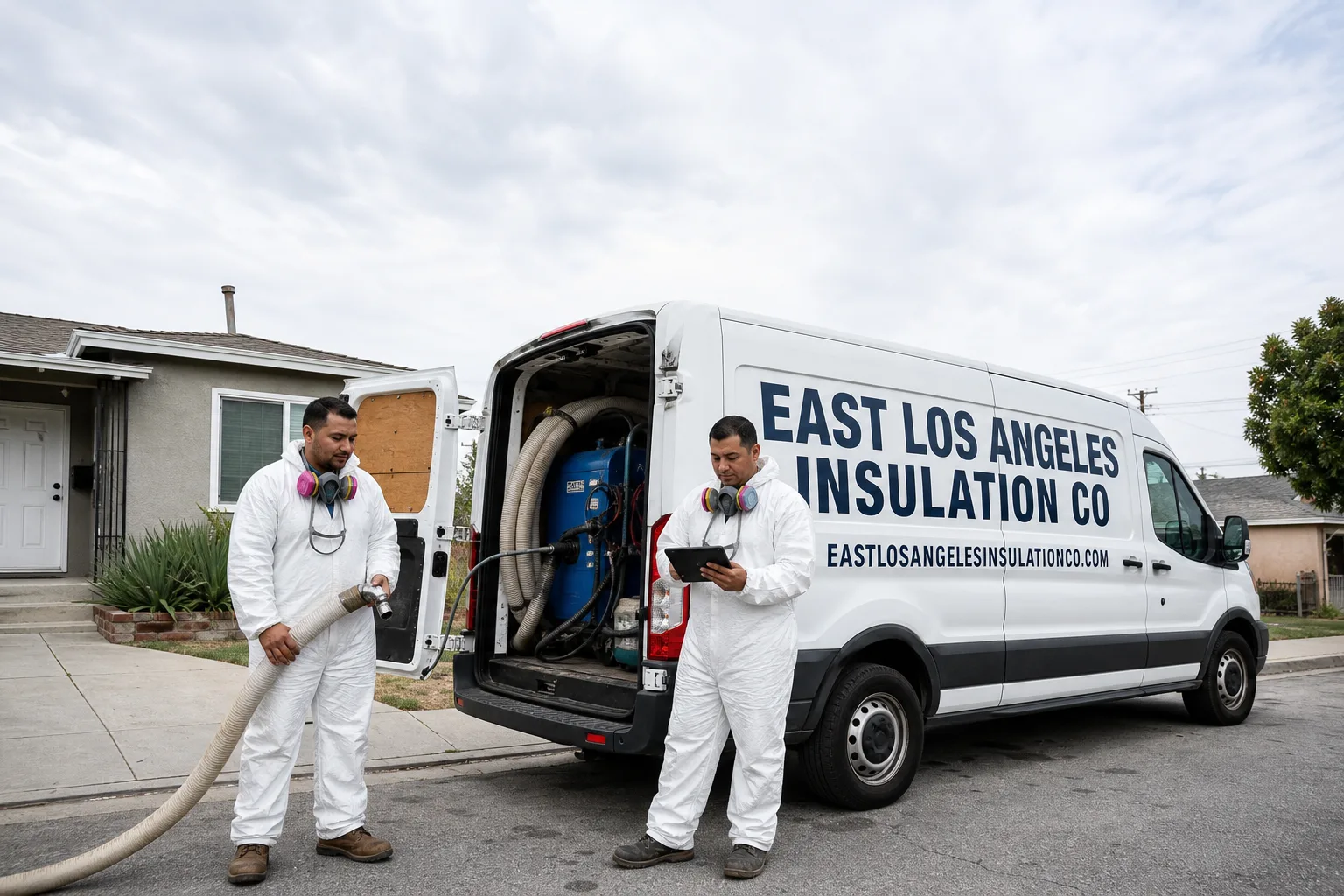
Fast, Reliable Spray Foam Insulation Across Sherman Oaks
Spray foam insulation in Sherman Oaks typically runs $2.50 to $6.50 per board foot installed, with most attic jobs landing between $3,800 and $9,500 depending on whether we’re sealing a flat Valley ranch attic or hand-shooting closed-cell along tight foothill rafter bays. We’re East Los Angeles Insulation Co, and we’ve worked Sherman Oaks homes long enough to know the split: the south-side hills demand a different approach than the flat lots north of Ventura Boulevard. Our crews reach most Sherman Oaks calls same-day or next-morning. Call Ruben and the team at (866) 566-0304 for a straight answer on your house.
Why East Los Angeles Insulation Co Is Sherman Oaks’s Preferred Spray Foam Insulation Company
We’re a dedicated insulation contractor, not a generalist juggling three trades. Sherman Oaks homeowners call us because we install all three insulation methods in-house: attic insulation, Spray Foam Insulation, and blown-in. That means we recommend what your 1950s ranch or hillside infill actually needs, not whatever product happens to be on our truck.
Ruben Acosta built this company around one idea: match the insulation to the house. In Sherman Oaks that often means Icynene or Demilec closed-cell on tight foothill rafter bays, open-cell in vented attic fields, and GreenFiber blown-in where a homeowner wants recycled content without sacrificing R-value. We carry all of them. Most single-brand installers can’t say that.
Response time to Sherman Oaks is typically same-day for estimates and within 48 hours for scheduled work. For a 91423 hillside home with a bedroom that won’t hold temperature, we’ll be on the phone the same afternoon. Our local reputation is built on showing up when we say we will and telling homeowners when spray foam isn’t the right call, rather than selling it anyway.
Spray Foam Attic Insulation in Sherman Oaks
Spray Foam Attic Insulation in Sherman Oaks splits into two distinct jobs. On flat-lot ranch homes from the 1940s through 1970s, we’re usually shooting open-cell foam across a vented attic field after air-sealing top plates and can penetrations. On south-side foothill streets below the Santa Monica Mountains, the work is different: steep sloped ceilings and low-clearance attic knees mean we hand-shoot closed-cell along rafter bays where a spray rig can’t reach. These hillside attics bake past 150°F in August, and the foam has to be applied in lifts, not one pass, or it won’t cure right.
A typical flat-attic spray foam job in Sherman Oaks runs $4,200 to $7,800. Hillside rafter-bay work runs higher, usually $6,000 to $11,000, because the labor is slower and the access is hard. Ventura Boulevard corridor homes with newer construction and higher ceilings often fall between those ranges.
Air-Sealing Before R-Value
We won’t spray foam over unsealed top plates and recessed-can penetrations. In a 150°F Sherman Oaks attic, that bypass air moves enough heat to overwhelm any insulation. Sealing first, then foaming, is what makes the AC bill drop.
Radiant-Barrier Logic for Valley Heat
Sherman Oaks sits in the San Fernando Valley’s hottest inland pocket. Summer temps run 15 to 25°F above coastal LA. Spray foam cuts conductive heat gain, but pairing it with a radiant barrier on the roof deck reflects the sun’s radiant load before it ever reaches the foam. For south-facing roof planes, this combination is the difference between an attic that hits 120°F and one that holds under 100°F.
Spray Foam Wall Insulation in Sherman Oaks
Spray Foam Wall Insulation in Sherman Oaks usually happens on two house types: older stucco ranches getting a remodel, and newer hillside infill where the builder left exterior walls under-insulated. On 1950s ranch homes near Longridge Drive and the foothills, we open the drywall and find original mineral wool batts that have collapsed off the studs. The wall cavity reads fine on paper but performs like it’s empty. Closed-cell foam fills the cavity, air-seals the shell, and adds structural rigidity that old batts never provided.
Wall foam in Sherman Oaks runs $2.75 to $4.50 per board foot for open-cell and $4.00 to $6.50 for closed-cell, plus drywall access and finishing. A typical exterior wall retrofit on a ranch home lands between $3,200 and $7,500 depending on wall height and how much cavity is accessible. Hillside homes with stucco over frame often cost more because we’re working from the inside out.
Closed-Cell for Hillside Exteriors
Sherman Oaks south-side homes face dry Santa Ana wind events and wildfire-adjacent conditions. Closed-cell foam is non-vented, adds shear strength, and won’t absorb moisture the way open-cell can in an exposed wall. For homes in the 91403 and 91423 hills, we recommend closed-cell as the default wall application.
Knee-Wall Retrofit Scenarios
The steep sloped ceilings on foothill streets create a condition flat-lot installers never see: a knee wall separating a conditioned bedroom from an unconditioned attic chase. If that knee wall isn’t foam-sealed, the back bedroom runs 8 to 10°F warmer than the rest of the house. We treat knee walls as part of the attic assembly, not an afterthought.
Trusted Brands We Service in Sherman Oaks
We stock and install Icynene and Demilec spray foam because both have proven field performance records in hot, dry attic conditions like Sherman Oaks. We also carry CertainTeed and GreenFiber for homes where a blown-in or batts solution makes more sense than foam. Eight brands total: Owens Corning, Johns Manville, Knauf, Rockwool, CertainTeed, Icynene, Demilec, and GreenFiber. For Sherman Oaks customers that means we show up with the right product on the truck, not a generic substitute. Parts and material lead times are short because we warehouse in East LA, and we can usually start a Sherman Oaks job within three to five days of the estimate.
Common Spray Foam Insulation Problems We See in Sherman Oaks Homes
- Collapsed legacy batts on low-slope rafters. Original 1940s to 1960s mineral wool and fiberglass batts fall off the rafter bays, leaving bare drywall that radiates afternoon heat into living space. The fix starts with removing failed material, not foaming over it.
- Unsealed top plates and can lights bypassing existing insulation. Adding R-value without sealing the penetrations lets 150°F attic air keep leaking into the house. We seal first, then foam, every time.
- Closed-cell applied too thick over vented soffits and eyebrow vents. On hillside homes this traps moisture and destroys the vented assembly the house was designed for. We won’t do it, and we’ll tell you if another contractor’s quote ignores your venting.
- Mismatched foam over aging flex duct. The foam seals the attic space beautifully, but brittle 1970s ductwork still leaks cooled air into the hot chase. We flag duct condition during our walkthrough, honestly, before you spend on foam.
Pricing for Spray Foam Insulation in Sherman Oaks, CA
A flat-attic open-cell spray foam job on a Sherman Oaks ranch home runs $4,200 to $7,800. Foam wall retrofits run $3,200 to $7,500 depending on access. Hillside rafter-bay closed-cell work runs $6,000 to $11,000 because the access is tight and the application is slow. Closed-cell generally costs $4.00 to $6.50 per board foot. Open-cell runs $2.50 to $4.00 per board foot. Square footage, roof pitch, and whether we’re sealing existing vents all move the number. Call (866) 566-0304 for a free estimate with actual numbers for your house, not a brochure range.
We Also Serve Cities Near Sherman Oaks
Our crews cover Sherman Oaks and the surrounding San Fernando Valley neighborhoods regularly. We’re in Valley Glen, Van Nuys, Studio City, and Encino on a weekly basis. For full details on the areas we serve, see our spray foam insulation service area page. Same response times and same pricing apply across the Valley.
Serving Sherman Oaks, CA - Our Local Coverage Area
We serve Sherman Oaks and nearby communities. Use the map below to see the area we cover. If you’re nearby, we can almost certainly help.
FAQs About Spray Foam Insulation in Sherman Oaks
Spray foam makes more sense because it air-seals while it insulates. A 1950s Sherman Oaks ranch attic has dozens of top-plate seams, can-light penetrations, and framing gaps that blow-in insulation can’t seal. Blown-in fiberglass or GreenFiber still lets 150°F attic air bypass into the house. Foam seals those leaks and adds R-value in one pass. Call (866) 566-0304 for an honest assessment of whether your attic needs foam, blow-in, or both.
Yes, we can. That’s exactly the work we do on south-side foothill streets below the Santa Monica Mountains. Our crews hand-shoot closed-cell along rafter bays and knee walls where a spray rig can’t reach. It’s slower work and it costs more than a flat-attic blanket job, but it’s the right fix for those houses. Call us for a hillside-specific quote.
You don’t need one, but it makes a big difference on south-facing roof planes. Summer sun hits Sherman Oaks roofs hard, and a radiant barrier reflects that radiant load before it reaches the foam. Foam alone cuts conductive heat gain. Radiant barrier plus foam cuts both. For a 91423 hillside home, we usually recommend both.
If applied correctly, no. We don’t seal over existing soffit vents or eyebrow vents on vented attics. The ventilation still works. Closed-cell won’t absorb moisture from the dry Santa Ana air, and it won’t wick water the way batts can. The moisture problems we see come from contractors who foam over vents or spray too thick. That’s not how we work.
We use Icynene and Demilec for spray foam. Both have established field records in hot, dry attics and both carry manufacturer product warranties. We also stock CertainTeed and GreenFiber for homes where blown-in or batts make more sense. Eight brands total across our truck stock, so the recommendation is based on your house, not our inventory.
Ready to talk numbers for your Sherman Oaks home? Call Ruben and the crew at (866) 566-0304. Free estimates, honest recommendations, and no pressure to buy foam if your house doesn’t need it.
Written by Ruben Acosta, Owner at East Los Angeles Insulation Co, serving Sherman Oaks and the San Fernando Valley.