
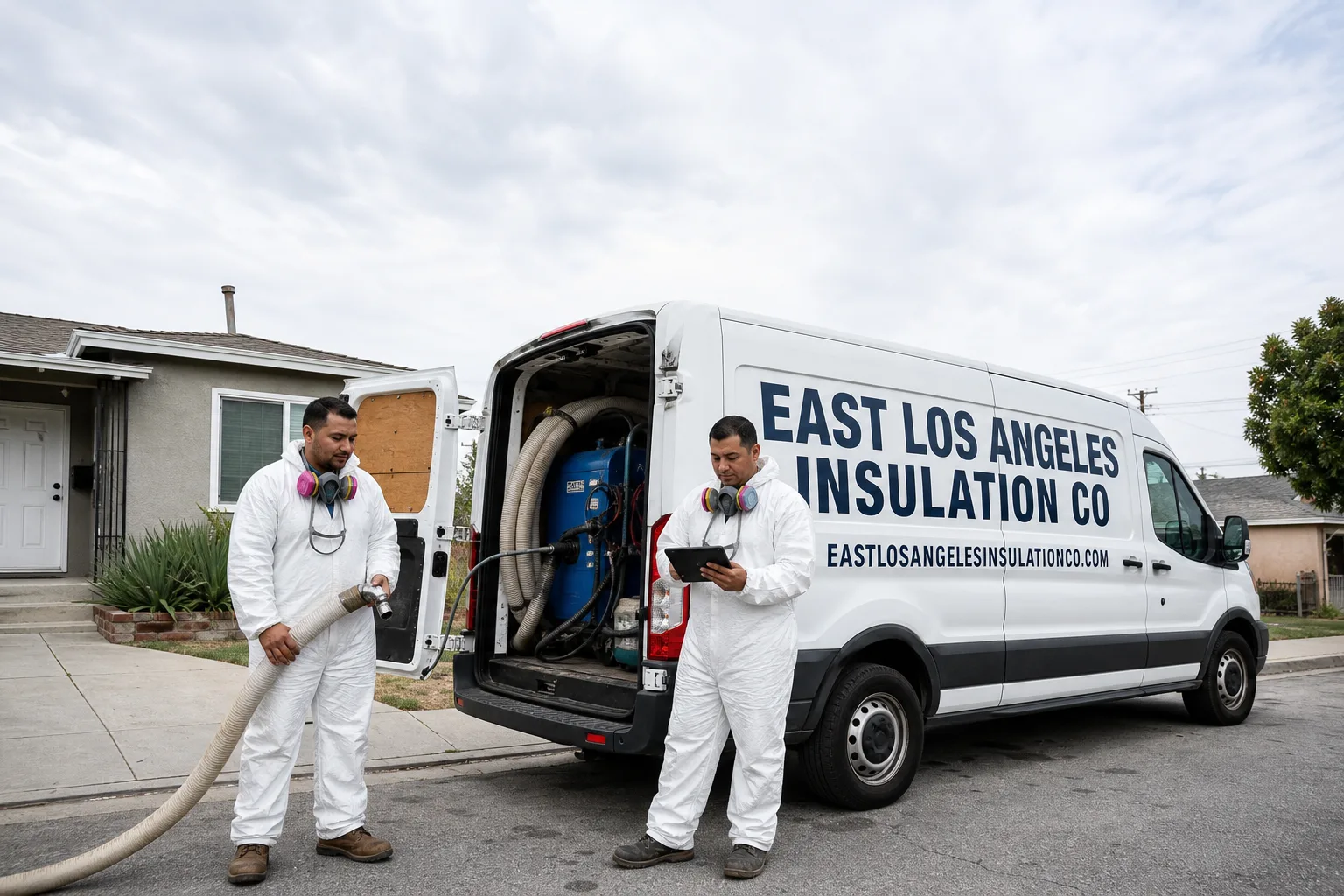
Fast, Reliable Spray Foam Insulation Across Walnut
If your Walnut home struggles to hold a comfortable temperature during summer, spray foam insulation is the highest-performing fix we install. In Walnut’s inland heat, where attic temperatures climb past 140°F in July and August, closed-cell and open-cell foam both outperform fiberglass batts by sealing the air leaks that let radiant heat pour into living spaces. Our crews are in Walnut weekly, and we typically begin work within days of your estimate, not weeks. Call (866) 566-0304 for a free insulation assessment and a straight answer on what your home actually needs.
Why East Los Angeles Insulation Co Is Walnut’s Preferred Spray Foam Insulation Company
Ours is a dedicated insulation contracting business, not a general contractor that picks up insulation work between remodels. That focus matters in a city like Walnut, where so many homes were built between the 1960s and 1990s with original builder-grade fiberglass that has long since stopped performing. We know the subdivisions off Amar Road, the two-story stucco tract homes near Lemon Avenue, and the hillside lots where attic heat hits hardest. Homeowners in Walnut’s 91789 zip code call us because we diagnose the specific failure rather than quoting a generic square-foot price.
We arrive with a clear explanation of what is going on in your attic and knee walls, not a sales pitch. Our team stocks multiple spray foam formulations so the product gets matched to the condition of your roof deck, the depth of your cathedral ceiling cavities, and the way your home handles the San Gabriel Valley’s afternoon sun. You get one specialist team handling the whole job, from air sealing to final inspection.
Spray Foam Insulation Contractors in Walnut
Spray Foam Insulation Contractors in Walnut do the hardest working part of your home’s thermal envelope: the roofline. When we install open-cell or closed-cell foam in a Walnut attic, we are not laying batts over existing insulation. We are removing failed material, air sealing every seam and penetration, and applying foam to the underside of the roof deck or the attic floor depending on your home’s design. In Walnut’s older hillside tracts, where two-story stucco homes carry cathedral ceilings and attached garages with uninsulated knee walls, this is precision work.
Typical spray foam contracting in Walnut runs $2,800 to $7,500 for a full attic roof deck application on a 1,500 to 2,800 square foot home. Smaller jobs, like a rim joist or garage ceiling, run $900 to $2,200. The price depends on foam type, cavity depth, and how much failed insulation we have to remove first. Every quote includes a written scope, and you will see the cost before we start, not after.
Knee walls and cathedral cavities
These are the most common problem spots in Walnut’s two-story homes. The knee walls that frame attic storage closets and bonus rooms were often insulated with R-11 batts that sag within a decade. When those batts fall away from the wall cavity, they leave a direct path for 140-degree attic air to reach your finished space. We remove them entirely and spray foam the cavity, which also blocks the dust and fiberglass particles that ride that same air path.
Rim joist and garage ceiling sealing
Attached garages in Walnut bake all afternoon. If the garage ceiling is not sealed, that heat migrates through the shared wall and into the house. We spray the rim joist band and garage ceiling cavities to stop heat before it crosses the envelope. It is quick work, usually done in one day.
Spray Foam Attic Insulation in Walnut
Spray Foam Attic Insulation in Walnut is the single most effective upgrade we perform for homes with original fiberglass batts. In the 91789 tract homes off Amar Road and Lemon Avenue, we routinely find 3 to 4 inches of settled fiberglass where 12 inches or more is required by modern standards. Worse, the heat compresses the fiberglass against the roof deck, trapping moisture and rendering the material nearly useless. We remove it, air seal the attic floor or roofline, and apply spray foam that will not settle, sag, or lose its R-value in Walnut’s heat.
For a typical Walnut ranch home with a vented attic, removing old fiberglass and applying open-cell spray foam to the attic floor runs $2,400 to $4,800. If you have a cathedral ceiling or want to convert the attic to a conditioned space, closed-cell foam on the underside of the roof deck runs $3,200 to $7,200. The higher cost delivers more than thermal resistance: it seals the air leaks that fiberglass cannot address, and it holds its shape under Walnut’s extreme summer temperatures.
Removing matted, settled batts first
We never spray foam over compressed fiberglass. Doing that traps air and moisture pockets between the foam and the old material, which leads to uneven performance and potential mold. Our crew clears the cavity, inspects the sheathing, and only then applies foam. On a 1978 two-story stucco home off Amar Road, we removed original R-11 batts from knee walls that had completely compressed and fallen away from the roof deck. We then sprayed Icynene open-cell foam across the roofline and knee walls, paired it with a radiant barrier, and the homeowner reported the upstairs bonus room held temperature through a 102-degree afternoon for the first time since they moved in.
Pairing foam with attic ventilation
Spray foam seals the envelope, but in Walnut’s summer sun, the roof deck itself still gets hot. Proper attic ventilation remains essential. Without it, an unvented roof deck with foam on the underside can overheat and accelerate foam degradation. We evaluate your existing soffit and ridge vents, and if airflow is inadequate, we adjust the job scope before applying any foam. The insulation and the ventilation have to work as one system, not two separate fixes.
Trusted Brands We Service in Walnut
We install and service spray foam from Icynene and Demilec because those two brands have proven field performance in high-heat attics like the ones we see throughout Walnut. Both offer manufacturer warranties on the product itself, which gives our customers a second layer of coverage beyond our own workmanship. For homeowners considering alternatives to spray foam, we also offer GreenFiber blown-in insulation, a recycled-content option with strong air-sealing characteristics, and CertainTeed fiberglass for retrofits where spray foam is not the right physical fit. We keep our own stocked inventory for Walnut jobs, which means fewer supply delays and faster scheduling when you want the work done this month, not next season.
Common Spray Foam Insulation Problems We See in Walnut Homes
- Compressed and settled R-11 batts in cathedral knee walls. Walnut’s summer attic heat, regularly above 140°F, works batts loose from wall cavities and compresses them against sheathing. The result is an uninsulated gap that pours radiant heat into upstairs bedrooms and bonus rooms.
- Spray foam applied over old fiberglass without air sealing. This happens when homeowners use a low-bid contractor who skips removal to save time. Moisture and warm air get trapped between the foam and the failed batts, creating a breeding ground for mildew and uneven insulation coverage.
- Inadequate attic ventilation paired with a sealed roof deck. Walnut’s intense afternoon sun beats directly on the roof. If the soffit or ridge vents are blocked or undersized, the sealed deck cannot shed heat and the foam underperforms. We check ventilation on every foam job to prevent this.
- Uninsulated rim joists in attached garages. Walnut’s tract homes often have garages that share a wall with living space. The rim joist bands in those garages are rarely insulated, so garage heat bleeds into the home throughout the late afternoon and evening.
Pricing for Spray Foam Insulation in Walnut, CA
Here are real numbers for the Walnut market, based on the job scopes we perform most often. Open-cell spray foam on an attic floor for a 1,200 to 1,800 square foot home runs $2,400 to $4,800. Closed-cell foam on the underside of a roof deck runs $3,200 to $7,200. Rim joist spray foam for a typical two-story home runs $900 to $1,800. Garage ceiling spray foam runs $1,100 to $2,200. The main cost variables are foam depth, surface prep, whether we are removing old insulation, and whether your attic needs ventilation upgrades at the same time. We provide line-item pricing in every quote, and estimates are free. Call (866) 566-0304 and Ruben Acosta will walk you through exactly what your home needs and what it will cost.
We Also Serve Cities Near Walnut
Beyond Walnut, our crews handle spray foam and full insulation work in South San Jose Hills, Rowland Heights, West Covina, and Pomona. If you live in one of those communities, you get the same dedicated Spray Foam Insulation service and the same straight-talking assessment we give Walnut homeowners. Call and tell us your city; we will give you an honest timeline for when we can be there.
Serving Walnut, CA - Our Local Coverage Area
We serve Walnut and nearby communities. Use the map below to see the area we cover. If you’re nearby, we can almost certainly help.
FAQs About Spray Foam Insulation in Walnut
Spray foam stops the two problems that fiberglass cannot handle in a Walnut summer: air leakage and heat-driven settling. Fiberglass batts in Walnut’s older homes compress to a fraction of their original thickness under attic heat, leaving gaps that let 140-degree air into living spaces. Spray foam adheres to the cavity, does not settle, and seals the air gaps at the same time. For homes built in the 1960s through 1980s, that air sealing matters more than the R-value number on paper. Call (866) 566-0304 for a free assessment of whether your Walnut home is a better candidate for foam or a blown-in retrofit.
Cathedral ceiling knee walls, attached garage rim joists, and the attic floor above two-story living spaces. In Walnut’s hillside subdivisions off Amar Road and Lemon Avenue, these three spots fail first because they bear the direct brunt of attic heat and afternoon sun. Our crew checks all three on every Walnut inspection, even if the homeowner called us about one.
No. Applying spray foam over settled fiberglass traps moisture and air pockets between the two materials, which leads to uneven insulation performance and potential mold in Walnut’s humid-winter, hot-summer climate. We remove the old fiberglass first, inspect the cavity, then apply foam to a clean surface. This is non-negotiable on every job we perform.
We schedule Walnut foam applications in the morning whenever possible, especially during July and August, because the two-part foam cures more predictably in moderate temperatures. Attics over 120°F are not safe or effective work environments for foam installation, so we start early and finish by early afternoon. Most Walnut attic jobs complete in one day regardless of season.
Often yes. Spray foam slows heat transfer through the building envelope, but it does not stop the sun from heating your roof deck to 160°F or more in July. A radiant barrier reflects that heat off the deck before it can radiate into the attic or living space, which is why we pair the two on most Walnut attic jobs where the roof is directly exposed to afternoon sun. We will tell you if your home is a case where the foam alone will do the job, and we will not sell you a radiant barrier you do not need.
If your Walnut home is uncomfortable in summer or your energy bills climb every July, we can tell you exactly why after one attic inspection. Call (866) 566-0304 for a free estimate. Ruben Acosta and the team at East Los Angeles Insulation Co serve Walnut homeowners from the 91788, 91789, and 91795 zip codes with spray foam, blown-in, and attic insulation done right the first time.
Written by Ruben Acosta, Owner at East Los Angeles Insulation Co, serving Walnut and the San Gabriel Valley.