
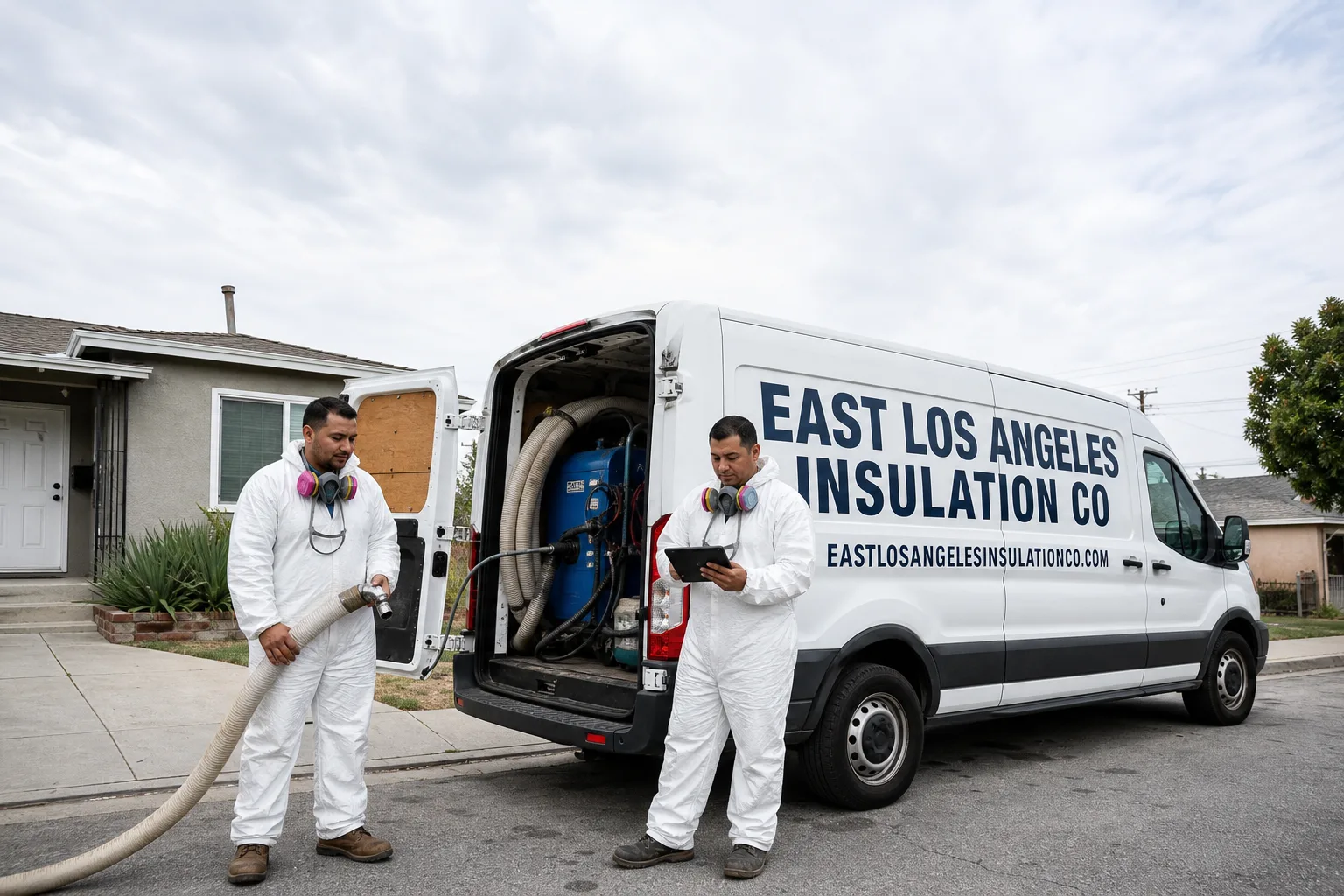
Fast, Reliable Spray Foam Insulation Across Sunland
Spray foam insulation in Sunland runs roughly $2,800 to $7,400 for a full attic and wall treatment on a typical 1,200 to 2,000 square foot home, with rim joist work starting around $900. Most jobs take one to two days, and we schedule Sunland appointments within 48 hours in most cases. You’re not calling a generalist who’ll send whoever’s free. You’re calling a dedicated insulation crew that works Sunland’s valley-floor tract homes and hillside properties every week. Call (866) 566-0304 and we’ll give you a straight answer on what your house actually needs.
Why East Los Angeles Insulation Co Is Sunland’s Preferred Spray Foam Insulation Company
Sunland homeowners ask us the same thing: can you actually get up Foothill Blvd and be here when you say you will? Yes. We dispatch from East LA and know the 210 to Sunland Blvd route cold, including the canyon-adjacent streets where parking gets tight and attics get tighter. Ruben Acosta sends a lead technician on every Sunland job, not a rotating cast of subcontractors. That means the person who quotes the work is usually the person who sprays it.
We’ve worked homes off La Tuna Canyon Road, along Oro Vista Avenue near the Verdugo foothills, and through the cluster of streets around Apperson Street Elementary. That local pattern matters. A 1963 stucco tract home at 91040 has different spray foam needs than a 1970s hillside build at 91041, and we’ve seen enough of both to know the difference before we open the attic hatch. Our Spray Foam Insulation team carries manufacturer-backed products from Demilec and Icynene, and we’ve built a reputation across the northeast Valley for being the crew that actually shows up with the right foam, not the foam that fits in the truck.
Response time to Sunland runs same-week for most bookings. In wildfire season, when homeowners want ember-resistant sealing done fast, we shift schedules to get canyon-adjacent homes inspected within days, not weeks.
Spray Foam Wall Insulation in Sunland
Spray foam wall insulation in Sunland is the single most effective fix we do for homes with thin 1960s-era wall cavities and uncomfortable rooms. Closed-cell foam applied directly into wall cavities fills gaps that batts never touch, and it stiffens the wall assembly too, which helps on hillside homes that catch wind off the Verdugos. A typical Sunland wall insulation job runs $1,800 to $4,600 depending on square footage and wall depth, and it’s the difference between a house that holds temperature and one that leaks conditioned air through every stud bay. We’re not guessing. We inspect the wall depth, check for existing sheathing, and tell you whether open-cell or closed-cell Icynene or Demilec makes sense before any foam goes in.
When Sunland Tract Homes Need Wall Foam
Post-WWII through 1970s Sunland homes usually have R-11 batts at best, often slumped and gapped. That’s not a problem you solve with more insulation on top. You solve it by filling the cavity properly, and closed-cell spray foam does that while adding an air seal batts never provide.
Hillside Walls and Wind Exposure
Homes above Foothill Blvd take wind that valley-floor houses never feel. That wind presses against wall cavities and drives outdoor air through every micro-gap. Closed-cell foam at two inches delivers an air barrier plus roughly R-13, and it holds fast through Sunland’s temperature swings without settling or sagging. For older stucco exteriors, we check sheathing condition first so the foam bonds to something solid.
Rim Joist Spray Foam in Sunland
Rim joist spray foam in Sunland starts around $900 and typically runs $1,200 to $2,800 for a full perimeter seal on a single-story home with a raised foundation. The rim joist is where the first floor meets the foundation wall, and on Sunland’s concrete slab and raised-floor homes, it’s the single biggest air leak most people have never heard of. We pull back the existing fiberglass or leave the bare joist, brush it clean, and spray two inches of closed-cell foam across every bay. The result is a thermal break at the floor line, fewer drafts in winter, and fewer bugs and dust blowing in through the gaps. This is the work we did on a hillside home off La Tuna Canyon Road, where the homeowner noticed wind-driven heat infiltrating through the rim bays during a red-flag warning. We sealed the rim joists with Icynene closed-cell foam and paired it with an Owens Corning radiant barrier in the attic. Tighter home, lower summer heat gain, and fewer ember intake points at the floor line.
Rim Joists on Raised-Floor Sunland Homes
Many Sunland valley-floor homes sit on raised foundations with open crawlspaces. Those rim bays pull in outdoor air all day, and in a triple-digit stretch that means the crawlspace turns into a heat source under your feet. Foam-sealed rim joists push that heat back outside.
Slab-Foundation Rim and Sill Work
On slab homes, the rim area still exists where floor framing meets the exterior wall. It’s smaller, but it leaks. We handle both raised and slab configurations, and on slab homes we’re often combining rim joist foam with knee wall sealing in attic spaces where hillside lots force split-level construction.
Trusted Brands We Service in Sunland
We don’t stock one brand and try to sell it to every house. For Sunland work, we’re most often spec’ing Demilec closed-cell foam for wall and rim joist applications because it handles the valley heat and foothill cold swings well. Icynene open-cell goes into attics and interior wall cavities where the homeowner wants sound dampening and a softer foam profile. GreenFiber comes up with Sunland homeowners who want recycled-content blown-in material, and we’ve paired Owens Corning radiant barrier with spray foam on several canyon-adjacent attics where heat rejection is the primary goal. The point: we pick the product for your house, not for our inventory sheet. Our Sunland customers see exactly what we’re spraying and why.
Common Spray Foam Insulation Problems We See in Sunland Homes
- Attic vents that pull in embers instead of dumping heat. On streets that back up to Angeles National Forest, gable and soffit vents are firebrand entry points. We see attics where the previous insulation work never touched venting, and the result is a hot attic that’s also a fire liability. We coordinate foam sealing with ember-resistant mesh screens.
- Closed-cell foam blistered from single-pass over-spray in triple-digit heat. Sunland summer temperatures above 100°F mean foam applied too thick in one lift can overheat, off-gas, and lose adhesion. We spray in controlled lifts and monitor substrate temperature before starting. That’s not standard practice on the valley floor, but it’s non-negotiable here.
- Incomplete rim joist coverage on hillside homes with awkward attic access. Knee walls, tight attic hatches, and split-level framing make it easy to miss rim bays. We’ve corrected work from other crews where half the perimeter was sealed and half wasn’t. Thermal bridging lingers, and the homeowner keeps feeling drafts with no idea why.
- Missing air-sealing around recessed lights and ceiling penetrations. In Sunland tract homes, the attic is laced with can lights, plumbing vents, and electrical chases. Foam without air-sealing around those penetrations leaves the biggest leaks untouched. We address them before we spray, not after.
Pricing for Spray Foam Insulation in Sunland, CA
Spray foam insulation in Sunland is priced by square footage, foam type, and access difficulty. A standard attic air-seal plus spray foam at the roofline runs $2,600 to $5,800. Wall cavity injection or full wall spray on a typical 1,400 square foot home runs $1,800 to $4,600. Rim joist sealing runs $900 to $2,800. Hillside homes with difficult attic access or split-level framing run toward the upper end of every range. Closed-cell foam costs about 2.5x open-cell per board foot but adds air-barrier performance and structural rigidity. We give written numbers before any equipment comes out. Call (866) 566-0304 and Ruben or a lead tech will walk you through what your Sunland home needs and what it’ll cost. Estimates are free.
We Also Serve Cities Near Sunland
Beyond Sunland, we work Shadow Hills, Tujunga, La Crescenta-Montrose, and Burbank on a regular schedule. Each area runs into the same heat and ember concerns to varying degrees, and we adapt foam type and venting details to the specific street and slope. If you’re nearby and uncertain which product fits, call us and we’ll tell you straight.
Serving Sunland, CA - Our Local Coverage Area
We serve Sunland and nearby communities. Use the map below to see the area we cover. If you’re nearby, we can almost certainly help.
FAQs About Spray Foam Insulation in Sunland
Yes, but only when it’s paired with proper venting work. Closed-cell spray foam seals the attic and rim joist gaps where embers can lodge, and we install ember-resistant mesh over gable and soffit vents before or during the insulation work. This matters most on the canyon-adjacent streets above Foothill Blvd, where wind-driven firebrands are a real annual threat, not a hypothetical. Call (866) 566-0304 for a specific assessment of your home’s ember-entry points.
Closed-cell foam like Demilec or Icynene closed-cell handles Sunland’s wide temperature swing best. It delivers roughly R-6 to R-7 per inch, acts as an air barrier, and doesn’t sag when attic temps hit 140°F in August. Open-cell works in interior wall cavities where you want sound control and a lower material cost, but closed-cell is the workhorse for exterior walls and rim joists in this climate.
We spray the roofline or attic floor in lifts, not one thick pass, because Sunland summer heat can blister thick single-pass foam. In older tract homes with low-pitch roofs and 24-inch-on-center rafters, we use a narrower spray pattern and longer hoses to reach the tightest corners. The goal is consistent thickness and full contact with the substrate, not just filling the cavity fast.
In most cases, no permit coordination is required for insulation work on an existing home, but vent modifications and certain fire-hardening measures can fall under local building code or HOA requirements. We know which Sunland canyon streets have tighter restrictions and we’ll tell you before we start if anything needs review. It’s part of knowing the area, not a service add-on.
Yes. Open-cell spray foam in shared walls and interior wall cavities cuts airborne noise significantly, which helps on tighter valley-floor lots where houses sit close together. For exterior walls facing a busy street like Sunland Blvd or Foothill Blvd, closed-cell foam provides both thermal and acoustic benefit. We’ll spec the right foam based on whether your main concern is sound, heat, or both.
Written by Ruben Acosta, Owner at East Los Angeles Insulation Co, serving Sunland and the northeast San Fernando Valley.